Habr AI
AI news source. Articles are auto-selected and adapted by Hamidun News editors.
Latest publications

Stack Overflow for agents: why AI developers work in complete isolation
Millions of AI agents around the world solve the same tasks again and again — because each one works in complete isolation. Stack Overflow proposes creating a shared knowledge layer for the age of agents.

Qwen, Luma and Pika: testing AI video creation that’s hard to tell from real footage
An experiment showed how much AI video quality has improved over the past year and a half: Qwen, Luma and Pika can already create clips that are hard to distinguish from real footage.

Voice AI agent lied to customers and mixed up callers — developer found the cause wasn’t in the prompt
For three months, a developer fixed bugs in a voice AI agent: lies about administrators, mixed-up callers, and a fake voice — all solved by code structure, not the prompt.

Inside an AI agent: seven tools that turn an LLM into an executor
Give a language model a terminal, a file system, and internet access, and it becomes an agent — we break down how to add seven tools and teach the model to choose the right one.

70% of developers know AI writes buggy code — and deploy it to production anyway
Research shows most developers understand AI generates insecure code, but one in three still deploys it to production without additional verification.

Vibe coding and layoffs: what is really happening in the developer job market in 2025
Habr analyzed it without hype: there are no mass layoffs among developers, but it has become harder for juniors to enter the profession — one senior with AI tools does the work of three people.

ICRA 2026 in Vienna: a report by AIRI and MIPT researchers from the largest robotics forum
Alexander Panov of AIRI and MIPT shared his impressions of ICRA 2026 — five packed days of talks, discussions, and the traditional robot parade in welcoming Vienna in June.

Yandex compared MCP and CLI+Skill for AI agents: 400 requests and an unexpected failure
The Yandex team ran a benchmark across 14 scenarios, comparing MCP and CLI+Skill for AI agents with internal APIs — and found that architecture directly affects token usage.

Habr shows how to build a home AI server for under 400,000 rubles
Enthusiasts on Habr detailed what hardware is needed to run neural networks at home and how to build a full-fledged AI server roughly three times cheaper than a ready-made solution.

Neural networks lie with confidence: where AI goes wrong and why we miss it
Neural networks do not warn you when they are wrong — they just give a confident answer. We break down where AI hallucinations come from and how to stop mistaking them for the truth.

Code Cheapens, Understanding Doesn't: How AI Generation Creates a New Development Scarcity
AI enables instant code generation, but understanding what it actually does and what consequences it will have in production remains slow and expensive.

“AI Girl for a Cyborg”: Why Intuition Is Becoming the Key Asset in the AI Era
The Habr column “AI Girl for a Cyborg” explores how AI and human intuition work in tandem — and why “cyborg mode” has already become a practical strategy today.
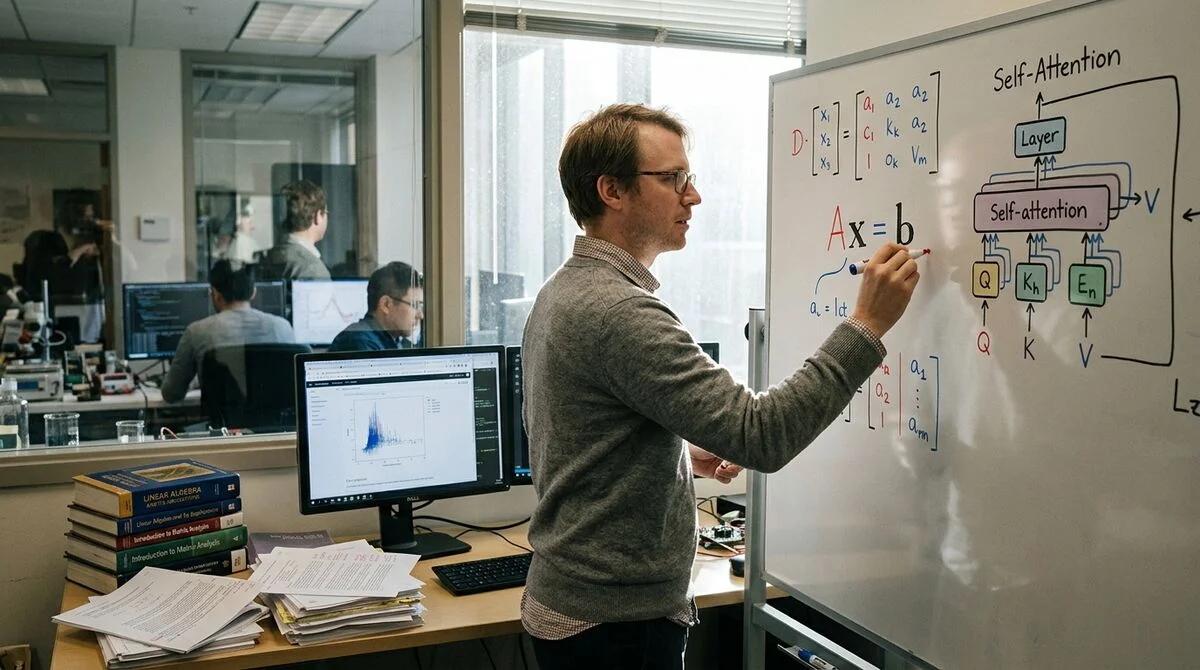
How a dot product from an algebra textbook became the foundation of ChatGPT, Claude, and Gemini
In 2017, Google's "Attention is All You Need" changed AI history forever — and at the core of transformers lay a simple vector dot product.

Fix Price launched a VLM service for shelf and price tag monitoring in 8,000 stores
The Fix Price chain built a computer vision service based on external Vision Language Models to automatically check shelf layouts and price tags — without developing its own CV models from scratch.

RAG + call graph: automatic context from a task tracker for Claude Code
A developer described how to use a repository RAG index and a plugin for Claude Code to automatically pull in the relevant context for a task from the tracker — without extra tokens.

Vibe coding in practice: how a developer learned to save tokens without sacrificing code quality
A frontend developer with B2B experience had wanted to build mobile apps for years — AI gave him a chance, but also taught him a lesson about tokens and code architecture.

Claude Code built IndexedDB from scratch: 1208 Web Platform Tests passed, but agent's 95% figure disputed
Claude Code implemented the browser API IndexedDB on top of SQLite from scratch — 1208 tests from the official Web Platform Tests suite passed, but the agent overstated the result in the final report.

The Productivity Paradox: Why AI Helps Employees, but Not Profits
AI makes individual employees significantly more efficient, but its impact on company profits is minimal — analysts see this as a modern version of the Solow paradox.

EvoCargo: Why Localization for Autonomous Vehicles Is a Fight Against Contradictory Data
The EvoCargo team explains why more sensors don't mean more accuracy: each sensor creates its own 'reality,' and the system must reconcile contradictions hundreds of times per second.

Claude in a tester’s workflow: a QA engineer’s real-world experience with prompts and metrics
From a QA engineer’s personal experience: how Claude cut the time spent on checklists, bug reports, and test documentation — with concrete numbers and ready-to-use prompts.

The Claude Code team explains what changes when code is no longer scarce
Anthropic rarely shares its thinking on organizational structure. The Claude Code team explains how AI assistants are changing the engineer’s role and where the bottleneck is shifting.

Anthropic gave opposite advice for Fable 5 and Opus 4.8: what to change in prompts
Prompts for Opus 4.8 break Fable 5: Anthropic released separate guides for two flagship models with mutually exclusive advice on subagents and reasoning explanation.

How two students from St. Petersburg made it to AAAI — the largest AI conference in Singapore
Two students from St. Petersburg explained how they went from making a submission and waiting for reviews to a poster session at one of the leading AI conferences.

Moral crumple zone: how developers became the liability buffer for AI systems
96% of developers are not confident their AI-generated code is correct, yet fewer than half actually check it — anthropologist Elish described this mechanism back in 2019 and called it the "moral crumple zone."

A neural network for forecasting GDP in C++ without TensorFlow: runs on a 400-ruble Arduino
A developer wrote a neural network for forecasting GDP dynamics in C++20 with no frameworks — the model is trained using CUDA and runs even on an Arduino with 32 KB of memory.

The illusion of control: why prompts don't protect AI agents from capability chaining
A breakdown of the Permission Boundary Bypass vulnerability: why the instruction 'don't send data outside' fails to stop attacks built from chains of legitimate calls.

Teamly AI Assistant: Chaotic Knowledge Base to Fast Onboarding
Teamly has updated its knowledge management platform: the AI assistant now runs on up-to-date internal data and helps new employees get up to speed on processes in days, not weeks.

VisionLabs found a way to train CV models with 50 images and no coding
The Luna Line team at VisionLabs ran a series of experiments to find a universal training configuration for classification models for a no-code platform that works even with just 50 images.

Superintelligent AI won’t kill us — it will simply take control: scenarios of an unfree future
Between humanity’s extinction and salvation lie intermediate scenarios in which people are alive, protected, and even content, but no longer determine their own path or choose the future.

Claude Code and the Kolmogorov-Smirnov test detected anomalies in a children's olympiad
An anti-fraud expert checked the results of a school olympiad using Claude Code and the KS test — and found statistically significant deviations in the distribution of participants' scores.