Neuroscientists find the brain uses the same neurons for sight and imagination
Neuroscientists have obtained direct evidence that imagination and visual perception rely on the same neural code at the level of single neurons. In intracranial recording experiments, cell activity in the ventral temporal cortex repeated both when people looked at real objects and when they visualized them mentally. This is a strong argument in favor of the generative model of the brain.
AI-processed from Habr AI; edited by Hamidun News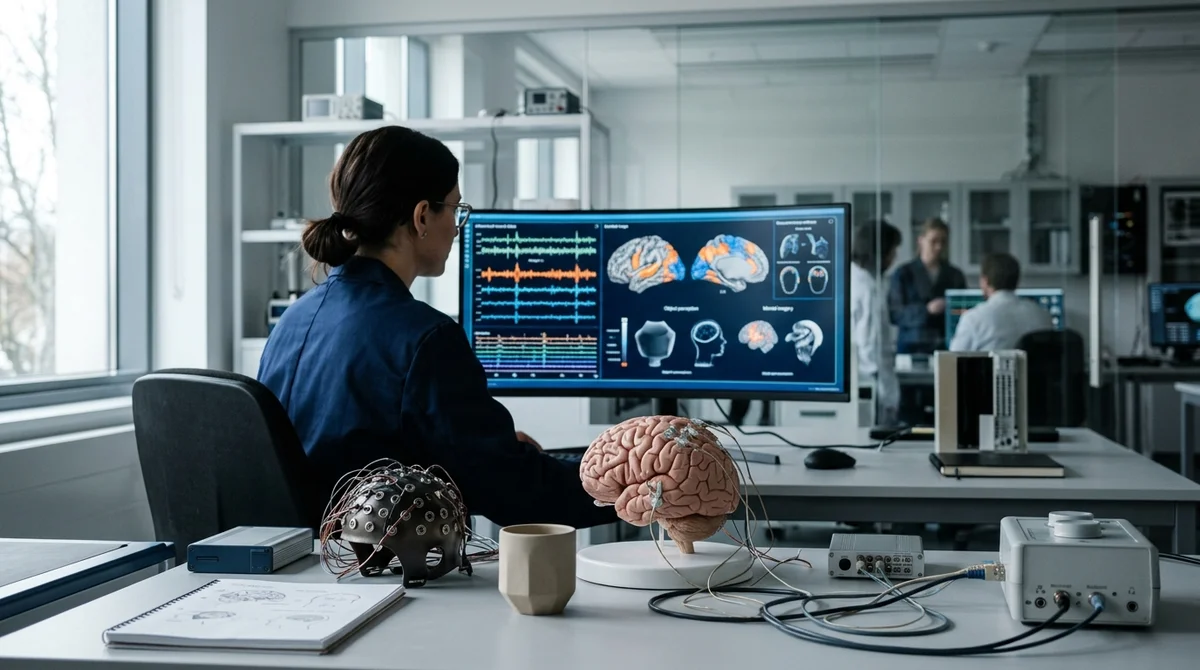
Neuroscientists have obtained one of the most direct confirmations yet of how imagination works: when a person pictures an object in their mind, the brain can switch on the same neural codes it uses when actually looking at that object. This brings the mechanisms of perception and mental visualization closer together not only at the level of brain regions, but at the level of individual neurons.
How it was tested
For a long time, researchers saw only the broad picture: fMRI and other methods showed that imagination and vision engage similar brain areas. But such tools offer very coarse resolution. They help establish which region is active, yet they do not answer the central question: do literally the same neurons work in both modes, and do they encode the image in the same way? This was the missing link in the whole picture.
To test it, researchers needed intracranial recording of the activity of single neurons in humans. This approach makes it possible to observe specific cells rather than an averaged signal from a large patch of tissue. The researchers focused on the ventral temporal cortex, an area that plays a key role in recognizing visual images. They then compared neuron responses in two states: when participants actually saw stimuli and when they only imagined them.
A shared code for images
The key finding turned out to be stronger than simply "imagination also activates the visual system." The ventral temporal cortex revealed a shared sensory code: some of the neurons that responded to real visual stimuli switched on again during mental visualization.
This did not look like a coincidence. The amplitude of the response during imagination correlated with how strongly the same cells reacted during ordinary perception. In other words, it was not only the fact of activation that matched, but also its profile.
This matters because it is not a vague, general activation, but a reuse of the same way of representing information. Put differently, the brain does not simply "think about a picture" in an abstract sense; it partly reproduces the sensory format in which that picture is encoded when actually seen. This makes a mental image a physiologically more concrete phenomenon than previously thought. That is the main shift in interpretation.
- Specific neurons in the ventral temporal cortex activated when people looked at an object
- When they imagined it, some of the same cells reactivated
- The strength of the response during imagination was linked to the response to the real stimulus
- So the brain uses a common encoding format for external and internal images
The brain's generative model
The results fit well with the hypothesis of a generative model of the brain. In this view, perception works not only bottom-up, from the eyes to interpretation, but also top-down: more abstract representations can re-trigger sensory patterns. Imagination then ceases to be a side effect of memory and looks like a separate working mode in which the brain assembles its own internal version of an image. Such a mechanism helps explain why mental images can be so vivid.
The practical implications are broad. The finding helps in understanding how memory retrieval, spatial planning and creative synthesis work, where a person needs not just to remember a fact but literally to "see" a scene in their head. It is also a useful reference point for AI: if effective imagination in the brain is built on reusing sensory codes, future architectures could link perception, memory and generation more tightly instead of keeping them as nearly isolated modules.
What this means
If the finding is confirmed in further studies, imagination could be described not as a hazy superstructure on top of vision, but as a mode that re-runs an existing sensory system. For neuroscience, this is a more precise map of the mechanism behind mental images; for AI, it is a hint at how to build models that not only recognize the world but also internally reproduce its representations. This is no longer a metaphor but a testable working scheme.
Key Questions Answered
How it was tested?
For a long time, researchers saw only the broad picture: fMRI and other methods showed that imagination and vision engage similar brain areas. But such tools offer very coarse resolution. They help establish which region is active, yet they do not answer the central question: do literally the same neurons work in both modes, and do they encode the image in the same way? This was the missing link in the whole picture. To test it, researchers needed intracranial recording of the activity of single neurons in humans. This approach makes it possible to observe specific cells ra
What are the key details on A shared code for images?
The key finding turned out to be stronger than simply "imagination also activates the visual system." The ventral temporal cortex revealed a shared sensory code: some of the neurons that responded to real visual stimuli switched on again during mental visualization. This did not look like a coincidence. The amplitude of the response during imagination correlated with how strongly the same cells reacted during ordinary perception. In other words, it was not only the fact of activation that matched, but also its profile. This matters because it is not a vague, general activat
What are the key details on The brain's generative model?
The results fit well with the hypothesis of a generative model of the brain. In this view, perception works not only bottom-up, from the eyes to interpretation, but also top-down: more abstract representations can re-trigger sensory patterns. Imagination then ceases to be a side effect of memory and looks like a separate working mode in which the brain assembles its own internal version of an image. Such a mechanism helps explain why mental images can be so vivid. The practical implications are broad. The finding helps in understanding how memory retrieval, spatial planning
Test Frontier LLMs & Autonomous Agents in One Workspace
Run Claude Opus 5.5, GPT-6, Gemini 3.1, and DeepSeek side-by-side in Nomad AI (nomadnet.ai) — unified model routing, deep research, and multimodal workflows under one subscription.
The AI world, distilled — once a week
Seven stories that actually mattered, hand-picked. No noise, no reposts, no press releases.
Done! Check your inbox for a confirmation.