OpenAI's GPT-5.4 Solves a Problem a Mathematician Spent 20 Years Building for FrontierMath
OpenAI's GPT-5.4 has solved a FrontierMath problem that Polish mathematician Bartosz Naskrecki spent almost 20 years preparing and believed was beyond the reach of AI. The correct answer was only part of the impression: the model found a shorter, more elegant path than the author expected. The story does not, however, settle questions about the benchmark's independence and the role of web search.
AI-processed from Habr AI; edited by Hamidun News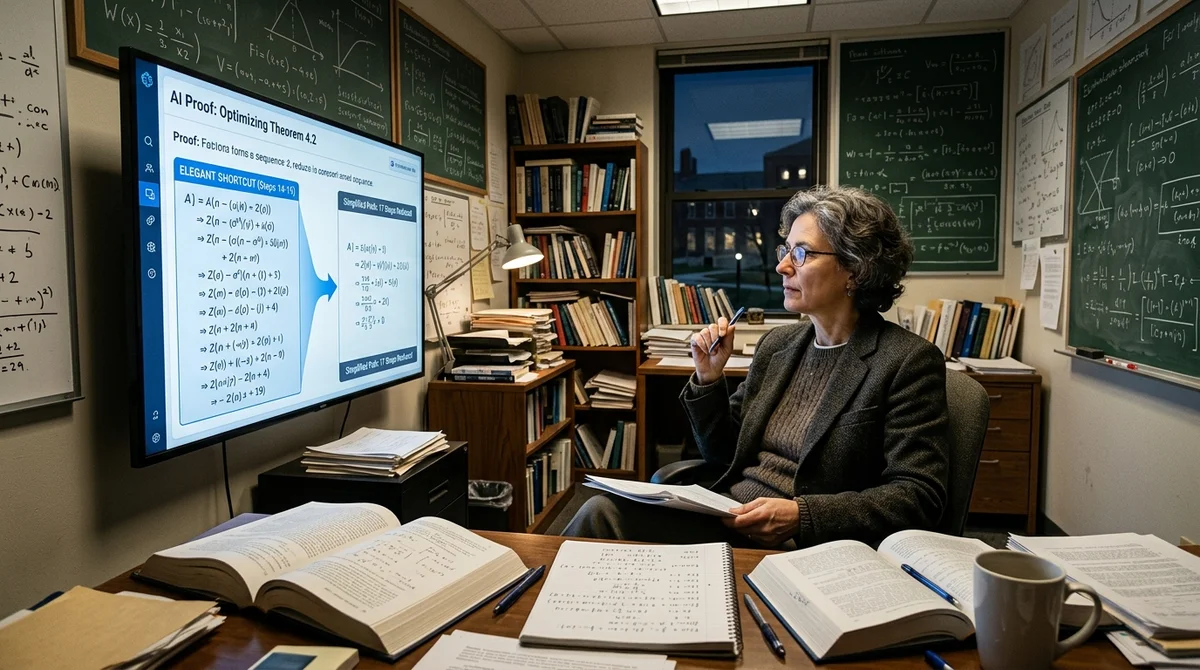
OpenAI's GPT-5.4 has solved a problem from the FrontierMath benchmark that Polish mathematician Bartosz Naskrecki spent almost twenty years building and considered practically out of reach for machines. For the author, it was a personal turning point: not long ago he called AI a "very advanced calculator", and now he talks about a new level of collaboration with the model.
Why it surprised everyone
FrontierMath is one of the toughest math benchmarks for AI. It contains 350 original problems in number theory, algebraic geometry, topology, combinatorics and analysis. The hardest layer, Tier 4, consists of 48 research-level problems: even a strong mathematician with a PhD may need at least a month just to work out how to approach one. Naskrecki prepared his example for exactly such cases: not a textbook exercise, but one near the limit of difficulty.
Naskrecki was one of the few European mathematicians invited to write problems for this set. His problem grew out of roughly fifteen years of narrow research work, and the written-up solution ran to 13 dense pages. The answer was a very large number, to rule out random guessing.
So the surprise was not only GPT-5.4's correct answer but how the model reached it: instead of brute-force search, it spotted a structure and found a shorter path. According to the author, the model's approach was "clean and elegant".
"My singularity has just happened… and there is life on the other side
— stretching into infinity!"
How fast the results have grown
The story matters not only because of one beautiful problem but because of the pace of progress. When FrontierMath launched in late 2024, the best models solved less than 2% of problems. Sixteen months later, scores have risen by an order of magnitude, not only on public examples but on a hidden set to which OpenAI had no direct access. That matters, because the dispute over "training on the answers" remains skeptics' main argument whenever a new model shows a sharp jump in math.
- Late 2024: the best models solve under 2% of FrontierMath problems.
- Mid-2025: GPT-5 Pro scores 13% on Tier 4.
- January 2026: GPT-5.2 Pro rises to 31% on Tier 4.
- March 2026: GPT-5.4 Pro reaches 50% on Tiers 1–3 and 38% on Tier 4.
The result on hidden problems stands out separately. According to the article, GPT-5.4 solved 55% of those examples versus 25% of the problems to which OpenAI could theoretically have been closer in terms of data and solutions. This does not prove the experiment is absolutely "clean", but it noticeably strengthens the case that the model can genuinely reason on new problems rather than merely reproduce patterns it has seen. For research benchmarks, this is arguably the most sensitive test: novelty matters more than any demonstration on already known examples.
Why the skepticism hasn't gone away
For all the strength of the case, the story does not reduce to "the machine already thinks like a human". In the same evaluation run, GPT-5.4 solved another Tier 4 problem, but a preliminary review showed the model may have relied on an old 2011 preprint that the problem's own author did not know about. It is a good example of how the line blurs between independent reasoning and very effective literature search, especially if the model can use the web and quickly gather rare sources.
There is also a second layer of questions: the benchmark's independence. FrontierMath is funded by OpenAI, and the company has access to a significant share of the problems and solutions. The hidden set, on which GPT-5.4 also scored strongly, partly eases the concern but does not remove the conflict of interest entirely.
So it makes sense to read this story in two modes at once: as a real signal of a sharp rise in models' mathematical abilities, and as a reminder that the industry still needs independent tests, transparent methods and outside verification of headline results.
What it means
The main takeaway is not that it is time to replace mathematicians. If anything, the opposite: Naskrecki's story shows that frontier models are starting to work as research partners that narrow the search space and suggest unexpected moves. For science and applied R&D, this is a serious shift: AI looks less and less like a calculator and more like a co-author whose ideas can no longer be ignored, but still need careful checking.
- Nov 2, 2026Arca gives AI agents finance tasks lasting up to 10 days, but leaves the trades to humans
- Nov 2, 2026Meta's Muse assistant keeps dossiers on loved ones and gets root on Ubuntu by default
- Nov 1, 2026Local models lose to Opus and Codex: 0.21 on a MacBook versus 1.00 for Codex
- Nov 1, 2026Kimi scores 96.2% on a 1C database analytics test and emerges as a fallback if Claude access is blocked
Key Questions Answered
Why it surprised everyone?
FrontierMath is one of the toughest math benchmarks for AI. It contains 350 original problems in number theory, algebraic geometry, topology, combinatorics and analysis. The hardest layer, Tier 4, consists of 48 research-level problems: even a strong mathematician with a PhD may need at least a month just to work out how to approach one. Naskrecki prepared his example for exactly such cases: not a textbook exercise, but one near the limit of difficulty. Naskrecki was one of the few European mathematicians invited to write problems for this set. His problem grew out of rough
How fast the results have grown?
The story matters not only because of one beautiful problem but because of the pace of progress. When FrontierMath launched in late 2024, the best models solved less than 2% of problems. Sixteen months later, scores have risen by an order of magnitude, not only on public examples but on a hidden set to which OpenAI had no direct access. That matters, because the dispute over "training on the answers" remains skeptics' main argument whenever a new model shows a sharp jump in math. Late 2024: the best models solve under 2% of FrontierMath problems. Mid-2025: GPT-5 Pro scores
Why the skepticism hasn't gone away?
For all the strength of the case, the story does not reduce to "the machine already thinks like a human". In the same evaluation run, GPT-5.4 solved another Tier 4 problem, but a preliminary review showed the model may have relied on an old 2011 preprint that the problem's own author did not know about. It is a good example of how the line blurs between independent reasoning and very effective literature search, especially if the model can use the web and quickly gather rare sources. There is also a second layer of questions: the benchmark's independence. FrontierMath is fu
Test Frontier LLMs & Autonomous Agents in One Workspace
Run Claude Opus 5.5, GPT-6, Gemini 3.1, and DeepSeek side-by-side in Nomad AI (nomadnet.ai) — unified model routing, deep research, and multimodal workflows under one subscription.
The AI world, distilled — once a week
Seven stories that actually mattered, hand-picked. No noise, no reposts, no press releases.
Done! Check your inbox for a confirmation.