Math Is No Longer Just for Humans: A 17-Year-Old Prodigy and AI Tackle the Unsolvable
A seventeen-year-old researcher has shown that AI is about more than text generation and "hallucinations." Using machine learning tools, he solved a math problem that had gone unanswered for a long time. The project drew attention from industry heavyweights, from the legendary mathematician Terence Tao to Google DeepMind chief Jeff Dean. It is an important signal: formal verification tools and neural networks are starting to reshape fundamental science in earnest. AI used to help write code; now it is entering the territory of pure mathematics, where there is no room for errors or approximate answers. The future of science now looks like a symbiosis of young talent and enormous computing power.
AI-processed from Jiqizhixin (机器之心); edited by Hamidun News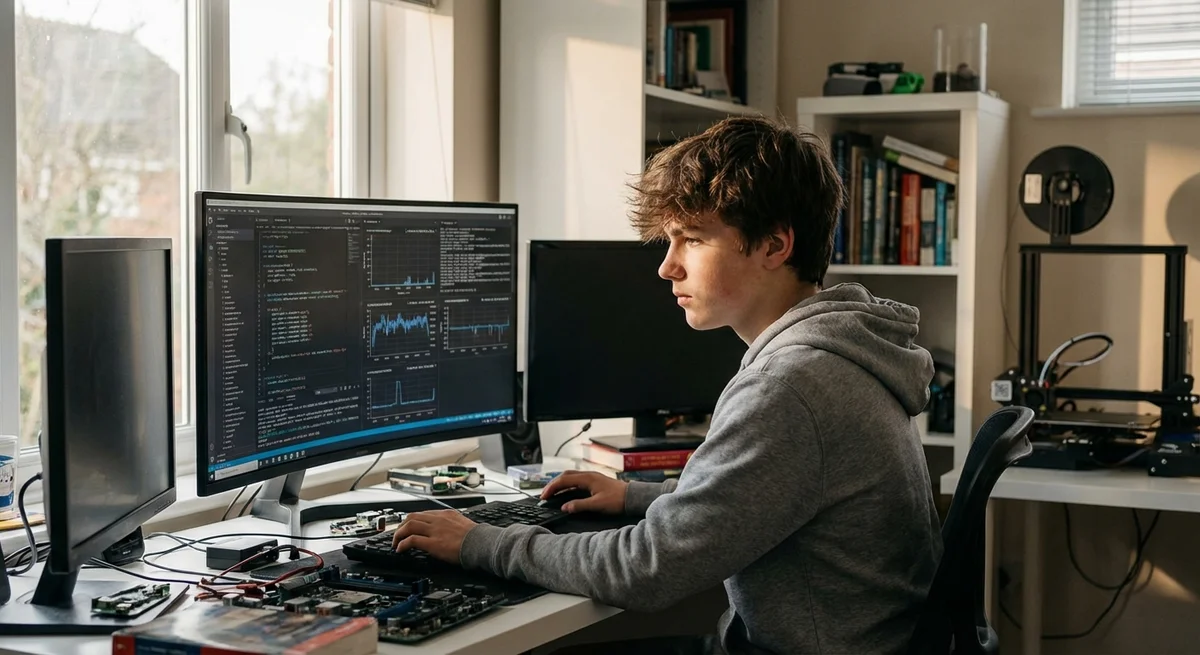
Picture a typical 17-year-old. At that age, the mind is usually on exams, video games or summer plans. But in a world where artificial intelligence is becoming a widely available tool, the rules of the game for "prodigies" have changed sharply. News that an ordinary high schooler used the power of AI to solve a hard math problem that had resisted professionals for years has rocked the professional community. And this is not just another story about someone using ChatGPT for homework. It points to a fundamental shift in how humanity will make scientific discoveries over the next decade.
For a long time, mathematics was considered the last bastion shielded from neural networks. Unlike writing an essay or painting a picture, here you cannot be "a little wrong." A mathematical proof is either one hundred percent correct or completely useless. Large language models long suffered from so-called hallucinations, presenting plausible-looking nonsense as truth. But integrating neural networks with formal verification systems such as Lean opened a new era. It was at this junction of technology and human intuition that the breakthrough happened, one that led Terence Tao himself, whom people call the "Mozart of mathematics," to leave an enthusiastic comment.
Why does this matter right now? We are at the point of transition from "stochastic parrots" to systems capable of deep reasoning. When Google's Jeff Dean applauds a schoolboy, he is not doing it out of politeness. For giants like DeepMind, it confirms their hypothesis: AI can be more than an assistant, a full partner in exploring uncharted areas of science. This is the democratization of genius. To challenge academic institutions, you no longer need to wait decades for your turn in a lab. It is enough to have a sharp mind, API access and an understanding of how to pose a problem to an algorithm correctly.
The context of this event is rooted in a long-running contest between human intuition and computational power. Automated theorem proving used to be the domain of a narrow group of scientists and required writing extremely complex code by hand. Today's tools let you use natural language to steer the search for solutions. In this case, the schoolboy acted as architect and strategist who understood the structure of the problem, while the AI took on the routine but enormously complex work of searching through and checking chains of logic. This is the "centaur" that Garry Kasparov once described in relation to chess, only now at the scale of all the world's science.
What does this mean for the industry as a whole? First, the barrier to entry into high science is falling fast. If a 17-year-old can attract the attention of the planet's leading minds, the traditional "student-professor" hierarchy is starting to crack at the seams. Second, we are seeing the birth of a new market for scientists' tools. These are no longer simply text editors but full cognitive accelerators. Companies that are first to build convenient interfaces for humans to work with logical AI engines will become the new market leaders, leaving behind those who merely make "smart chatbots."
The bottom line: AI has finally stopped being a toy for generating content and become a tool for seeking truth. If schoolchildren are starting to solve problems at the Fields Medal level, the scientific landscape will be unrecognizable in five years. Are we ready for a world where discoveries are made at the speed of a click?
- Nov 2, 2026Arca gives AI agents finance tasks lasting up to 10 days, but leaves the trades to humans
- Nov 2, 2026Meta's Muse assistant keeps dossiers on loved ones and gets root on Ubuntu by default
- Nov 1, 2026Local models lose to Opus and Codex: 0.21 on a MacBook versus 1.00 for Codex
- Nov 1, 2026Kimi scores 96.2% on a 1C database analytics test and emerges as a fallback if Claude access is blocked
Test Frontier LLMs & Autonomous Agents in One Workspace
Run Claude Opus 5.5, GPT-6, Gemini 3.1, and DeepSeek side-by-side in Nomad AI (nomadnet.ai) — unified model routing, deep research, and multimodal workflows under one subscription.
The AI world, distilled — once a week
Seven stories that actually mattered, hand-picked. No noise, no reposts, no press releases.
Done! Check your inbox for a confirmation.