The Math Behind RNNs: Why "Naive" Questions Stump Engineers
Recurrent neural networks (RNNs) are considered foundational, yet their mathematical internals often give even experienced developers a headache. Standard textbooks tend to sidestep the tricky parts, such as differentiating vectors with respect to matrices or the real problems with backpropagation through time (BPTT). Walking through the simplest possible architecture, inspired by Andrej Karpathy's classic examples, lets you look at these processes through a child's eyes and ask awkward questions about why the algorithms work the way they do. Understanding the fundamental limits of RNNs is essential to grasping why the industry eventually leapt to transformers — and which old architectural problems we are still trying to solve in modern LLMs.
AI-processed from Habr AI; edited by Hamidun News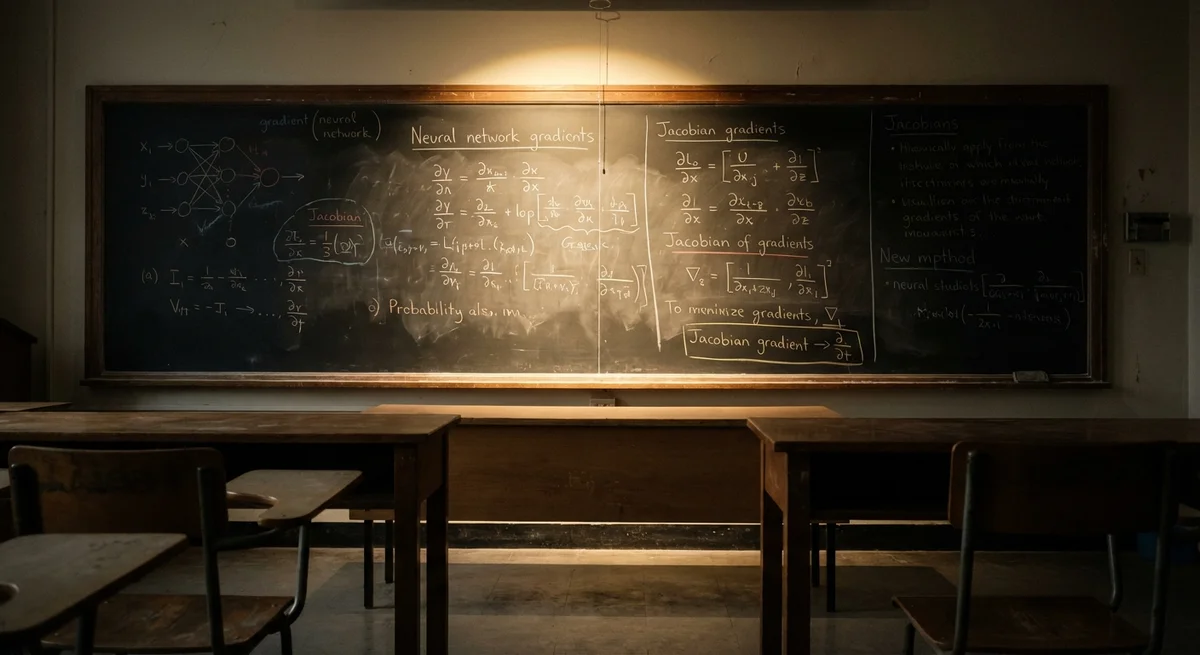
We tend to treat neural networks as a black box that simply works once you feed it enough data and compute. But dig just slightly below the level of PyTorch or TensorFlow, and it turns out that the foundation of modern AI rests on things we often take on faith. Recurrent neural networks (RNNs) look like a relic today, overshadowed by dominant transformers, yet their structure contains the very mathematical principles you need to understand the evolution of deep learning. RNNs were what first taught machines to handle sequences, and understanding what happens under their hood is not just an academic exercise — it explains why modern models turned out the way they did.
Every RNN is built on the idea of passing state from the past into the future. Mathematically, it looks elegant — until you start computing derivatives. Most textbooks helpfully hand you ready-made formulas but rarely explain how you actually differentiate a vector with respect to a matrix. For many engineers, this is a moment of truth: the familiar rules from school calculus work differently here and turn into unwieldy operations with Jacobians. We are often afraid to ask "naive" questions, such as why gradients add up rather than multiply at certain nodes of the graph during backpropagation. The answers lie in the nature of the chain rule itself and in how information flows through layers of neurons.
RNNs emerged from attempts to imitate human memory. In practice, however, researchers quickly ran into the problem of vanishing and exploding gradients. This is not just a technical bug but a direct consequence of the mathematical structure of recursion. When you multiply a matrix by itself dozens or hundreds of times during backpropagation through time (BPTT), any deviation of its eigenvalues from one either drives the signal to zero or makes it grow without bound. This mathematical dead end pushed the industry to look for alternatives: first LSTM and GRU, with their elaborate systems of "gates," and then attention mechanisms, which became the basis of the GPT architecture.
Taking apart the simplest RNN, like the one Andrej Karpathy once popularized, exposes an irony of the industry: we build enormous systems on principles whose implementation details are still debated. Take the question of how to initialize weights so that training doesn't collapse within the first few seconds — it remains more art than rigorous science. We rely on heuristics that work, but we can't always explain "why" from first principles. It's like a curious child taking apart a toy to see what's inside and finding parts whose purpose even the adults don't understand.
Revisiting these fundamentals changes how you see the current neural network boom. Once you realize how hard it was to get an RNN to remember even a dozen words in a sentence, you start to genuinely appreciate the engineering behind today's context windows of millions of tokens. Yet the old problems haven't gone away — they've just changed shape. Computational efficiency and gradient stability remain pressing issues even on massive H100 clusters. Going back to basics and working through "naive" questions about differentiation and error propagation lets you drop the senior-developer swagger and see the code not as a mere call to .backward(), but as a complex and fragile dance of numbers.
The bottom line: a fundamental understanding of RNN math shows that there is no magic in AI — only long chains of derivatives that sometimes behave unpredictably because of our fondness for simplification.
Test Frontier LLMs & Autonomous Agents in One Workspace
Run Claude Opus 5.5, GPT-6, Gemini 3.1, and DeepSeek side-by-side in Nomad AI (nomadnet.ai) — unified model routing, deep research, and multimodal workflows under one subscription.
The AI world, distilled — once a week
Seven stories that actually mattered, hand-picked. No noise, no reposts, no press releases.
Done! Check your inbox for a confirmation.