Epoch AI: 14 problems nobody has solved (yet)
Researchers at Epoch AI have rolled out FrontierMath, a set of 14 fundamental problems that currently have no solution. These aren't textbook exercises: they're questions on the level of the Mathieu group and knot topology. We used to measure neural network progress with olympiads; now the bar sits at the frontier of active research. This matters because success here would mean more than a "smart chatbot": it would mean a full-fledged research scientist. The bottom line: the era of imitating knowledge is ending, and the era of real discovery is beginning, one in which AI becomes a co-author of scientific breakthroughs.
AI-processed from Habr AI; edited by Hamidun News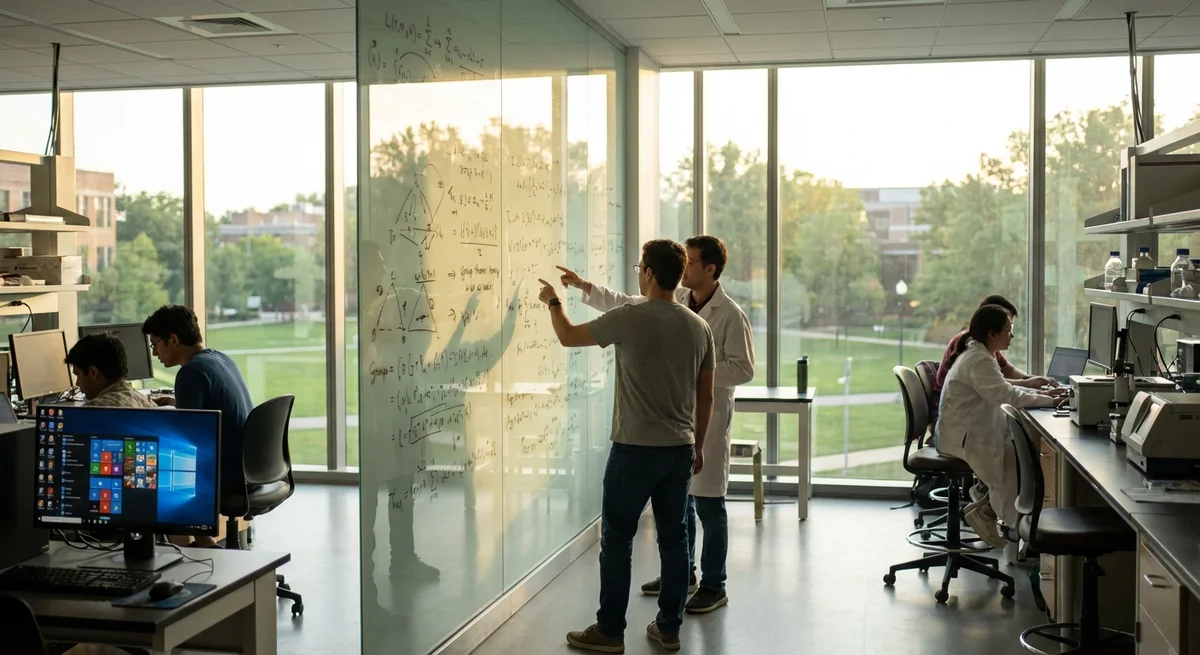
Remember the good old days when we joked about neural networks that couldn't add two three-digit numbers without hallucinating? Those days are officially over. We've moved fast from the "look how cute it is when the robot writes poems" era to the "look at the algorithm trying to crack the foundations of the universe" era. As recently as mid-2024, GPT-4 stumbled on high-school-level problems; by the end of 2025, new models were cracking olympiad problems like nuts. But olympiad problems still have known answers. Researchers at Epoch AI decided it was time to stop handing neural networks cheat sheets and rolled out FrontierMath: a list of 14 problems that nobody on the planet has solved.
The point of FrontierMath is to test whether AI can generate fundamentally new knowledge. These aren't textbook exercises that could turn up in a training set. A working research mathematician formulated each of the fourteen problems, at least two high-level professionals tried to solve each one, and each is worthy of publication in a leading scientific journal. There are no hints online and no ready-made algorithms. These are the blank spots on the map of modern mathematics, ones that human minds have ignored or simply failed to crack for decades.
Let's look at the details to get a sense of the scale of the challenge. One problem concerns the Mathieu group M23. Mathematicians love symmetry, but sporadic groups are "mathematical monsters" that don't fit into any general family.
For most of them, researchers have already found polynomials with the corresponding Galois groups, but M23 remains the last holdout, a gap in a line of research that has been going on for years. Finding this polynomial would close an entire chapter of algebra. Another problem only looks simpler at first glance: devise an algorithm that determines whether a knot can be untied with a single move.
Topologists call this "unknotting number equal to one." It's a fundamental question in low-dimensional topology that still has no clear answer.
Why does this matter right now? The AI industry has reached the point where simply adding more data no longer delivers explosive gains in quality. We've taught models to imitate human speech and compile existing knowledge, but we're still waiting for a neural network to make a scientific discovery. If a model solves even one of these problems, it won't just be a "technological achievement." It will be a genuine scientific result, one that lands in a peer-reviewed journal not because of AI hype but because of the value of the solution itself. We're talking about AI turning from an advanced search engine into a full-fledged research colleague.
The connection to earlier developments is clear. Once models started routinely acing tests like MATH and GSM8K, it became obvious we needed new measuring tools. FrontierMath is an attempt to find the boundary where memory ends and intelligence begins. It's a challenge not only for OpenAI or Anthropic but for the entire scaling paradigm. Having the biggest GPU cluster is no longer enough; you need an algorithm capable of deep logical reasoning under complete uncertainty. It's a stress test for every promise about "strong AI" or AGI.
What does this mean for us? We're on the verge of a situation where AI could become the key to solving problems in materials science, cryptography, or quantum physics through mathematics. If a neural network can handle knot topology or Mathieu groups, it will be able to design new molecules or optimize supply chains at a level beyond human reach. That would mean we finally have a tool that's smarter than us in the hardest abstract domains. The irony is that we may not immediately understand how the AI arrived at its solution, but the result will change our physical reality.
The bottom line: FrontierMath is the final boss for the current generation of neural networks. Will a hypothetical GPT-5 or Claude 4 clear this barrier, or will we have to wait for fundamentally new architectures?
- Nov 1, 2026OpenAI Rewrites GPT Behavior Rules: Five Values and a Chain of Command
- Nov 1, 2026Google admits AI Mode cuts search revenue, shares fall 15%
- Oct 31, 2026Author puts his script before an AI jury: the verdict cost 850 thousand tokens
- Oct 31, 2026Anthropic: Fold Subagents Back Into a Single Loop — One Customer's Tasks Ran Twice as Fast
Test Frontier LLMs & Autonomous Agents in One Workspace
Run Claude Opus 5.5, GPT-6, Gemini 3.1, and DeepSeek side-by-side in Nomad AI (nomadnet.ai) — unified model routing, deep research, and multimodal workflows under one subscription.
The AI world, distilled — once a week
Seven stories that actually mattered, hand-picked. No noise, no reposts, no press releases.
Done! Check your inbox for a confirmation.