Pony AI and Uber Begin Robotaxi Tests in Croatia, Extending Their Partnership to Europe
Pony AI and Uber have begun testing autonomous vehicles in Zagreb. It is the partners' first step into Europe: their joint projects had so far been confined to the Middle East. This is not a mass launch but a round of road tests. They will show whether the pairing of Pony AI's robotaxis and the Uber platform is ready for the next stage of scaling in the European market.
AI-processed from Bloomberg Tech; edited by Hamidun News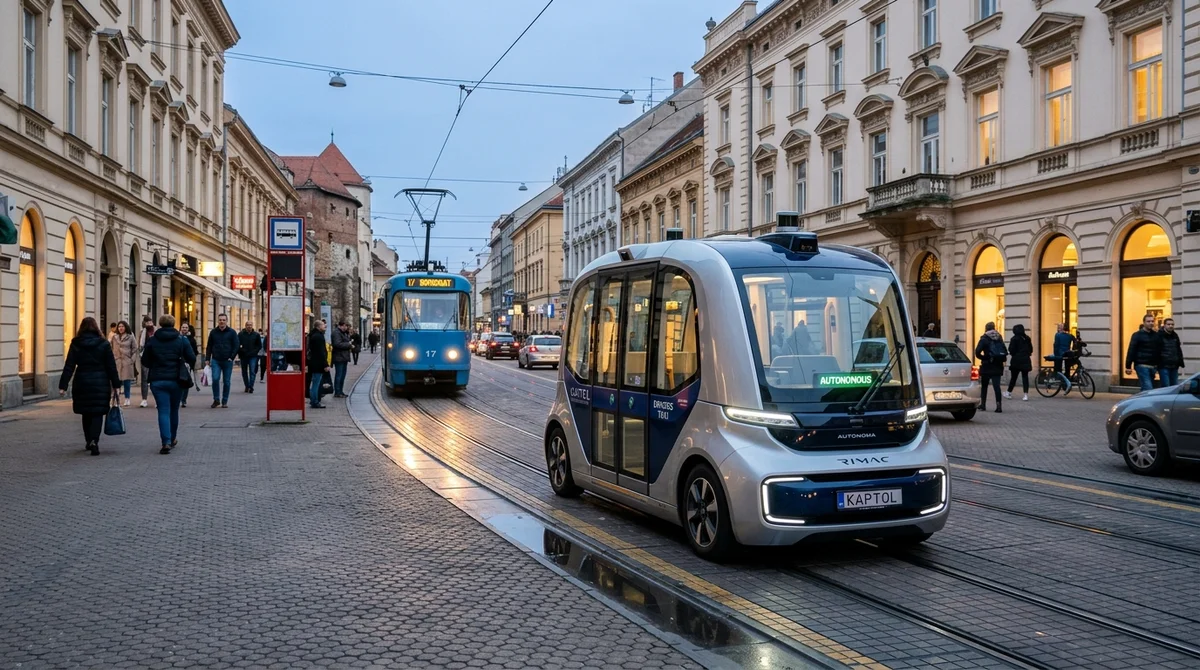
Pony AI and Uber have begun testing driverless cars in Zagreb. For the two companies, it is the partnership's first move into Europe: their joint projects previously ran in the Middle East, and now the expansion has reached the EU market.
Tests in Zagreb
The launch in the Croatian capital matters above all because it is not a concept presentation but real testing on city streets. Pony AI is one of the more prominent players in the robotaxi market, and Uber brings access to its ride platform and its experience scaling a service.
At the testing stage, companies typically check how vehicles behave in ordinary traffic, how they react to difficult road scenarios, and whether the infrastructure is ready for a future launch. For now these are tests only, not a mass commercial service for passengers.
This format lets the companies collect data, tune the driverless system to a specific city and work through local safety requirements. In Europe the issue is especially sensitive: autonomous transport is expected to show not only technological maturity but also very clear rules of liability if the system makes a mistake. Without that, no such project can move on to regular rides.
The roles in this model are fairly clear. Pony AI is responsible for the self-driving technology and the car's behavior on the road, while Uber handles the user layer, from ordering a ride to the familiar ride-hailing interface. This combination currently looks like one of the most realistic on the market: rather than building a new service from scratch, embed autonomous transport in an existing consumer platform. That speeds up market entry and lowers the cost of deployment.
Entering Europe
The main news is bigger than Zagreb itself: Pony AI and Uber are moving their partnership to a new geography. Until now their joint push was in the Middle East, and now they are stepping toward Europe. For Uber, it is a way to strengthen its bet on a model in which the app becomes a storefront for different autonomous operators. For Pony AI, it is a chance to establish itself not only as a Chinese robotaxi developer but also as an international technology supplier.
The European market for autonomous transport is considered one of the hardest and, at the same time, one of the most valuable. It has dense urban environments, mixed traffic, high safety requirements and regulators who watch any new transport model closely. If the Croatian pilot succeeds, it will give the companies an argument for further talks with other cities and help show that robotaxis can operate beyond isolated demonstration zones.
It is also a telling moment for Europe itself. So far, much of the talk about robotaxis in the region has stayed at the level of expectations and cautious pilots. The pairing of a major ride-hailing platform with a specialized driverless developer makes the case more grounded: what is under discussion is not an abstract technology but a future service that users could potentially order just like an ordinary ride. That is why even a limited pilot quickly becomes an indicator of the maturity of the whole category.
What to watch
What matters most now is not the fact of the tests but what they turn into. The market will look past the loudness of the headline for concrete signs that the project is moving toward a real service. For the industry, the key question is whether the companies can turn the demonstration phase into a clear operating scheme, with predictable safety, sound economics and the ability to scale the model beyond a single city. Those metrics will determine the project's fate far more than the European debut itself.
- How many vehicles take part in the pilot and how quickly the fleet grows
- Whether this is closed testing or preparation for public rides
- What requirements local authorities and insurance regulators will impose
- Whether the future service will appear inside the Uber app in a form familiar to passengers
For users, the criteria are even simpler: how quickly the car arrives, how much the ride costs, and whether the service works reliably in ordinary city conditions, not only in ideal ones. This is the stage at which most autonomous projects meet reality: a technology demo is impressive, but a mass service demands discipline in operations, safety and support. Passengers need not a technological attraction but a predictable service every day.
If the companies can get through this stretch without notable incidents and delays, Zagreb may become not a one-off dot on the map but the entry point to a broader European rollout. For the industry it is an important test: investors and cities have long been waiting for proof that autonomous taxis can move from isolated pilots to a sustainable operating model. Then the pilot would be seen as a template for the next launches, not a one-off PR stunt.
What it means
Pony AI and Uber are doing more than running a local experiment: they are testing whether a robotaxi and ride-ordering pairing can scale across European territory. If the Croatian trials go well, that will increase pressure on competitors and speed up the discussion of where in Europe driverless rides will appear next.
- Nov 1, 2026Local models lose to Opus and Codex: 0.21 on a MacBook versus 1.00 for Codex
- Nov 1, 2026Adobe's EditAgent judge picks a usable edit 81.3% of the time, versus 74.8% for EditScore
- Nov 1, 202616 models tested on 7 search tools: Exa averaged 10.5 out of 14, SearXNG about 3
- Nov 1, 2026Google's StreamVibe video agent beats other models by 10.7% on response timing and quality
Key Questions Answered
What are the key details on Tests in Zagreb?
The launch in the Croatian capital matters above all because it is not a concept presentation but real testing on city streets. Pony AI is one of the more prominent players in the robotaxi market, and Uber brings access to its ride platform and its experience scaling a service. At the testing stage, companies typically check how vehicles behave in ordinary traffic, how they react to difficult road scenarios, and whether the infrastructure is ready for a future launch. For now these are tests only, not a mass commercial service for passengers. This format lets the companies
What are the key details on Entering Europe?
The main news is bigger than Zagreb itself: Pony AI and Uber are moving their partnership to a new geography. Until now their joint push was in the Middle East, and now they are stepping toward Europe. For Uber, it is a way to strengthen its bet on a model in which the app becomes a storefront for different autonomous operators. For Pony AI, it is a chance to establish itself not only as a Chinese robotaxi developer but also as an international technology supplier. The European market for autonomous transport is considered one of the hardest and, at the same time, one of th
What to watch?
What matters most now is not the fact of the tests but what they turn into. The market will look past the loudness of the headline for concrete signs that the project is moving toward a real service. For the industry, the key question is whether the companies can turn the demonstration phase into a clear operating scheme, with predictable safety, sound economics and the ability to scale the model beyond a single city. Those metrics will determine the project's fate far more than the European debut itself. How many vehicles take part in the pilot and how quickly the fleet gr
Test Frontier LLMs & Autonomous Agents in One Workspace
Run Claude Opus 5.5, GPT-6, Gemini 3.1, and DeepSeek side-by-side in Nomad AI (nomadnet.ai) — unified model routing, deep research, and multimodal workflows under one subscription.
The AI world, distilled — once a week
Seven stories that actually mattered, hand-picked. No noise, no reposts, no press releases.
Done! Check your inbox for a confirmation.