Uber, Pony.ai and Verne Prepare Europe's First Commercial Robotaxi Service
Uber, Pony.ai and Verne have announced Europe's first commercial robotaxi service. Road tests are already under way in Zagreb, using the Pony.ai Gen-7 system on the Arcfox Alpha T5. Uber plans to invest in Verne, and the partners expect to deploy thousands of driverless vehicles across Europe over time, though they are not yet naming an exact launch date. The companies have split the roles: Uber supplies the platform, Pony.ai handles autonomous driving, and Verne provides the European service layer and local operations. The most sensitive detail remains hidden. The companies say outright that they are not ready to name a commercial start date.
AI-processed from TNW; edited by Hamidun News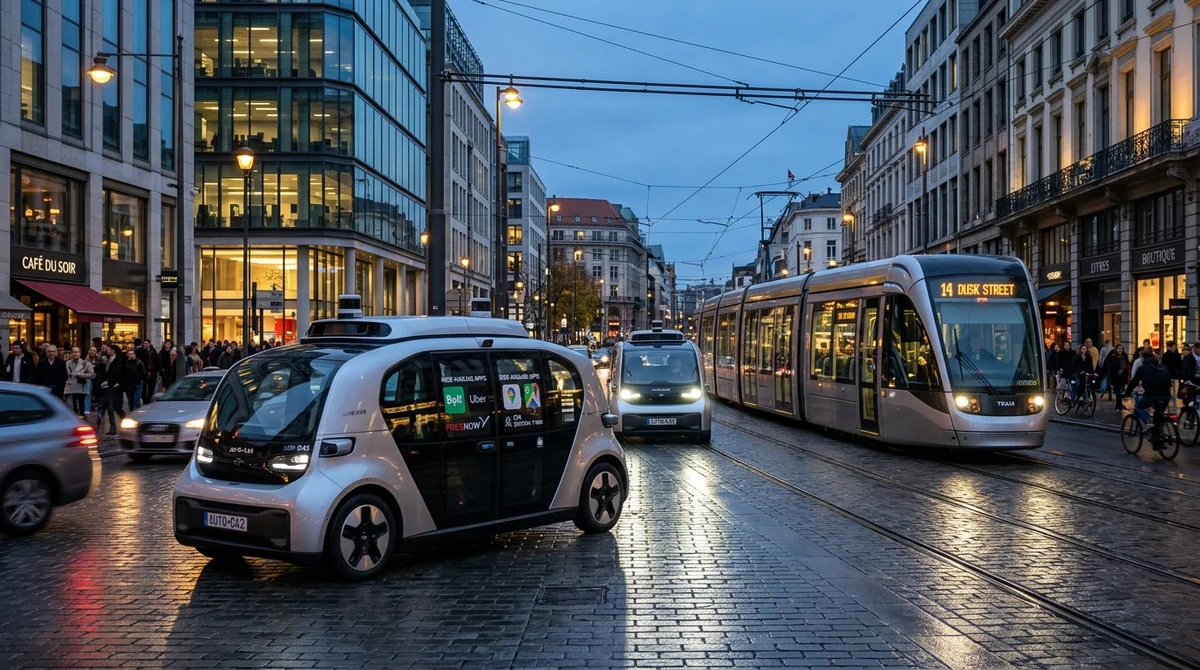
Uber, Pony.ai and Verne have announced Europe's first commercial robotaxi service, and road tests in Zagreb have already begun. The partners promise to scale the project to thousands of vehicles across the continent, but they are not yet naming a date for a full launch.
What is being launched
This is a joint project of three companies with different roles. Uber provides the platform and, as expected, financial backing: the company intends to invest in Verne. Pony.ai is responsible for autonomous driving, while Verne handles the European service layer and local development of the project. For Uber, this is another step toward a model in which the app serves as a storefront not only for ordinary drivers but also for driverless rides.
In practice, the project has already moved past the presentation stage. Road tests are under way in the Croatian capital, meaning the vehicles are not just shown in renders or on closed proving grounds but tested in city conditions. That matters for any robotaxi service: the streets are where real limitations show up, such as the behavior of other drivers, traffic density, lane marking quality, unpredictable maneuvers, and the need to react safely to all of it at once. This is usually the stage where it becomes clear how confidently a system performs outside a sterile environment.
Technology and fleet
The trials use the Pony.ai Gen-7 system installed on the Arcfox Alpha T5, a Chinese production electric car adapted for driverless operation. The published details suggest the partners are betting not on a one-off demonstrator but on a platform that can scale. That fits their plan to deploy not dozens but thousands of vehicles in Europe. Choosing a production model also hints at a wish to move beyond a single pilot faster.
Several key details of the project are known so far:
- road tests are already under way in Zagreb;
- Pony.ai, with its Gen-7 system, is responsible for autonomous driving;
- the test vehicle is the Arcfox Alpha T5, made in China;
- Uber plans to invest in Verne;
- the alliance's goal is to scale the service to thousands of vehicles across Europe.
The most sensitive parameter, however, is still hidden: the commercial start date. The companies say outright that they are not yet ready to name it. For the market, this is a typical situation. Driverless transport runs into more than software and hardware: it also depends on regulation, insurance, agreements with city authorities, and reputational risk. Even successful tests do not yet guarantee a quick move to open operation, especially for passenger rides in a city center.
Why this matters for Europe
Europe has long lagged behind the US and China in public robotaxi launches, particularly when it comes to a commercial service rather than limited pilots. Against that backdrop, the choice of Zagreb looks logical: the city is large enough for real driving scenarios, but not as congested and politically sensitive as top-tier megacities. For Verne, it is a chance to build the service on real traffic and a real urban environment rather than on paper.
The lineup of partners is also notable. The name of Mate Rimac has so far been associated mainly with electric hypercars and the Rimac engineering brand. Now a more practical line of business is forming around that name: urban autonomous mobility. Together with Uber and Pony.ai, it gives the project three components without which scale is usually impossible: a customer channel, an autopilot, and a local operator focused on the European market.
If the plan for thousands of vehicles works, it will mean more than the launch of yet another driverless service. It will be an attempt to build a networked robotaxi model from the start with expansion across countries in mind, not just one test city. That is what sets the project apart from many demonstration initiatives that stay for years at the stage of an "interesting experiment." That is also why competitors and regulators will now be watching it closely.
What this means
The deal between Uber, Pony.ai and Verne shows that the robotaxi market in Europe is finally moving from talk to infrastructure build-out: tests are on the roads, investment is on the table, and the scale target has been declared. But without a launch date, the main question remains the same: can Europe quickly turn a technology pilot into a mass-market commercial service?
- Nov 12, 2026Claude in Chrome requires approval for every click on category 3 sites
- Nov 12, 2026Norwest raises record $4 billion fund, betting on agents, voice and physical AI
- Nov 12, 2026AWS shows how 100% retrieval precision can hide an AI agent's failure
- Nov 12, 2026Garage Eight dropped peer approvals for 69 MRs in an internal service using AI review
Key Questions Answered
What is being launched?
This is a joint project of three companies with different roles. Uber provides the platform and, as expected, financial backing: the company intends to invest in Verne. Pony.ai is responsible for autonomous driving, while Verne handles the European service layer and local development of the project. For Uber, this is another step toward a model in which the app serves as a storefront not only for ordinary drivers but also for driverless rides. In practice, the project has already moved past the presentation stage.
What are the key details on Technology and fleet?
The trials use the Pony.ai Gen-7 system installed on the Arcfox Alpha T5, a Chinese production electric car adapted for driverless operation. The published details suggest the partners are betting not on a one-off demonstrator but on a platform that can scale. That fits their plan to deploy not dozens but thousands of vehicles in Europe. Choosing a production model also hints at a wish to move beyond a single pilot faster.
Why this matters for Europe?
Europe has long lagged behind the US and China in public robotaxi launches, particularly when it comes to a commercial service rather than limited pilots. Against that backdrop, the choice of Zagreb looks logical: the city is large enough for real driving scenarios, but not as congested and politically sensitive as top-tier megacities. For Verne, it is a chance to build the service on real traffic and a real urban environment rather than on paper. The lineup of partners is also notable.
Test Frontier LLMs & Autonomous Agents in One Workspace
Run Claude Opus 5.5, GPT-6, Gemini 3.1, and DeepSeek side-by-side in Nomad AI (nomadnet.ai) — unified model routing, deep research, and multimodal workflows under one subscription.
The AI world, distilled — once a week
Seven stories that actually mattered, hand-picked. No noise, no reposts, no press releases.
Done! Check your inbox for a confirmation.