Canonical has no plans for a global AI off switch in Ubuntu, and Linux users are pushing back
Canonical wants to add AI features to Ubuntu, and part of the Linux community has met the idea with hostility. Users in the discussions are asking for a separate AI-free edition, or at least a global "kill switch". The company says it does not plan such a universal switch, and that has only deepened concerns. For Ubuntu's audience, the issue is less AI itself than the right to fully control the system.
AI-processed from The Verge; edited by Hamidun News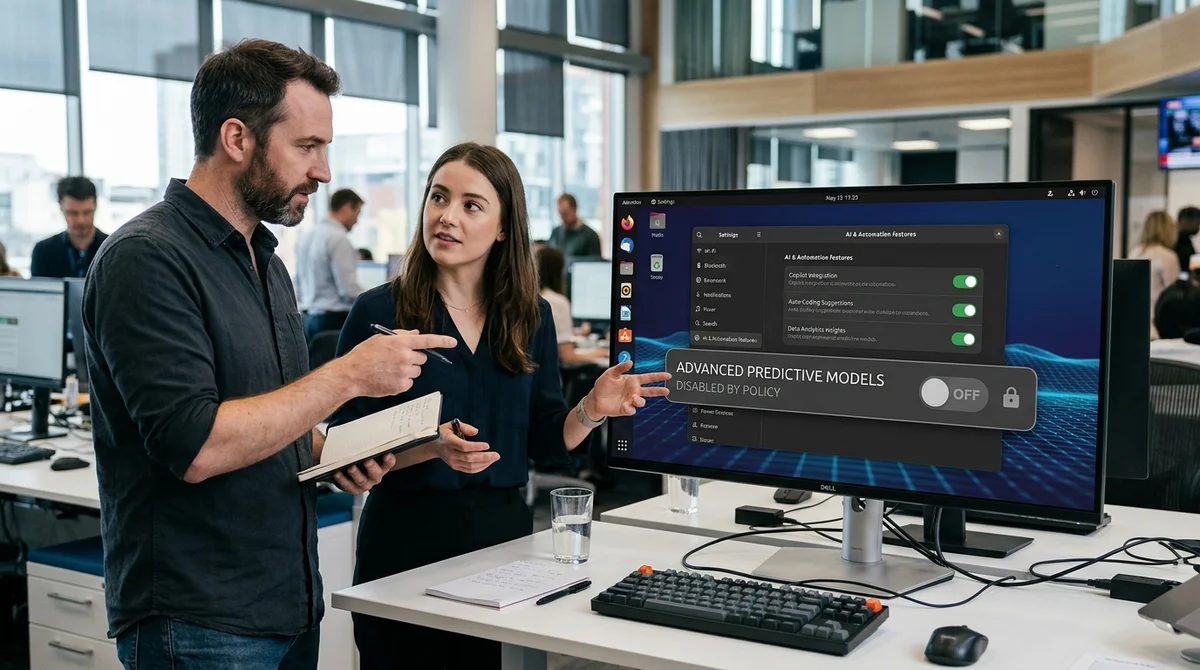
Canonical intends to add AI features to Ubuntu, and it has already provoked noticeable irritation in part of the Linux community. Users are asking either for a fully fledged mode without AI, or at least a clear way to turn off the new capabilities system-wide.
Where the conflict comes from
The trigger was Canonical's announcement of plans to bring AI capabilities to Ubuntu. Instead of the usual enthusiasm, the company immediately met a wave of skepticism: some asked for a separate build without such features, others wrote that they would stay on older releases, and still others began thinking about moving to other distributions. For the Linux community this is a sensitive topic, because many people choose Ubuntu precisely for control over the system, predictable behavior and a minimum of imposed decisions.
The context of recent years amplified the reaction. Users have already watched large platforms embed AI ever deeper, often without any explicit request from their audience. So comparisons with Windows 11 quickly appeared in the Ubuntu discussions, where for many people the new AI tools have become a symbol of needless overhead, dubious value and a weaker sense that the computer belongs fully to its owner. That is why any forced innovation here is read as a threat to freedom of choice.
What users fear
At the center of the dispute is not the idea of machine intelligence itself but how it is introduced. Linux users are usually relaxed about new features if they are transparent, documented and can be turned off without wrestling with config files. But when AI arrives as part of the base system, questions arise at once: what exactly will run locally, which components will be preinstalled, will background services appear, and will it be possible to remove all of it without side effects.
- Extra processes and resource consumption on laptops and workstations
- Non-obvious telemetry or network calls from the new components
- Growing system complexity where minimalism was once valued
- The risk that AI features will eventually be enabled by default and woven deeper into the interface
Hence the request for a "kill switch": not as a loud slogan, but as a clear engineering guarantee. People want to know they can install Ubuntu and, if they wish, return the system to classic behavior with one action, without AI add-ons. For open source projects such a request matters especially: trust here is built not on promises but on verifiable control mechanisms. Otherwise the discussion quickly moves from features to principles.
Canonical's response
Canonical's vice president of engineering, Jon Seager, answered the criticism. According to him, the company does not plan to add a global AI switch to Ubuntu. This appears to be the key point users wanted to hear, and it is exactly where their expectations diverged from the position of the distribution's developer. For many, it sounds like a refusal to even acknowledge the question of a full, distribution-level, default opt-out for all users.
"We need a version of Ubuntu without these features."
From the available description of the discussion, Canonical does not want to settle the matter with a single master switch for the whole system. Judging by the community's reaction, that is exactly what is seen as the problem: users are asking not only for the features themselves but for a clear architecture for disabling them. Even if individual components can later be configured one by one, the absence of a general opt-out mode is already read as a signal that AI will become part of the standard Ubuntu experience rather than an optional module.
Canonical's logic is understandable: the company wants to show that Ubuntu is not sitting out the AI trend, and it is trying to build new scenarios into one of the most popular Linux distributions. But the Linux ecosystem has a different threshold of tolerance for such changes. Users here are more often ready to give up a convenient new feature if the price is a loss of transparency, autonomy and full control over the system. That clash of expectations has now come to the fore.
What this means
The Ubuntu story shows that for Linux users the question is not AI itself but the right to decide whether it is needed at all. If Canonical does not offer a simple and convincing way to opt out of the new AI components entirely, the dispute over a feature could easily turn into a dispute over trust in the distribution itself. For Canonical this is no longer an argument about a feature but a test of how well the company can listen to its community.
- Nov 2, 2026DeepSeek open-sources Super-agent prototype: p95 task completion time of 15.7 minutes vs. 29.5
- Nov 2, 2026TensorFold 1.2.0 boosts Qwen3.8-27B throughput on M3 Ultra by 44.2% at 16 streams
- Nov 1, 2026Adobe's EditAgent judge picks a usable edit 81.3% of the time, versus 74.8% for EditScore
- Nov 1, 202616 models tested on 7 search tools: Exa averaged 10.5 out of 14, SearXNG about 3
Key Questions Answered
Where the conflict comes from?
The trigger was Canonical's announcement of plans to bring AI capabilities to Ubuntu. Instead of the usual enthusiasm, the company immediately met a wave of skepticism: some asked for a separate build without such features, others wrote that they would stay on older releases, and still others began thinking about moving to other distributions. For the Linux community this is a sensitive topic, because many people choose Ubuntu precisely for control over the system, predictable behavior and a minimum of imposed decisions. The context of recent years amplified the reaction. U
What users fear?
At the center of the dispute is not the idea of machine intelligence itself but how it is introduced. Linux users are usually relaxed about new features if they are transparent, documented and can be turned off without wrestling with config files. But when AI arrives as part of the base system, questions arise at once: what exactly will run locally, which components will be preinstalled, will background services appear, and will it be possible to remove all of it without side effects. Extra processes and resource consumption on laptops and workstations Non-obvious telemetry
What are the key details on Canonical's response?
Canonical's vice president of engineering, Jon Seager, answered the criticism. According to him, the company does not plan to add a global AI switch to Ubuntu. This appears to be the key point users wanted to hear, and it is exactly where their expectations diverged from the position of the distribution's developer. For many, it sounds like a refusal to even acknowledge the question of a full, distribution-level, default opt-out for all users. "We need a version of Ubuntu without these features." From the available description of the discussion, Canonical does not want to s
Ship AI Faster with Founders, Engineers & Weekly Architecture Reviews
Inside Vibe Club (hamidun.com/club) — weekly live masterminds with Zhemal Khamidun, Tech Radar, full LMS access, and 370+ production Claude Code skills.
The AI world, distilled — once a week
Seven stories that actually mattered, hand-picked. No noise, no reposts, no press releases.
Done! Check your inbox for a confirmation.