Canonical to build local AI tools into Ubuntu 26.10, with a one-click off switch
Canonical is preparing built-in AI tools based on large language models for Ubuntu 26.10. The key difference is that everything runs locally and stays fully optional: features can be enabled individually, switched off in one click, or removed entirely. The first release with this architecture is scheduled for October 15, 2026. With it, Canonical is trying to bring AI to Linux without tying users to cloud services.
AI-processed from 3DNews AI; edited by Hamidun News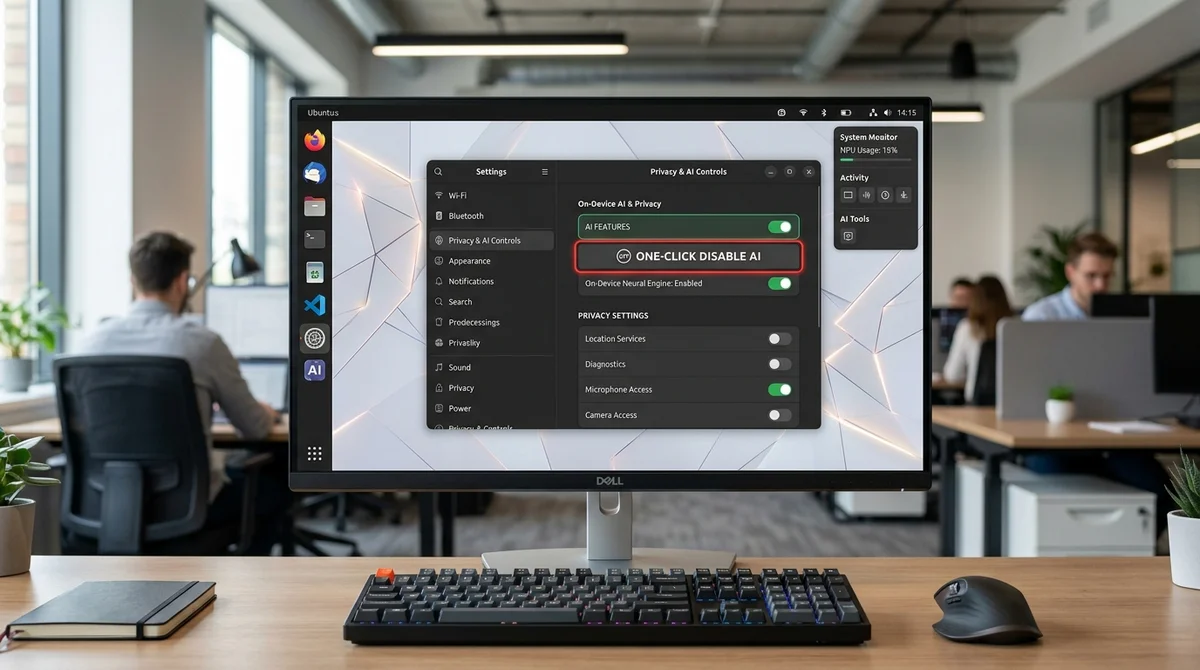
Canonical has decided to build its own set of AI tools based on large language models into Ubuntu, but it is not taking an all-inclusive approach. In Ubuntu 26.10, scheduled for release on October 15, 2026, these features will arrive as optional modules: users will be able to enable them when needed, disable them with a single action, or remove them completely.
How it works
The company is not talking about a one-off demo, but about a systemic change to future Ubuntu releases. The idea is to give Linux users built-in LLM capabilities directly in the distribution, without an imposed usage scenario. The first release with this architecture will ship as Ubuntu 26.10 Stonking Stingray. For Canonical, it is an attempt to build AI into the base platform as carefully as drivers, container tools, or development tools were added to the system before.
The key principle is modularity. AI features will not be hard-wired into the system in a way that makes them impossible to get rid of. Users will decide for themselves whether they need suggestions, local text generation, intelligent search, or other scenarios that Canonical will detail closer to the release. If they do not need these features, they can simply leave them inactive. If they need only some of them, the system will let them keep exactly the components they actually use.
What users get
According to Canonical's description, the bet is on control as much as on convenience. For the Ubuntu audience this matters particularly: many people choose Linux precisely because they want to know which services are running on the machine, which packages are installed, and where their data goes. That is why AI in Ubuntu is presented not as a mandatory assistant, but as a set of tools that should fit the system's familiar philosophy rather than break it.
- Local model execution, with no data sent to the cloud by default
- Pluggable AI components instead of a mandatory feature set
- The ability to turn the tools off in one click
- Complete removal of AI modules if they are not needed
- First launch in Ubuntu 26.10 on October 15, 2026
This approach can be useful both for ordinary users and for corporate environments. Home users get built-in AI capabilities without a subscription to a separate cloud service, while companies get a more predictable security model and better alignment with internal policies. For the Linux ecosystem this is an important detail: AI stops being an external add-on and starts becoming part of the standard user environment. For developers, it is also a way to get new tools without changing their usual workflow.
Why local
The most important emphasis in the announcement is local inference. By default, data should not leave for external servers, and processing will run on the user's device. For Ubuntu this is a strong move, because privacy here is a practical issue, not a marketing one. Developers, engineers, administrators, and companies often work with code, internal documents, and configurations that cannot simply be sent to the cloud for a convenient suggestion. That makes the choice of a local architecture understandable even without a full list of upcoming features.
This approach also has a technical cost. Local models need resources: enough RAM, a suitable CPU or GPU, and careful integration into the system so that the new features do not turn a workstation into a slow experimental test bench. The success of the idea will therefore depend not only on the fact of adding AI, but on how carefully Canonical chooses models, interfaces, and the entry threshold for machines with different performance.
What it means
Canonical is trying to show that built-in AI in an operating system does not have to be an intrusive cloud service; it can be a managed local tool. If the company brings this scheme to a stable release, Ubuntu 26.10 may become one of the first mainstream Linux distributions where AI is built in by default yet remains fully under the user's control. If the model works, other distributions may follow Ubuntu in the next few release cycles.
- Oct 30, 2026Inclusion AI speeds up LLM generation by up to 6.9x with a draft tree
- Oct 30, 2026Anthropic rewrote the Messages API in Rust using Claude, cutting CPU load by 40–50%
- Oct 29, 2026Cloudflare releases open-source Clef models: 98.5% on BFCL and 38.8 ms
- Oct 28, 2026Cline Pushes an Open Model to 11,840 Tokens per Second on a Single GPU
Key Questions Answered
How it works?
The company is not talking about a one-off demo, but about a systemic change to future Ubuntu releases. The idea is to give Linux users built-in LLM capabilities directly in the distribution, without an imposed usage scenario. The first release with this architecture will ship as Ubuntu 26.10 Stonking Stingray. For Canonical, it is an attempt to build AI into the base platform as carefully as drivers, container tools, or development tools were added to the system before. The key principle is modularity. AI features will not be hard-wired into the system in a way that makes
What users get?
According to Canonical's description, the bet is on control as much as on convenience. For the Ubuntu audience this matters particularly: many people choose Linux precisely because they want to know which services are running on the machine, which packages are installed, and where their data goes. That is why AI in Ubuntu is presented not as a mandatory assistant, but as a set of tools that should fit the system's familiar philosophy rather than break it. Local model execution, with no data sent to the cloud by default Pluggable AI components instead of a mandatory feature
Why local?
The most important emphasis in the announcement is local inference. By default, data should not leave for external servers, and processing will run on the user's device. For Ubuntu this is a strong move, because privacy here is a practical issue, not a marketing one. Developers, engineers, administrators, and companies often work with code, internal documents, and configurations that cannot simply be sent to the cloud for a convenient suggestion. That makes the choice of a local architecture understandable even without a full list of upcoming features. This approach also ha
Test Frontier LLMs & Autonomous Agents in One Workspace
Run Claude Opus 5.5, GPT-6, Gemini 3.1, and DeepSeek side-by-side in Nomad AI (nomadnet.ai) — unified model routing, deep research, and multimodal workflows under one subscription.
The AI world, distilled — once a week
Seven stories that actually mattered, hand-picked. No noise, no reposts, no press releases.
Done! Check your inbox for a confirmation.