Canonical to add AI features to Ubuntu for accessibility and new workflows
Canonical is preparing a notable shift of Ubuntu toward built-in AI within the next year. The company wants to add features that run in the background, strengthening capabilities the system already has, as well as new AI-native workflows. The first areas include improved speech-to-text and text-to-speech, along with agentic tools for carrying out user tasks.
AI-processed from The Verge; edited by Hamidun News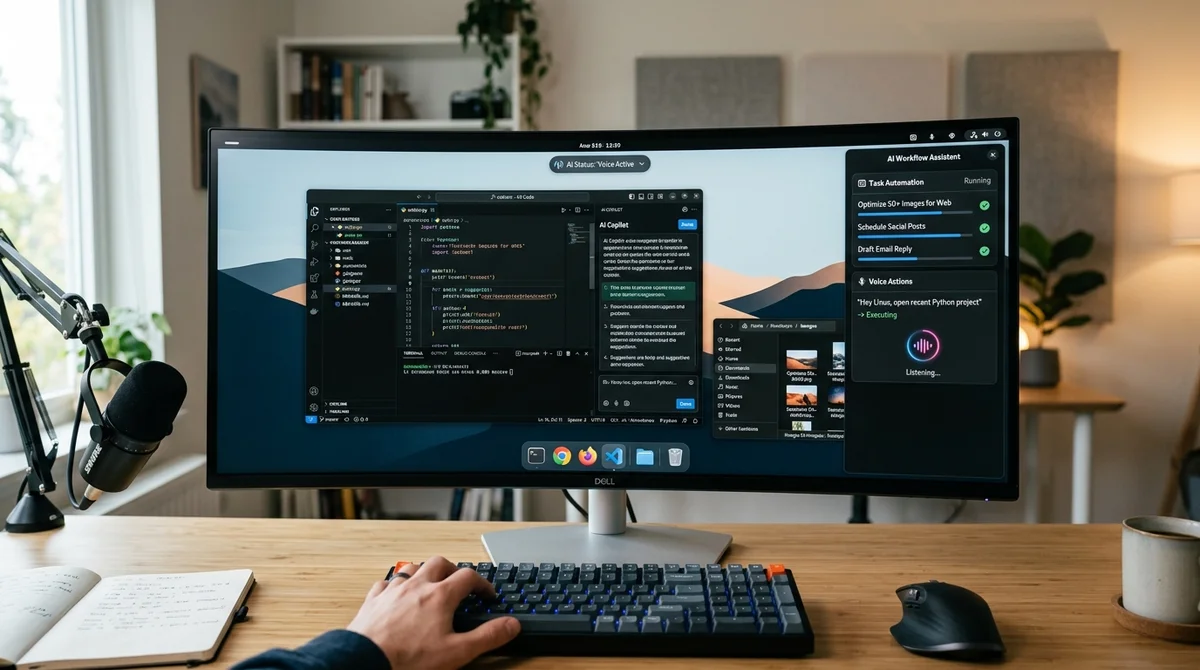
Ubuntu, one of the most popular Linux distributions, is preparing a notable turn toward built-in artificial intelligence. Over the next year, Canonical plans to add a set of AI features to the system. They will not simply run separate models alongside the OS; they will strengthen familiar Ubuntu workflows, from accessibility features to more complex automated actions. For the Linux market this is an important milestone: AI is starting to be seen not as an external add-on but as part of the core user experience.
Canonical's vice president of engineering, Jon Seager, described the plans. According to him, the company sees AI in Ubuntu developing in two directions. The first is improving the operating system's existing capabilities with models running in the background. The second is the arrival of separate AI-native features and workflows for users who genuinely need such tools.
The wording matters in itself: Canonical is not talking only about a chatbot inside the desktop, but describes a broader layer of system capabilities built directly into the everyday work of the OS.
Among the examples already named are more advanced speech-to-text and text-to-speech tools. For Ubuntu this is a fairly logical entry point. Speech recognition and voice synthesis are directly tied to accessibility, so they can bring practical benefit not only to AI enthusiasts but also to ordinary users who need more convenient input, text read aloud, or support in scenarios involving limited vision or motor ability. Such improvements are usually received far more calmly than loud experimental assistants, because they solve clear problems and do not require completely changing the familiar way of working with the system.
The second direction looks even more interesting. Canonical explicitly mentions agentic AI capabilities for carrying out tasks, although a detailed list of scenarios has not yet been disclosed. In everyday terms, this may mean assistants that understand the context of the user's actions and can do more than answer a question in a separate window. In the Ubuntu ecosystem, such tools could potentially help with system configuration, working with files, finding the right settings, preparing commands, summarizing text or automating repetitive steps. It is important, though, that the company so far describes only a development framework, not a finished product with a full list of features.
The choice of Ubuntu for this course is especially telling, because it is one of the most widely used and recognizable Linux distributions, both on the desktop and among developers. Any change in Ubuntu quickly becomes a reference point for partners, hardware makers, enterprise customers and neighboring projects in the open source ecosystem. So this is not only a local Canonical initiative but a possible signal for the whole Linux segment: users increasingly expect AI to be built into interfaces, system services and daily workflows, rather than exist separately in a browser or a third-party app.
At the same time, Canonical faces a question of trust. The Linux audience is traditionally sensitive to control, transparency and privacy, so the fate of these features will depend not only on how convenient they are but on exactly how they are implemented. For such a platform it matters a great deal whether models run locally or through the cloud, how easy it is to turn off AI components, how data access permissions are structured and how transparently the system's behavior is explained. Even if the company has not yet revealed all the technical details, these questions are likely to dominate the discussion of future Ubuntu releases.
The main takeaway is simple: Canonical wants AI in Ubuntu to be not a separate showcase but a system layer that gradually works into familiar features and is supplemented by new workflows for those who want them. If the company can balance usefulness, control and unobtrusiveness, Ubuntu has a chance to show one of the most practical approaches to integrating AI into a desktop operating system. If not, the Linux community will quickly remind it that it values not only new capabilities but also freedom of choice.
- Nov 2, 2026Karpathy builds a YouTube clone with 6454 videos from Hacker News recommendations in two hours
- Nov 2, 2026Karpathy used Claude to build HackerTube from 6,454 videos recommended on Hacker News
- Nov 2, 2026Arca gives AI agents finance tasks lasting up to 10 days, but leaves the trades to humans
- Nov 2, 2026DeepSeek open-sources Super-agent prototype: p95 task completion time of 15.7 minutes vs. 29.5
Test Frontier LLMs & Autonomous Agents in One Workspace
Run Claude Opus 5.5, GPT-6, Gemini 3.1, and DeepSeek side-by-side in Nomad AI (nomadnet.ai) — unified model routing, deep research, and multimodal workflows under one subscription.
The AI world, distilled — once a week
Seven stories that actually mattered, hand-picked. No noise, no reposts, no press releases.
Done! Check your inbox for a confirmation.