Robots That Predict the Future: How AI Is Learning to See Tomorrow
Forecasting is a core survival skill, long considered uniquely human. But current research in robotics and AI is changing the rules. Scientists are building systems that analyze past experience and cause-and-effect relationships to predict future scenarios. These technologies let robots do more than react to change: they can act ahead of it. From agriculture to industrial automation, the ability to anticipate what comes next is becoming the main advantage of new autonomous systems that mimic human logic and intuition.
AI-processed from MIT Technology Review; edited by Hamidun News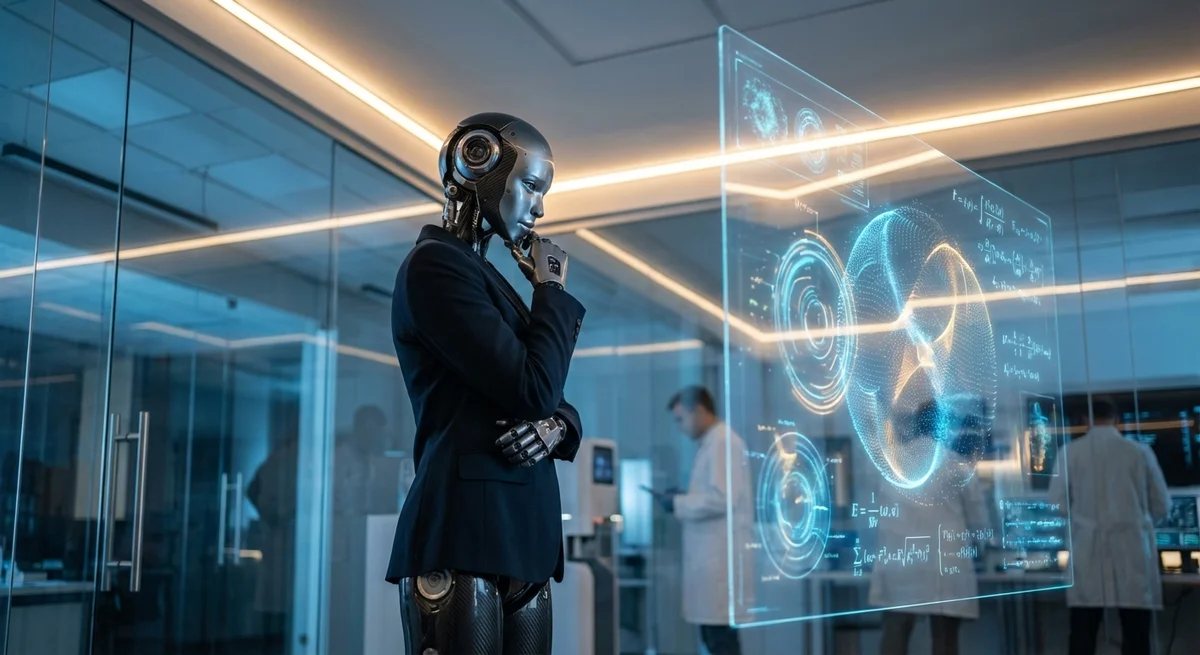
Robots That Predict the Future: How AI Is Learning to See Tomorrow
The ability to anticipate is, at its core, one of the cornerstones of human survival, a skill long considered our exclusive domain. From the instinct to avoid danger to the complex planning of long-term projects, we constantly analyze the past and present to forecast what tomorrow will bring. But modern research in artificial intelligence and robotics is rapidly changing this paradigm, opening the door to a world where machines can do more than react to their surroundings: they can actively act ahead of events, predicting what is coming.
For a long time, robotics focused on building machines that could perform set operations with high precision and speed. Their actions were governed by rigid algorithms and direct reactions to current input data. That approach has its limits, especially in dynamic and unpredictable conditions.
Recognizing this, scientists began working actively on systems that could imitate the human capacity for forecasting. The key development was progress in machine learning methods, which let robots analyze huge volumes of data and identify hidden patterns and cause-and-effect relationships. Instead of simply following instructions, the new systems learn from past experience, much as people learn from their mistakes and successes.
This lets them build internal models of the world that are continually updated and refined, making their predictions increasingly accurate.
A closer look shows that modern AI systems use complex probabilistic models and deep learning methods to predict future states. In agriculture, for example, robots equipped with sensors and cameras can analyze soil conditions, weather and plant growth to predict the best time for watering, fertilizing or harvesting. This can raise yields and also optimize resource use, reducing losses.
In industrial automation, robots learn to predict equipment failures by analyzing data from vibration, temperature and pressure sensors. Once it detects anomalies, the system can alert staff in advance that maintenance is needed, preventing costly downtime. In autonomous vehicles, AI systems forecast the behavior of other road users and pedestrians, and even changes in weather, so they can drive safely and efficiently.
They learn to understand not only direct actions but also the potential intentions of other objects, an extremely hard task that brings robots closer to human intuition.
The implications of these technologies are enormous. The ability to anticipate is becoming the main competitive advantage for autonomous systems. It opens the way to more adaptive, efficient and safe robots that can work in highly varied environments, from complex production lines to unexplored corners of space. Forecasting allows a shift from reactive to proactive control, which is critical for tackling global problems such as climate change, resource management and emergency response. Robots that can predict become more than tools: they become partners that can help humanity make more considered, far-sighted decisions.
In conclusion, we are watching the dawn of a new era in robotics, in which machines learn not just to perform tasks but to understand and anticipate the future. Building human logic and intuition into AI algorithms makes it possible to create autonomous systems that promise to revolutionize many areas of our lives. From agriculture to transport, from manufacturing to scientific research, robots that can see tomorrow are becoming reality, opening up previously unseen possibilities and posing new, exciting challenges.
- Nov 27, 2026Hackers Breached Meta's Muse AI Agent Through a Single Web Page and Stole Chat Logs
- Nov 27, 2026Google Brings Gemini Distillation to Vertex AI: Pro Teaches Cheap Flash
- Nov 27, 2026OpenAI Fixes Codex Limit Bug: Quotas Are 25–40% Smaller
- Nov 27, 2026An AI agent turned a 200-line feature into 8,391 lines: boredom no longer stops overengineering
Free 2-Day Vibecoding & AI Agents Intensive
Day 1: the autonomous Hermes + DeepSeek AI agent — vibecoding and development on par with Claude Code / Codex / Gemini. Led by Jemal Hamidun, Head of AI at Alpina Digital and academic supervisor at MIPT. Right after you register with our bot Nika: the recording + 11 materials from the previous intensive.
Daily 60-sec AI Voice Brief + Weekly Production AI Agent Playbook
Listen to a 60-second AI news brief every morning and get a weekly hands-on playbook for shipping AI agents to production — tools, MCP servers and patterns that work. Curated by Jemal Hamidun, Head of AI at Alpina Digital.
