NVIDIA Earth-2: Jensen Huang Wants to Replace Every Forecaster at Once
NVIDIA has taken a serious step toward climate dominance by open-sourcing new models for its Earth-2 platform. The AI can now build global weather forecasts 15 days ahead, using a completely new architecture. While traditional weather services battle it out with supercomputers, NVIDIA proposes using the power of its GPUs to simulate a digital twin of the Earth. This is not just a rain forecast for Moscow: it is a tool for dealing with natural disasters and for planning the economies of entire countries. Jensen Huang clearly intends to turn his graphics cards into humanity's main survival tool.
AI-processed from Jiqizhixin (机器之心); edited by Hamidun News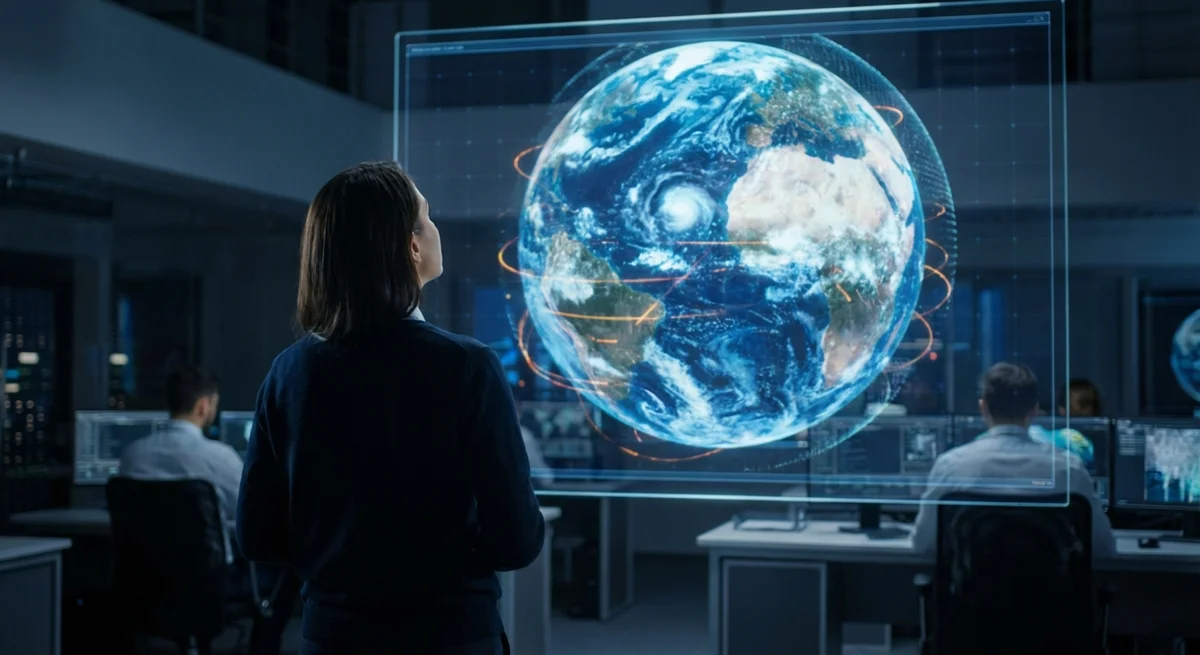
While we grumble at the phone app that promised sun and delivered a downpour, NVIDIA is quietly building a digital twin of the planet. The latest update to the Earth-2 platform is not a cosmetic software refresh but a full release of new models into the open. Jensen Huang clearly believes that predicting the planet's future should not be left to closed government institutions alone, but should be open to anyone with enough GPUs and the right algorithms.
The digital-twin concept, which the company has been pushing for the past couple of years, is finally taking shape as concrete tools for meteorologists and researchers. The new model architecture makes it possible to look 15 days ahead with unprecedented accuracy. If you think that's easy, consider how often forecasters get even tomorrow wrong.
Classical meteorology has a so-called predictability limit, caused by the chaotic nature of atmospheric processes. Traditional numerical weather prediction (NWP) methods require solving extremely complex Navier-Stokes equations on supercomputers the size of a football field. NVIDIA proposes another path: train a neural network on decades of historical data so it finds patterns where classical mathematics drowns in computation.
This works faster, uses less energy and, more importantly, is more accessible to business. Why would NVIDIA give this technology away by open-sourcing it? The answer lies in setting an industry standard.
When the whole world, from insurers to agricultural holdings, starts modeling climate change, floods and droughts on NVIDIA software, the question of whose hardware to buy for the job answers itself. It is the classic ecosystem play for capturing a market, which we have already seen with CUDA in deep learning. Now the company is repeating the trick in fundamental Earth science, creating an environment where proprietary hardware becomes the foundation for open innovation.
Interestingly, the new Earth-2 models can generate forecasts in remarkable detail. This is no longer just an average temperature for a region, but precise data on air-mass movement, humidity levels and the probability of extreme events at the level of a specific city. For business, that means billions of dollars saved in logistics and agriculture.
Energy companies will be able to plan wind and solar output more accurately, and insurers to estimate damage from approaching hurricanes in advance. NVIDIA is effectively turning weather from an unpredictable act of God into a manageable data stream that can be analyzed and monetized. Of course, skeptics may point out that AI weather models still tend toward specific errors and cannot yet fully replace physical simulations.
However, unlike language models, which can invent a historical fact, Earth-2 models are tightly constrained by the physical parameters of their input data. NVIDIA claims its new architecture radically minimizes the error accumulation that used to make forecasts useless by day ten. That is a serious bid for leadership in a field once dominated only by government agencies with the budgets of small countries.
The bottom line: NVIDIA is turning meteorology from a closed government service into a computational task for the private sector. Will traditional weather services be able to compete with the computing power and training speed of modern GPUs?
- Nov 2, 2026TensorFold 1.2.0 boosts Qwen3.8-27B throughput on M3 Ultra by 44.2% at 16 streams
- Nov 1, 2026Local models lose to Opus and Codex: 0.21 on a MacBook versus 1.00 for Codex
- Nov 1, 2026Habr author fine-tunes YOLOv8l on dental X-rays and pushes mAP50 to 0.642
- Nov 1, 2026Voice bots built on LLMs turn to Jev, a fast classifier, for decisions in 200–500 ms
Test Frontier LLMs & Autonomous Agents in One Workspace
Run Claude Opus 5.5, GPT-6, Gemini 3.1, and DeepSeek side-by-side in Nomad AI (nomadnet.ai) — unified model routing, deep research, and multimodal workflows under one subscription.
The AI world, distilled — once a week
Seven stories that actually mattered, hand-picked. No noise, no reposts, no press releases.
Done! Check your inbox for a confirmation.