Nvidia and OpenAI: Jensen Huang reminds everyone who really calls the tune
Rumors that Nvidia was ready to pour an astronomical $100 billion into OpenAI turned out to be somewhat exaggerated. Jensen Huang set the record straight: there are no commitments, and each investment round will be considered separately. That's an important signal for the market. While OpenAI tries to assemble a coalition to build its own chip infrastructure, Nvidia is carefully keeping its distance. Huang understands that his company is a monopolist, and it pays him better to sell shovels to every gold miner at once than to tie himself to one project — even the loudest one, and one that dreams of making its own hardware.
AI-processed from Bloomberg Tech; edited by Hamidun News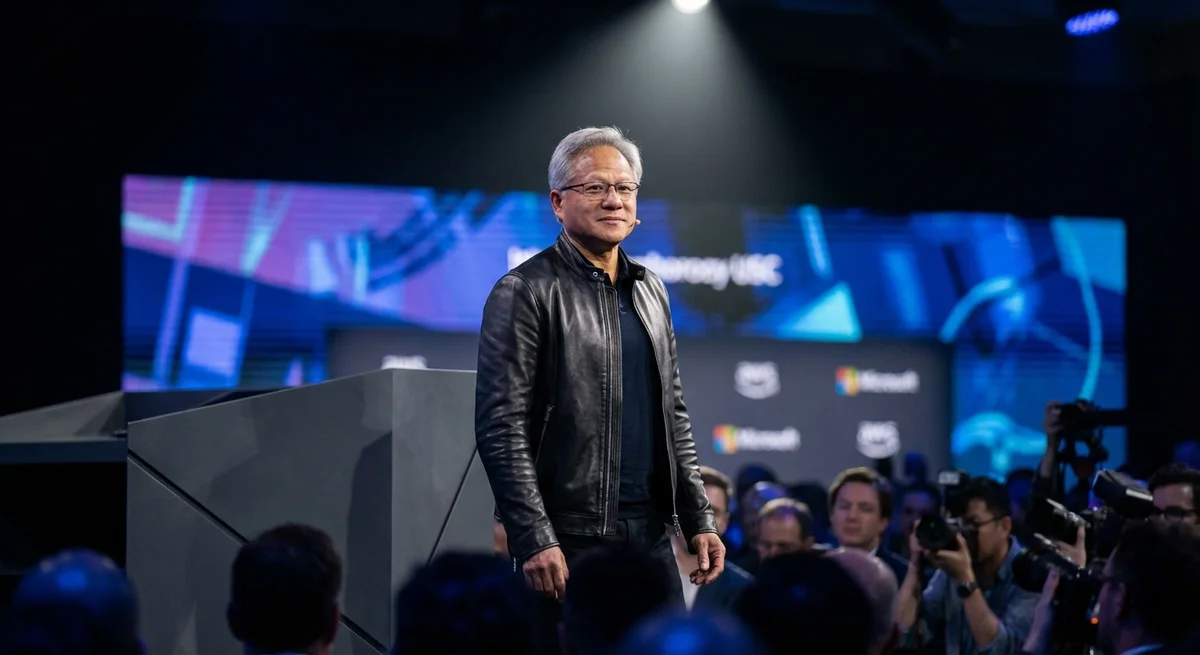
The investment saga around OpenAI has taken an unexpected turn that will force many to rethink their forecasts for the next couple of years. While the industry debated a potential alliance of titans and an incredible $100 billion cash injection, Nvidia CEO Jensen Huang decided to bring everyone back down to earth. His statement that the company has no firm commitments to Sam Altman's brainchild lands like a cold shower for anyone who had already pictured a cloudless future for OpenAI under the wing of the world's leading chipmaker. Huang stressed that Nvidia will consider any funding rounds one at a time, without making advance pledges.
To see why this statement matters so much, recall the context of recent months. OpenAI is in a permanent hunt for money. Scaling models takes not just millions but tens of billions of dollars — mostly spent on the very H100 and Blackwell accelerators that Nvidia makes. On the surface, investing in OpenAI looks like Nvidia moving money from one pocket to another: you give them capital, and they immediately hand it back by buying your hardware. But at this level of business, closed-loop logic doesn't always hold, especially when the sums at stake rival the budgets of small countries.
Huang stressed that Nvidia evaluates each funding round separately. It's a classic position of strength. Why lock yourself into long-term commitments with a company that is reportedly looking hard for ways to kick its Nvidia habit and is developing its own processors? Project Tigris, which Sam Altman has been pitching to investors, is a direct threat to Nvidia's dominance. As a seasoned strategist, Jensen knows full well that OpenAI is his best customer today and could be a competitor in the silicon market tomorrow. Funding a rival so it can later drop your services looks like a dubious strategy.
Nvidia also needs to remain neutral ground. If it gets too close to OpenAI, that will raise questions among other giants — Google, Amazon, and Meta — which also spend billions on Nvidia chips. Huang does better selling tools to everyone in the gold rush without openly favoring any single player. Distancing itself from OpenAI sends a clear message to the market: Nvidia has no intention of becoming hostage to the ambitions of one lab, even if that lab kicked off the current generative AI boom. It's also a way to avoid extra scrutiny from antitrust regulators, who already watch Nvidia's every move closely.
For OpenAI itself, the statement is a warning sign. If the main beneficiary of the AI revolution isn't ready to guarantee support, the project's risks are being rated higher than they appear from the outside. The concerns may cover not only the payback on future models but also OpenAI's corporate structure, which lately resembles a patchwork quilt of commercial and nonprofit interests. As long as Microsoft remains its main partner, OpenAI feels relatively safe, but its dependence on investors' whims and the lack of guarantees from its hardware supplier leave it more vulnerable.
Ultimately, we're watching a high-stakes poker game. Huang simply reminded everyone that he's the only one in the room holding all the trump cards. He doesn't need to invest $100 billion to control the market; all he has to do is ship orders on time to whoever is ready to pay here and now. OpenAI, meanwhile, will have to prove its value in every new round, like any other startup — even the most valuable one in the world. The era of unconditional faith in the promises of artificial general intelligence is gradually giving way to pragmatic calculation and an assessment of real profits.
The bottom line: Nvidia is staying neutral and is in no hurry to rescue OpenAI's budget without good reason. Can Altman find $100 billion without the industry's biggest player?
*Meta is designated an extremist organization and banned in the Russian Federation.
- Nov 1, 2026OpenAI Rewrites GPT Behavior Rules: Five Values and a Chain of Command
- Nov 1, 2026Google admits AI Mode cuts search revenue, shares fall 15%
- Oct 31, 2026Author puts his script before an AI jury: the verdict cost 850 thousand tokens
- Oct 31, 2026Anthropic: Fold Subagents Back Into a Single Loop — One Customer's Tasks Ran Twice as Fast
Test Frontier LLMs & Autonomous Agents in One Workspace
Run Claude Opus 5.5, GPT-6, Gemini 3.1, and DeepSeek side-by-side in Nomad AI (nomadnet.ai) — unified model routing, deep research, and multimodal workflows under one subscription.
The AI world, distilled — once a week
Seven stories that actually mattered, hand-picked. No noise, no reposts, no press releases.
Done! Check your inbox for a confirmation.