Jensen Huang vs. Wall Street: The Panic Over Software Makes No Sense
Jensen Huang has decided to talk some sense into Wall Street. After the recent crash in software stocks, driven by fear of "AI disruption," the Nvidia chief called the whole thing absurd. Investors worry that neural networks will replace traditional software and gut the revenues of the industry's giants, but Huang sees it differently. To him, AI is not a software killer but its most powerful accelerator. If Nvidia sells the shovels in a gold rush, software is the gold itself, and it will be mined even more aggressively. Markets often misjudge long-term trends, and what we are watching now is a classic bout of panic.
AI-processed from Bloomberg Tech; edited by Hamidun News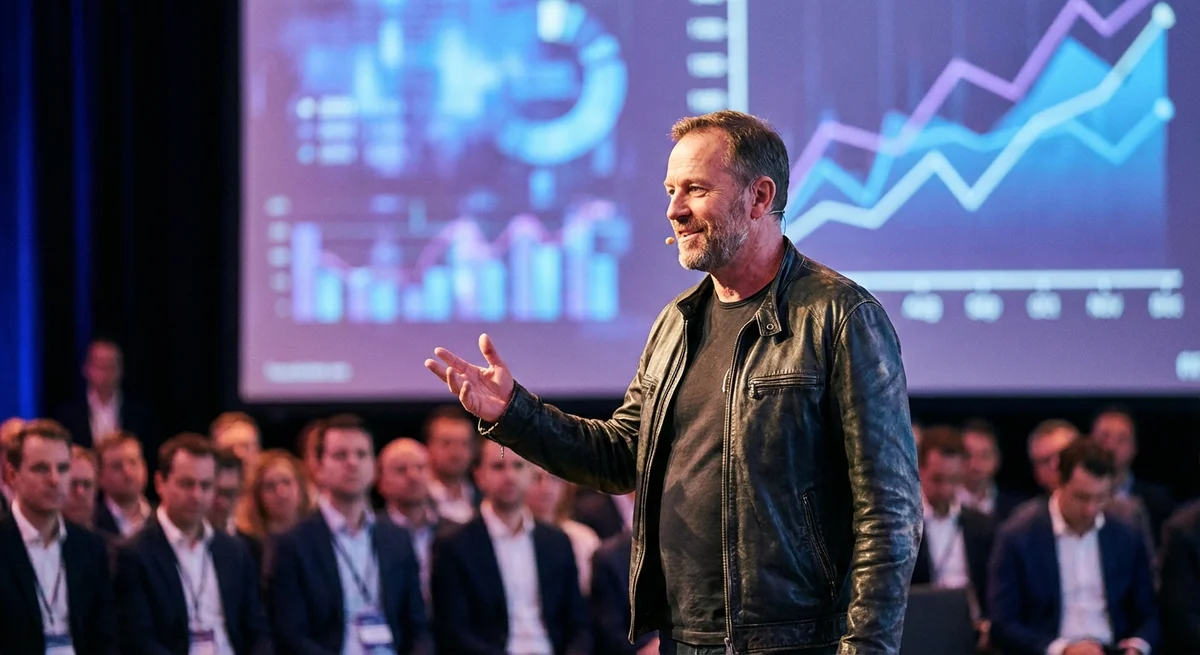
While Wall Street once again tries to bury traditional software under the rubble of generative-AI hype, the man in the leather jacket has decided to remind everyone of the basics of economics. Jensen Huang, whose company Nvidia has effectively become the main beneficiary of the current technology race, called the recent selloff in software stocks "the most illogical thing in the world." And this is not just an attempt to back partners in the ecosystem, but the cold calculation of an industry leader who sees the architecture of the future a little more clearly than analysts in the glass offices of New York.
The market is now feverish with fear of so-called "AI disruption." The investors' logic is simple and blunt: if neural networks can write code, build interfaces and automate routine work, why pay for subscriptions to Salesforce, Adobe or ServiceNow? Good old SaaS, the thinking goes, is turning into a pumpkin, and omnipotent agents that need no complicated dashboards will take its place. That fear has pushed the share prices of many tech giants down, creating a sense of the end of an era.
Huang, however, sees a fundamental misunderstanding of how progress works. If Nvidia is the forge producing the best swords and armor, then software is the army itself. One cannot exist without the other. In the Nvidia chief's view, artificial intelligence does not replace software but fundamentally changes its nature, making it more valuable and more in demand. Every line of old code now needs a "smart" layer on top, and every existing enterprise tool becomes a platform for training new models.
Remember the shift from on-premises servers to the cloud. Back then, too, people shouted that classic software vendors would die out. In the end, the software market grew many times over, because access to tools got easier and their capabilities broadened. We are at a similar point now. Yes, old monetization models may wobble, but the volume of tasks that can now be solved with AI-enhanced software is growing exponentially.
Jensen stresses that the AI agents everyone is so excited about require a colossal amount of infrastructure and application software. Someone has to manage data flows, someone has to ensure security, someone has to interpret the results. The irony is that the very companies whose shares are being dumped in panic hold the most valuable data for training specialized models. These are assets that a simple chatbot cannot replace.
It is worth understanding that Nvidia is in a unique position. Jensen sees orders from all the biggest players, from three-person startups to giants like Microsoft. And when he says software is not going anywhere, he is relying on real development pipelines that are scheduled years ahead. What we are seeing is not the decline of SaaS but its rebirth as so-called Agentic Software. It is a world where applications do not just wait for a user's click, but anticipate needs and carry out tasks in the background.
Investors often confuse a temporary change of paradigm with the complete disappearance of a market. It is a classic mistake. When smartphones appeared, many predicted the death of the web. In the end, the web simply adapted and became even bigger. AI is now doing the same thing to software: it forces developers to rethink interfaces and interaction logic, but the need for logic layers between hardware and business tasks only keeps growing. Huang's chips are not bought just to heat the air in data centers. They are bought to run next-generation software on them.
The takeaway: market panic is often an opportunity for those who understand the technology stack more deeply than media headlines. If even the leading hardware supplier considers the software crash absurd, perhaps investors should have some chamomile tea. What awaits us is not the death of software but its greatest transformation in the last thirty years.
- Nov 2, 2026TensorFold 1.2.0 boosts Qwen3.8-27B throughput on M3 Ultra by 44.2% at 16 streams
- Nov 1, 2026Local models lose to Opus and Codex: 0.21 on a MacBook versus 1.00 for Codex
- Nov 1, 2026Habr author fine-tunes YOLOv8l on dental X-rays and pushes mAP50 to 0.642
- Nov 1, 2026Voice bots built on LLMs turn to Jev, a fast classifier, for decisions in 200–500 ms
Test Frontier LLMs & Autonomous Agents in One Workspace
Run Claude Opus 5.5, GPT-6, Gemini 3.1, and DeepSeek side-by-side in Nomad AI (nomadnet.ai) — unified model routing, deep research, and multimodal workflows under one subscription.
The AI world, distilled — once a week
Seven stories that actually mattered, hand-picked. No noise, no reposts, no press releases.
Done! Check your inbox for a confirmation.