Glass Ceiling Broken: Ant Group Teaches Robots to See the Invisible
Ant Group has entered the field of embodied intelligence (Embodied AI) with a fix for one of the industry's oldest problems: perceiving transparent objects. For years, robots have gone "blind" in front of glass doors and tableware because of how lidars and cameras work. Ant's new research not only proposes an algorithm for correctly recognizing glass, it also releases the source code in full. It's an important signal for the market: even digital payments giants are now investing in the physical world. The "smart home" now has a chance to become truly sighted, rather than just an expensive set of sensors bumping into corners.
AI-processed from Jiqizhixin (机器之心); edited by Hamidun News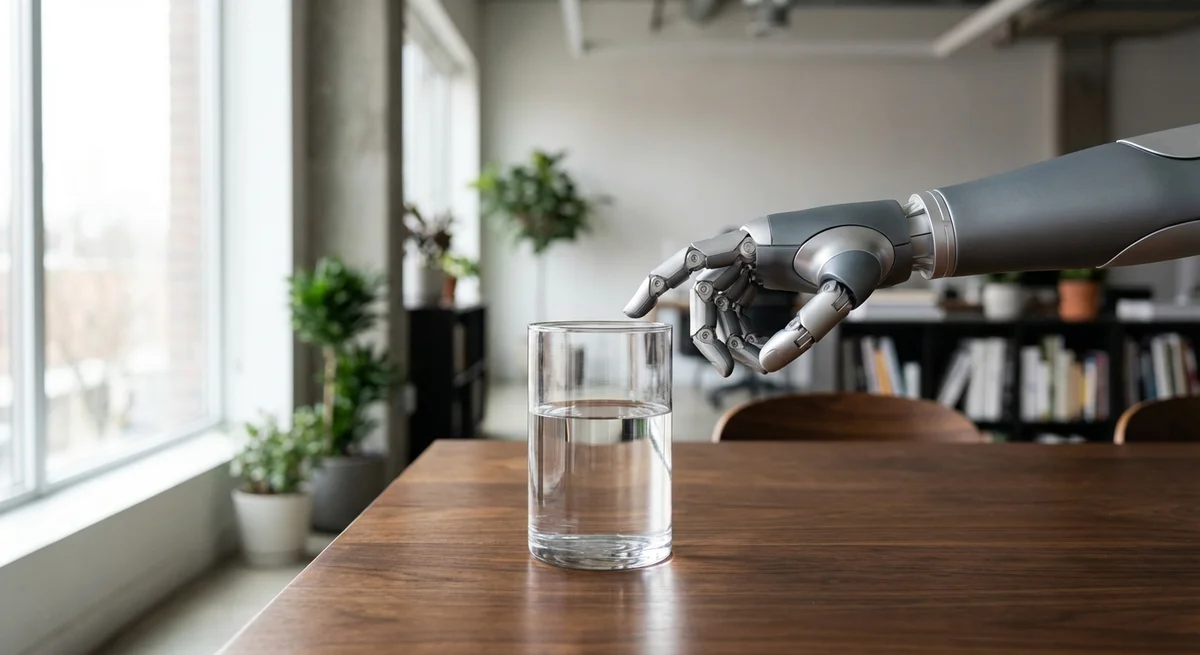
Imagine you bought a helper robot for a couple of tens of thousands of dollars, and on day one it smashed into a panoramic window, or tried to grab thin air instead of a glass of expensive Chardonnay. Funny? Only if it isn't happening in your home. The problem of transparent objects has been the "Achilles' heel" of robotics for years. While we argue about whether AI will gain consciousness, engineers are struggling to get it to simply stop freezing up in front of an ordinary glass door. Recently, Chinese giant Ant Group decided it was time to close this gestalt and presented its first serious research in embodied intelligence (Embodied AI).
Why is this a problem at all? Most modern robots rely on lidars and RGB-D cameras. Lidars work by reflecting a laser beam: if the beam passes through glass or refracts chaotically, the robot concludes there is nothing in front of it. Depth cameras also go haywire trying to compute the distance to a transparent surface. The result is advanced machines that behave in an ordinary living room like disoriented kittens. Ant Group has proposed a framework that combines visual data and deep learning to correctly reconstruct the shape and position of transparent objects in space.
Ant Group's entry into this niche looks like a logical continuation of its strategy. After regulators cooled the ardor of its fintech business, the company began actively diversifying its portfolio toward foundational technologies. Embodied intelligence research is not just an attempt to build a robot waiter. It is a fight for leadership in the next technological order, where AI moves beyond chatbots and starts manipulating physical objects. The fact that Ant immediately released its work as open source suggests a desire to quickly build a developer community around itself and set industry standards.
Looking at the proposed solution, you see that the focus has shifted from simple pattern recognition to understanding the physics of light. Ant Group's algorithms train neural networks to predict how light will refract through a transparent medium. This lets the robot not merely "see" glass but understand its volume and boundaries. For the industry, this means a qualitative leap: from warehouse robots working in sterile conditions with cardboard boxes, we are moving toward household helpers that can interact sensibly with the fragile and complex world of human homes.
What does this mean for us? Most likely, within the next couple of years we will see a wave of new startups using this open code to build smarter robot vacuums, manipulators and even autonomous carts for shopping malls. China is once again proving that its approach to innovation is not only about copying, but also about solving fundamental engineering problems that Western companies sometimes sidestep, preferring to focus on software. Ant Group is clearly signaling that it is here in earnest and for the long haul, and its ambitions extend far beyond digital wallets.
Bottom line: Ant Group has successfully entered the territory of physical AI by solving the "invisibility" of glass. The open-source release will speed up the arrival of robots that finally stop being a threat to your windows and dishes. Will this be the beginning of the end for specialized sensors in favor of pure machine vision?
- Nov 2, 2026Karpathy builds a YouTube clone with 6454 videos from Hacker News recommendations in two hours
- Nov 2, 2026Karpathy used Claude to build HackerTube from 6,454 videos recommended on Hacker News
- Nov 2, 2026Arca gives AI agents finance tasks lasting up to 10 days, but leaves the trades to humans
- Nov 2, 2026DeepSeek open-sources Super-agent prototype: p95 task completion time of 15.7 minutes vs. 29.5
Test Frontier LLMs & Autonomous Agents in One Workspace
Run Claude Opus 5.5, GPT-6, Gemini 3.1, and DeepSeek side-by-side in Nomad AI (nomadnet.ai) — unified model routing, deep research, and multimodal workflows under one subscription.
The AI world, distilled — once a week
Seven stories that actually mattered, hand-picked. No noise, no reposts, no press releases.
Done! Check your inbox for a confirmation.