LingBot-VA: Ant Group Teaches Robots to Think, Not Just Imitate
A unit of Ant Group has unveiled LingBot-VA, an open world model for embodied intelligence. Unlike older motion-imitation methods, the system builds an internal map of physical interactions. On complex tasks, it outperforms the popular Pi0.5 by 20%. It is an important signal for the industry: robotics is moving from simply copying human actions to a deeper understanding of space. The model's open-source status could make it a standard for humanoid developers, while OpenAI and Google keep their secrets under lock and key.
AI-processed from Jiqizhixin (机器之心); edited by Hamidun News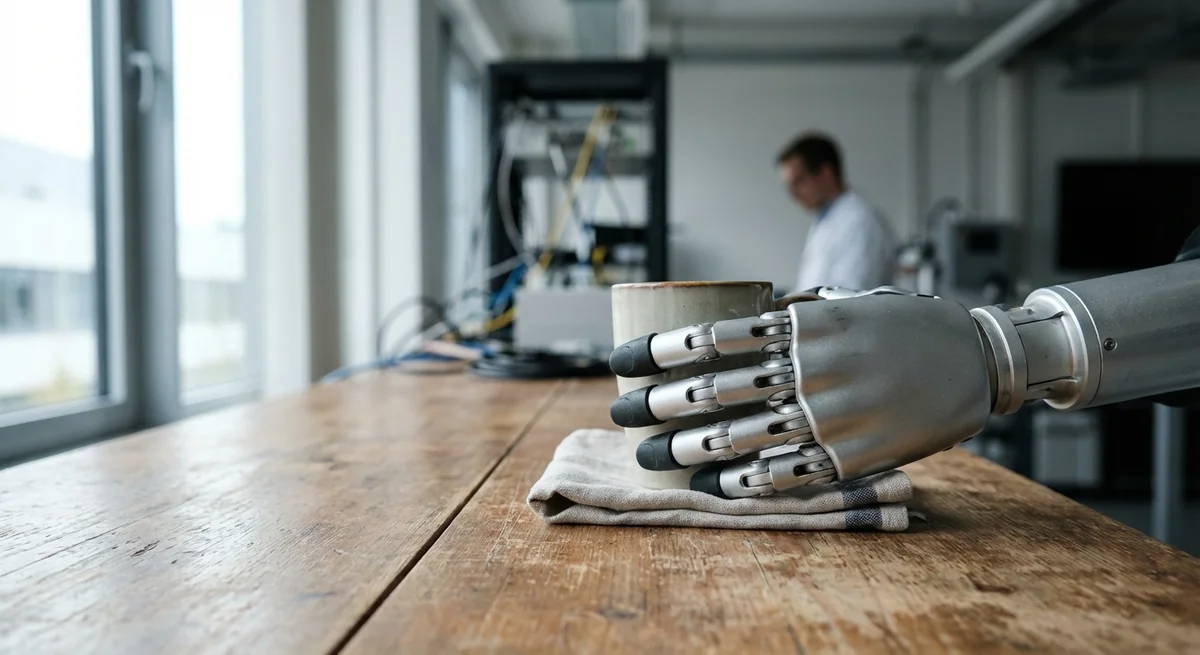
While we debate whether ChatGPT will replace programmers, Ant Group's labs are tackling a far more down-to-earth but difficult problem: how to get a robot to avoid slamming into a wall and carefully move a cup. The new LingBot-VA model is not just another software update but a serious bid for leadership in embodied intelligence. Robots used to be trained like dogs, with a "do as I do" approach. Now researchers are trying to teach them to think like physicists. Progress here is measured not by text quality but by a machine's ability not to break a glass in an unfamiliar setting.
The problem with modern robots is not the hardware. Motors and servo drives have long allowed engineers to build remarkable things, but the problem has always been the "brains." Most systems still rely on Behavior Cloning. The robot sees an image, recalls what a human did in a similar situation, and tries to imitate the movement. But if the lighting changes or an object shifts by a couple of centimeters, the algorithm breaks.
LingBot-VA takes a different path, using the concept of a world model. The robot literally simulates possible futures in its virtual head before moving its manipulator.
The numbers speak for themselves. The developers claim that in complex scenarios, where the robot must do more than grasp and show some spatial ingenuity, LingBot-VA scores 20% higher than the well-known Pi0.5 model. That is a huge gap in an industry where the fight is usually over fractions of a percent. Ant Group has managed to combine visual perception with a deep understanding of physical interactions. For the rest of us, this means the era of robot vacuums helplessly stuck on a carpet is gradually ending, giving way to systems able to navigate the chaos of an ordinary home.
The decision to make LingBot-VA an open project deserves special attention. AI now has a clear split. On one side are closed ecosystems such as OpenAI, which jealously guard their weights and architectures. On the other are open-source advocates who believe real progress is impossible alone. By releasing LingBot-VA freely, the Chinese engineers are effectively inviting the whole world to fine-tune their model. It is a classic strategic move: become the foundation for hundreds of startups and turn your technology into an industry standard while competitors try to monetize closed access.
Why does this matter right now? We are on the threshold of a humanoid robot boom. Tesla, Figure and Boston Dynamics are competing over whose creation looks more human and moves more smoothly. But appearance is secondary. Without an adequate world model, any humanoid remains just a very expensive and dangerous toy. LingBot-VA narrows the gap between theory and practice by giving machines an understanding of cause and effect.
China's AI school is once again showing that it can do more than copy quickly: it can set the pace in the most difficult disciplines. The question remains: how quickly will Western labs present their answer, and will it be just as accessible to independent developers?
Bottom line: Open source in robotics is becoming a new force. While the giants build walls, Ant Group is handing out the blueprints of the "brains" for the robots of the future. Are we ready for the next AI breakthrough to come not from Silicon Valley but from Hangzhou?
- Nov 2, 2026Meta's Muse assistant keeps dossiers on loved ones and gets root on Ubuntu by default
- Nov 1, 2026Local models lose to Opus and Codex: 0.21 on a MacBook versus 1.00 for Codex
- Nov 1, 2026Kimi scores 96.2% on a 1C database analytics test and emerges as a fallback if Claude access is blocked
- Nov 1, 2026OpenAI Rewrites GPT Behavior Rules: Five Values and a Chain of Command
Test Frontier LLMs & Autonomous Agents in One Workspace
Run Claude Opus 5.5, GPT-6, Gemini 3.1, and DeepSeek side-by-side in Nomad AI (nomadnet.ai) — unified model routing, deep research, and multimodal workflows under one subscription.
The AI world, distilled — once a week
Seven stories that actually mattered, hand-picked. No noise, no reposts, no press releases.
Done! Check your inbox for a confirmation.