Tesla: Why Elon Musk Is Turning Car Factories into Data Centers
Tesla is changing its strategy in China. By 2026, the company plans to flood the market with investment in AI software, hardware and energy. Vice President Tao Lin confirmed that global spending will exceed $20 billion. The focus is shifting from electric cars to the driverless Cybercab, humanoid robots and Megapack systems. A giant energy storage factory is already under construction in Shanghai. This is not just an expansion but a final transformation into an AI corporation. Cars are now merely "carriers" for intelligence. The bottom line: Musk is betting that in the future, software and energy will matter more than the hardware itself.
AI-processed from 36Kr (36氪); edited by Hamidun News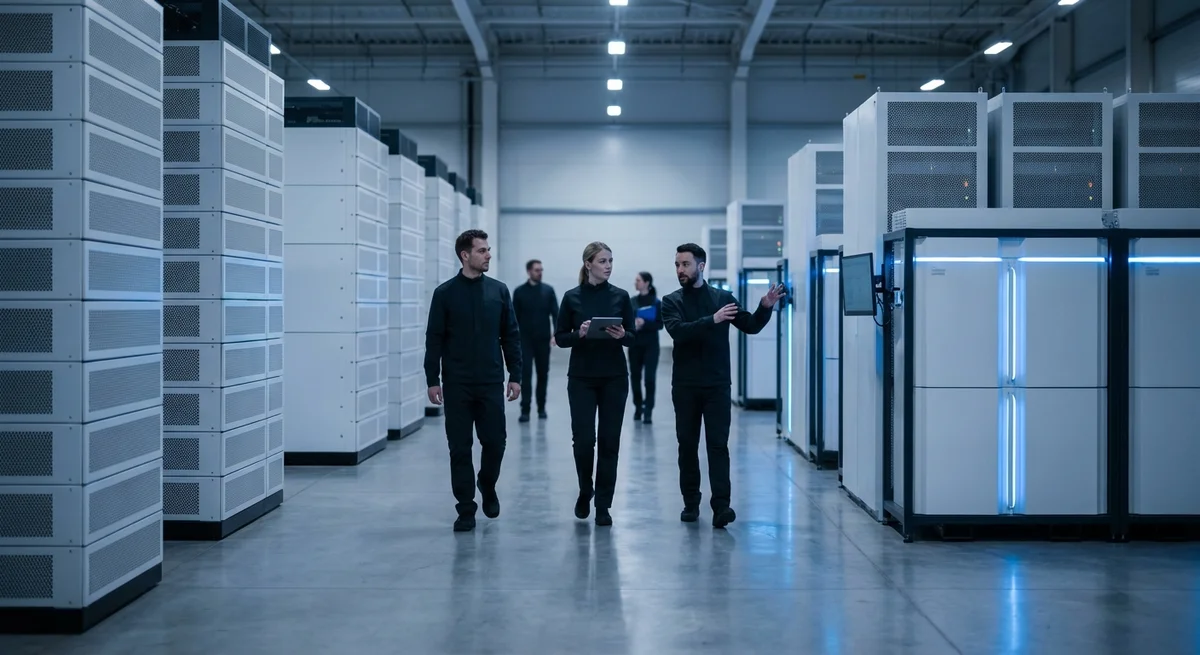
If you still think Tesla is a company that simply assembles good-looking electric cars with a big tablet inside, Vice President Tao Lin has news for you. At a recent meeting in Beijing, she said bluntly that the era of "just cars" is over. By 2026, Tesla intends to become a giant resting on three pillars: artificial intelligence, robotics and energy. And China is not merely an assembly shop here, but the main proving ground for the new reality.
Let's go through the numbers, because they impress even those used to Elon Musk's appetites. Tesla's global capital expenditure in 2026 will top $20 billion. Where will the money go? Not to new production lines for the Model 3. The main flow of funds will go to computing capacity for AI, factories that build humanoid robots, and preparation for mass production of the Cybercab robotaxi. To make all this "fly," Tesla has already set up local neural network training centers in China, which fine-tune the autopilot for the specific and, frankly, chaotic traffic of the country's megacities.
Notably, the company has begun to admit openly that the car is only a temporary form of existence for its AI. Tao Lin stressed that the car remains the most important "carrier" of intelligence, but the company's vision is now broader. It is an attempt to build a global ecosystem in which Optimus robots work in factories and Cybercab driverless vehicles carry people, while all of this infrastructure runs on intelligent power grids. Musk is betting that the world of the future will be fully electrified, and that a single AI brain will manage both the electricity and the hardware.
The energy side deserves separate attention. While competitors try to squeeze an extra 50 kilometers out of a battery, Tesla is building a super-factory for energy storage in Shanghai. The product, called Megapack, will become a key export item for Asia-Pacific and European markets. The logic is simple: AI data centers need colossal amounts of energy, and old power grids will not cope with such a load. Tesla wants to sell not only the "brains" in the form of software, but also the "food" for those brains in the form of energy storage systems.
Essentially, we are watching Tesla try to escape the trap of the classic auto industry, where margins fall under pressure from Chinese brands such as BYD or Xiaomi. Instead of getting dragged into price wars over hardware, the company is moving into high-value-added territory: software and infrastructure. If the plan works, then in a couple of years buying a Tesla will be seen not as buying a means of transport, but as subscribing to a global neural network that also happens to drive you to work. The only question is whether Musk can deliver on these ambitions before Chinese tech giants copy his approach.
The bottom line: Tesla is officially ceasing to be a carmaker and joining the league of AI infrastructure companies. Can Musk convince investors that robotaxis and mega-batteries will bring in more profit than Model Y sales?
Test Frontier LLMs & Autonomous Agents in One Workspace
Run Claude Opus 5.5, GPT-6, Gemini 3.1, and DeepSeek side-by-side in Nomad AI (nomadnet.ai) — unified model routing, deep research, and multimodal workflows under one subscription.
The AI world, distilled — once a week
Seven stories that actually mattered, hand-picked. No noise, no reposts, no press releases.
Done! Check your inbox for a confirmation.