Waymo and Tornadoes: How Google DeepMind Is Teaching Driverless Cars to Survive Chaos
Waymo's driverless cars are reaching a new level of safety thanks to Genie 3, a neural network from Google DeepMind. Instead of waiting for rare accidents on real roads, engineers build "world models": hyperrealistic, interactive 3D spaces where a car can run into a tornado or a herd of elephants. Genie 3 generates these worlds from text descriptions, letting Waymo rehearse scenarios that happen once in a hundred years in reality. That targets the central problem of autonomous driving: edge cases, where algorithms usually break. While competitors log miles of boring trips, Waymo trains its cars in a controlled digital hell.
AI-processed from The Verge; edited by Hamidun News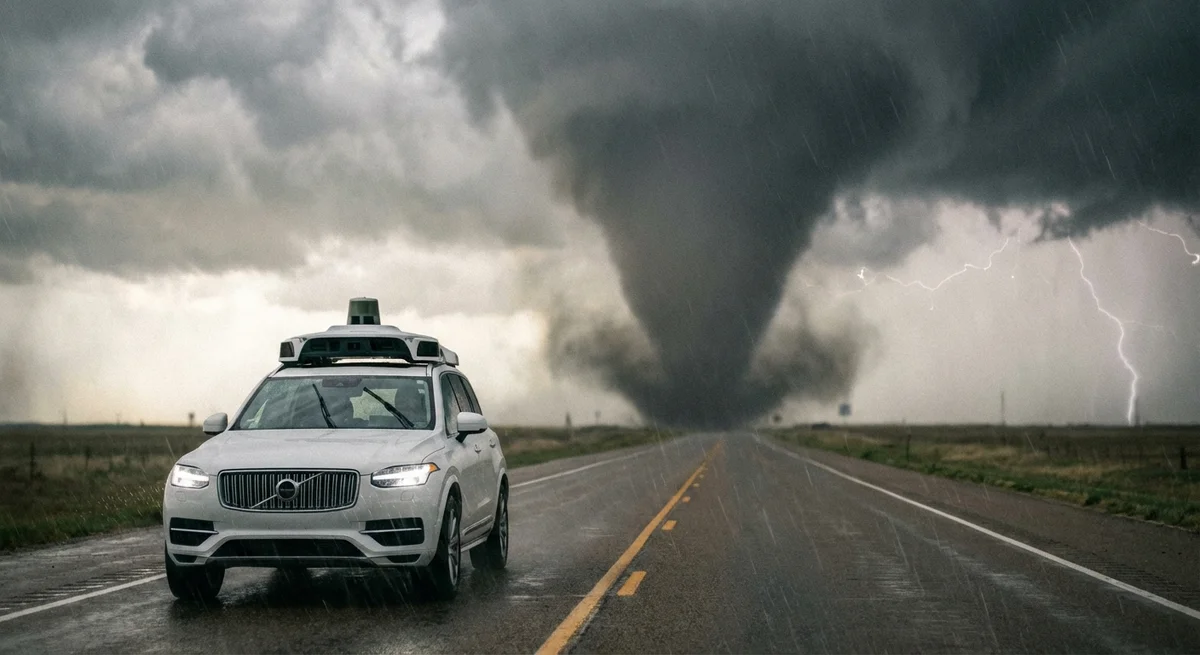
Picture an empty highway somewhere in Oklahoma at sunset. Suddenly a giant tornado descends from the clouds straight ahead. What should a driverless car do? Engineers used to have two options: wait years for a real disaster, hoping their test vehicle happened to be nearby and survived, or try to hand-code the physics of wind and debris in an old game engine. Waymo chose a different path and joined forces with the specialists at Google DeepMind. Together they built a system based on Genie 3, a neural network that turns text prompts into interactive and eerily realistic 3D worlds.
Genie was originally conceived as a fun toy for generating simple platformers in the spirit of Super Mario. But DeepMind quickly realized that if a model can grasp the physics of a pixel character's jump, it can also handle the dynamics of a multi-ton truck on an icy road. For Waymo, this is not just another graphics upgrade for its simulator. It is a move toward full-fledged "world models" adapted to the harsh demands of real-world traffic. Developers can now write literally any craziness into a scenario, from an elephant running onto the highway to a sandstorm, and watch how the AI behaves.
The problem is that teaching a driverless car to drive around sunny San Francisco or Phoenix is not that hard today. The real challenge for the industry is so-called "edge cases": events that happen once in a million miles but cause fatal accidents. Collecting data on such incidents on real roads is physically impossible, too expensive and simply dangerous for bystanders. With Genie 3, Waymo can generate thousands of variations of the same dangerous scenario at the snap of a finger, forcing its algorithms to learn from their mistakes in a virtual world.
The key difference between Genie 3 and classic simulators is that the network creates an environment that reacts to the agent's actions. If the simulated car swerves sharply or hits the brakes, the world around it changes according to the physics the network predicts. This is an attempt to teach artificial intelligence the cause-and-effect relationships of our reality, rather than just copying human drivers' behavior from a template. It is a fundamental shift in how we approach the safety of autonomous systems.
The move looks like a direct answer to skeptics and competitors, including Tesla. While Elon Musk bets on mass data collection from millions of ordinary trips by his customers, Waymo is going deep into theory and extreme simulation. It is a classic clash of approaches: brute force versus intellectual preparation in the lab. If Waymo manages to prove that its "digital twins" of chaos reflect reality adequately, regulators may become far more receptive to a large-scale launch of driverless robotaxis.
Of course, an open question remains: how accurately do the hallucinations of the Genie 3 neural network match the real physics of a tornado or the behavior of a frightened animal? If the model miscalculates tire grip on a road in the rain, training in such a simulation could even do harm by instilling false skills in the algorithm. But given DeepMind's expertise in deep learning, this is arguably the most serious attempt in recent years to build a full-fledged proving ground for AI.
The bottom line: Waymo is moving the arms race from the real world into virtual simulations. Will other companies be able to build world models of the same quality, or will driverless safety become a monopoly of those with access to Google's compute?
- Nov 2, 2026Bun creator uses Claude Code to port 750K lines from Zig to Rust in 11 days
- Nov 2, 2026The Verge reviewer builds a $50 Meta Muse Charm alternative with Claude Code
- Nov 1, 202616 models tested on 7 search tools: Exa averaged 10.5 out of 14, SearXNG about 3
- Nov 1, 2026Google's StreamVibe video agent beats other models by 10.7% on response timing and quality
Test Frontier LLMs & Autonomous Agents in One Workspace
Run Claude Opus 5.5, GPT-6, Gemini 3.1, and DeepSeek side-by-side in Nomad AI (nomadnet.ai) — unified model routing, deep research, and multimodal workflows under one subscription.
The AI world, distilled — once a week
Seven stories that actually mattered, hand-picked. No noise, no reposts, no press releases.
Done! Check your inbox for a confirmation.