Waymo and DeepMind Are Building "The Matrix": Why Self-Driving Cars Need to Imagine Crashes
Waymo and Google DeepMind have unveiled Genie 3, a generative world model that turns ordinary road footage into interactive simulators. Instead of waiting for rare crashes to happen in real life, the AI fills in dangerous scenarios on its own and learns from them. This tackles the industry's biggest problem: the "long tail" of rare events that cars almost never encounter on real roads but still have to handle. Robotaxis now do more than drive. They constantly play out how a situation might unfold, and that imagination makes them safer.
AI-processed from Jiqizhixin (机器之心); edited by Hamidun News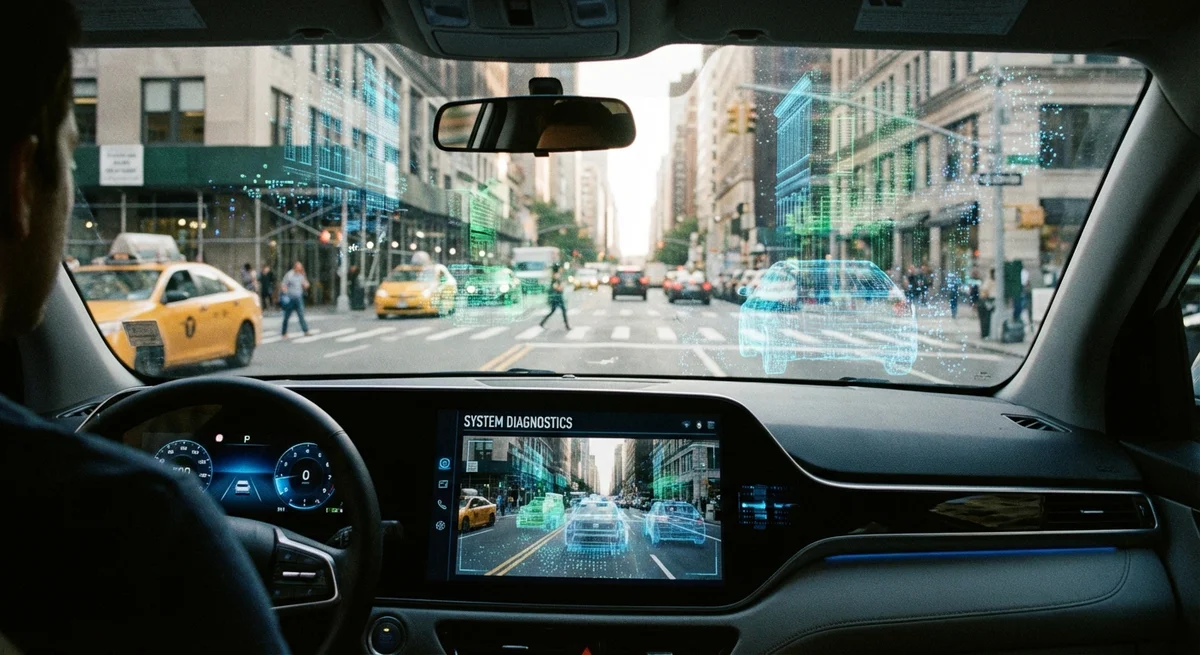
Imagine teaching a child to cross the street. Instead of waiting years for a reckless driver to speed past or a piano to fall out of a truck, you put a VR headset on them that generates these nightmares on demand. That is roughly what Waymo and Google DeepMind are doing now.
They decided that reality doesn't provide enough data to train a truly safe self-driving car, so they built Genie 3, a generative world model that can "imagine" traffic situations. Every modern autonomous driving system runs into the same wall: the so-called "long tail." Self-driving cars handle typical traffic on a sunny day just fine, but they stumble on anomalies such as a kangaroo darting onto the road or oranges scattered across the asphalt.
Collecting enough of these examples in the real world is physically impossible and dangerous. Engineers used to draw such scenes by hand in video-game-style simulators, but those always ended up too sterile and too far removed from real life. Genie 3 changes the rules.
It isn't a video player; it's a full neural network environment. The model takes a short clip of real footage from Waymo's cameras and turns it into an interactive sandbox. Engineers can tell the model, "Now have that car suddenly cut us off," and Genie 3 redraws the footage in real time while respecting the laws of physics and keeping the visuals realistic.
The self-driving car inside this simulation can react to the changes, and the model then generates how the surrounding environment responds. This is the "world model" people talk about so much in the context of GPT-5 and the future of AI. Technically, Genie 3 is built on an architecture that understands cause and effect.
It doesn't just shuffle pixels: it understands that if a car hits the brakes, the distance to it should shrink. That lets Waymo train its algorithms under "controlled hallucinations." While competitors rack up millions of real-world miles hoping to run into something unusual, Waymo simply generates the experience it needs on DeepMind's servers.
The move to world models marks a fundamental shift in robotics. The field is moving away from simply copying human driver behavior and toward teaching systems how reality works. If an AI understands how the world works, it doesn't need to see a thousand crashes to grasp the danger of an object flying at the windshield.
The irony is that hallucinations were long considered neural networks' worst enemy. Now the ability to "hallucinate" on a given topic is becoming the key to building the safest driver in history. The bottom line: Waymo is shifting from collecting data to synthesizing it at industrial scale.
If this bet on Genie 3 pays off, physical road tests will become a mere formality for a system that has already lived millions of lives in a digital "Matrix." Can anyone catch up with Google without access to that kind of compute and generative-model expertise?
- Nov 2, 2026Bun creator uses Claude Code to port 750K lines from Zig to Rust in 11 days
- Nov 2, 2026The Verge reviewer builds a $50 Meta Muse Charm alternative with Claude Code
- Nov 1, 202616 models tested on 7 search tools: Exa averaged 10.5 out of 14, SearXNG about 3
- Nov 1, 2026Google's StreamVibe video agent beats other models by 10.7% on response timing and quality
Test Frontier LLMs & Autonomous Agents in One Workspace
Run Claude Opus 5.5, GPT-6, Gemini 3.1, and DeepSeek side-by-side in Nomad AI (nomadnet.ai) — unified model routing, deep research, and multimodal workflows under one subscription.
The AI world, distilled — once a week
Seven stories that actually mattered, hand-picked. No noise, no reposts, no press releases.
Done! Check your inbox for a confirmation.