Samsung to pay memory staff £310,000 bonuses on the back of the AI boom
Samsung will pay employees in its memory division an average bonus of £310,000 each under a new profit-sharing agreement, driven by soaring revenue from the global AI boom. The unions backed the deal: 74% of the 62,000 employees voted in favor. The agreement shows how accelerating demand for AI chips is changing the earnings of the world's largest memory makers.
AI-processed from Guardian; edited by Hamidun News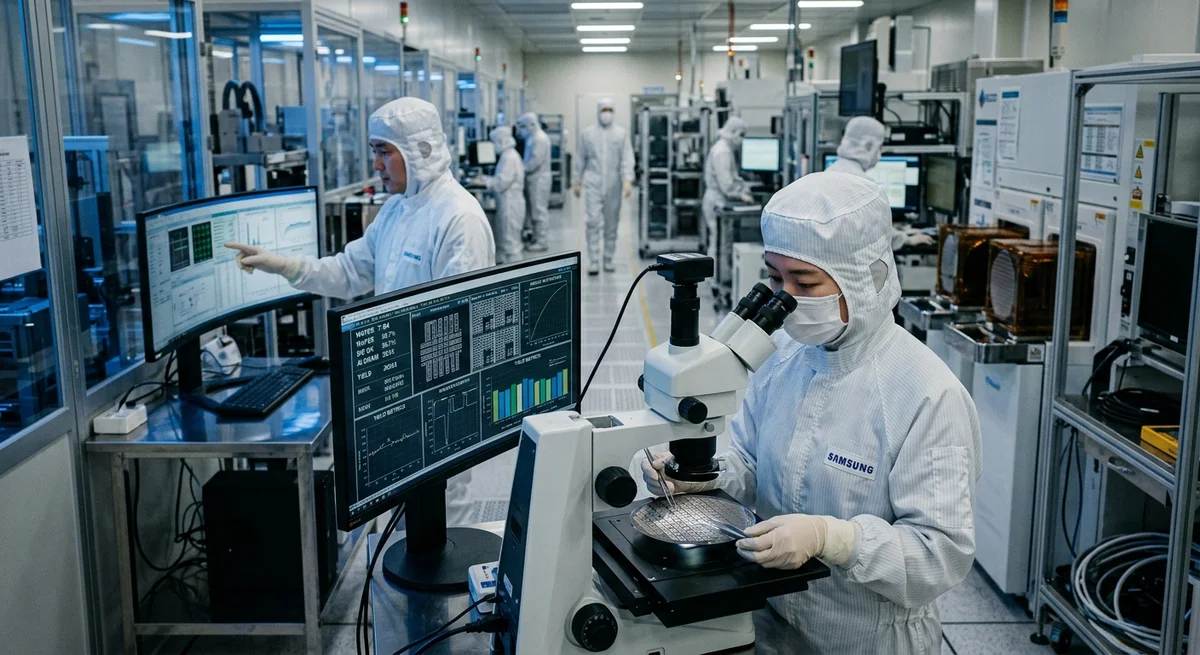
Samsung will pay its memory division employees record bonuses under a profit-sharing agreement born of the AI boom. The final deal shows how quickly semiconductor makers' revenue is growing on the back of demand for artificial intelligence, and how willing companies are to reward workers generously for their part in that prosperity.
Bonuses on a trillion-won scale
Samsung's two major unions have told employees that the long negotiations ended successfully. Each of the 62,616 memory division workers will receive an average bonus of £310,000, a sum that makes the job attractive to many. The vote showed convincing support: 74% of those who voted approved the agreement, averting the threat of a large-scale strike.
This is not a typical bonus size for the electronics industry. The payouts became possible because Samsung's profitability has jumped in recent months. Demand for the memory chips needed to deploy AI systems and large language models has risen exponentially. Prices for DRAM (RAM) and NAND (flash memory) have hit all-time highs. As the world's largest memory maker, Samsung captures the bulk of this enormous revenue stream, and it is now sharing the proceeds with the workers who build the product.
Competition for talent and stability
Over the past two years, all the major semiconductor makers, including Samsung, SK Hynix, TSMC and Intel, have competed fiercely for talented engineers and technicians, who have become a critical resource in a fast-growing industry. The shortage of skilled staff has pushed wages up and set off an intense fight for the best specialists.
Samsung faces especially sharp pressure: its production capacity is running at the limit, and any line stoppage costs the company billions in lost sales. If the union had called a strike, Samsung could have lost billions given such extraordinary demand for its products. The generous bonuses are therefore a strategic investment in production stability.
The payments also strengthen worker loyalty at a company known for its demanding corporate culture. Keeping production sites stable during the AI boom is not merely desirable; it is a critical necessity.
The trillion-dollar club and the new reality of memory
Two weeks ago, Samsung and its main rival SK Hynix joined the so-called trillion-dollar club, the group of companies with a market capitalization above $1 trillion. It happened almost simultaneously and became a vivid symbol of the upheaval in the industry.
Memory makers were previously seen as a boring, low-margin corner of the electronics industry, producing a "commoditized" product. Today it is one of the most profitable and fastest-growing sectors in all of electronics. The shift is driven by explosive demand for AI computing power. Demand for chips is growing much faster than production capacity can expand:
- Nvidia and AMD are expanding GPU production to serve growing demand for AI compute
- TSMC, Samsung and Intel are competing for contract manufacturing orders on advanced nodes for new AI chips
- DRAM and NAND prices remain at all-time highs because of an acute supply shortage
- Investment in new fabs has reached record levels, with companies putting hundreds of billions into expanding production capacity
What this means
Samsung's deal shows that the AI boom is not confined to software companies and startups. It is fundamentally transforming the economics of hardware and the entire supply chain. The benefit of AI demand flows up the supply chain, reaching memory and processor makers. Now that benefit is starting to be shared with the workers who build these critical components.
But behind this optimism lies a deeper signal: the industry is at the peak of a cyclical demand. When demand for AI chips eventually levels off, prices will inevitably fall, profits will shrink, and such generous bonuses may become a rarity.
- Nov 1, 2026Voice bots built on LLMs turn to Jev, a fast classifier, for decisions in 200–500 ms
- Nov 1, 2026MoneyGate safety layer blocked all 42 fraudulent requests to local AI models
- Oct 31, 202622B-Parameter LTX-2.5 Runs on a 10 GB RTX 3080, but Takes 5 Minutes per Shot
- Oct 30, 2026Mistral opens Large 4 weights: strong at code, but Chinese models score 32 to its 26
Key Questions Answered
What are the key details on Bonuses on a trillion-won scale?
Samsung's two major unions have told employees that the long negotiations ended successfully. Each of the 62,616 memory division workers will receive an average bonus of £310,000, a sum that makes the job attractive to many. The vote showed convincing support: 74% of those who voted approved the agreement, averting the threat of a large-scale strike. This is not a typical bonus size for the electronics industry. The payouts became possible because Samsung's profitability has jumped in recent months. Demand for the memory chips needed to deploy AI systems and large language
What are the key details on Competition for talent and stability?
Over the past two years, all the major semiconductor makers, including Samsung, SK Hynix, TSMC and Intel, have competed fiercely for talented engineers and technicians, who have become a critical resource in a fast-growing industry. The shortage of skilled staff has pushed wages up and set off an intense fight for the best specialists. Samsung faces especially sharp pressure: its production capacity is running at the limit, and any line stoppage costs the company billions in lost sales. If the union had called a strike, Samsung could have lost billions given such extraordin
What are the key details on The trillion-dollar club and the new reality of memory?
Two weeks ago, Samsung and its main rival SK Hynix joined the so-called trillion-dollar club, the group of companies with a market capitalization above $1 trillion. It happened almost simultaneously and became a vivid symbol of the upheaval in the industry. Memory makers were previously seen as a boring, low-margin corner of the electronics industry, producing a "commoditized" product. Today it is one of the most profitable and fastest-growing sectors in all of electronics. The shift is driven by explosive demand for AI computing power. Demand for chips is growing much fast
Test Frontier LLMs & Autonomous Agents in One Workspace
Run Claude Opus 5.5, GPT-6, Gemini 3.1, and DeepSeek side-by-side in Nomad AI (nomadnet.ai) — unified model routing, deep research, and multimodal workflows under one subscription.
The AI world, distilled — once a week
Seven stories that actually mattered, hand-picked. No noise, no reposts, no press releases.
Done! Check your inbox for a confirmation.