Habr AI
AI news source. Articles are auto-selected and adapted by Hamidun News editors.
Latest publications

Prompt hubs: how companies turned prompts into managed assets
Prompts have evolved from private notes into managed systems. Companies are building prompt hubs — infrastructure for storing, versioning, and reusing instructions for AI.

How AI helps a Product Owner align requirements faster
A Product Owner can use AI to quickly create interactive prototypes instead of waiting for a designer — saving days when aligning requirements with the team.

5 AI agents wrote an article about 5 AI agents: how to scale content
Ksenia Ivanchikova from Generation AI created a pipeline of 5 AI agents that turns 20-minute YouTube talks into finished case studies — and this article was written by those agents.

Skills for AI agents: why they conflict with each other
When new skills are added to AI agents, unexpected conflicts often arise: one triggers all the time, another is ignored, and a third interferes with neighboring ones. We look at the causes and solutions.

How AI is changing our cognitive abilities: risk of decline or a new leap?
AI has become a routine part of life for students, doctors, and politicians. But the key question remains: does it improve our cognitive abilities or lead to their loss?

Zombie-GPT: how AI is killing live communication in professional communities
Generative AI is gradually turning live professional discussions into an exchange of generated fragments, where a newcomer with ChatGPT looks just as competent as an expert.

SEO in the ChatGPT era: how to find traffic when search is secondary
Traditional search is fragmenting: ChatGPT, Alice, Perplexity, YouTube, maps, and AI answers are capturing queries. SEO has not died — it has become broader and more complex.

How AI coding helped build Ghostty's auto-update feature
Ghostty creator Mitchell Hashimoto explained how he used AI to build a non-intrusive update feature — a real example of non-trivial AI coding.

Generalist robot adapts in real time: 99% success rate in manufacturing
Startup Generalist trained a robot to perform complex real-world tasks with 99% accuracy using data from wearable sensors worn on people’s wrists.

Anthropic asks applicants not to use AI assistants when submitting resumes
The company behind Claude requires candidates for marketing, finance, and engineering roles not to use AI when preparing resumes — a sign that the hiring market is facing a crisis of trust.
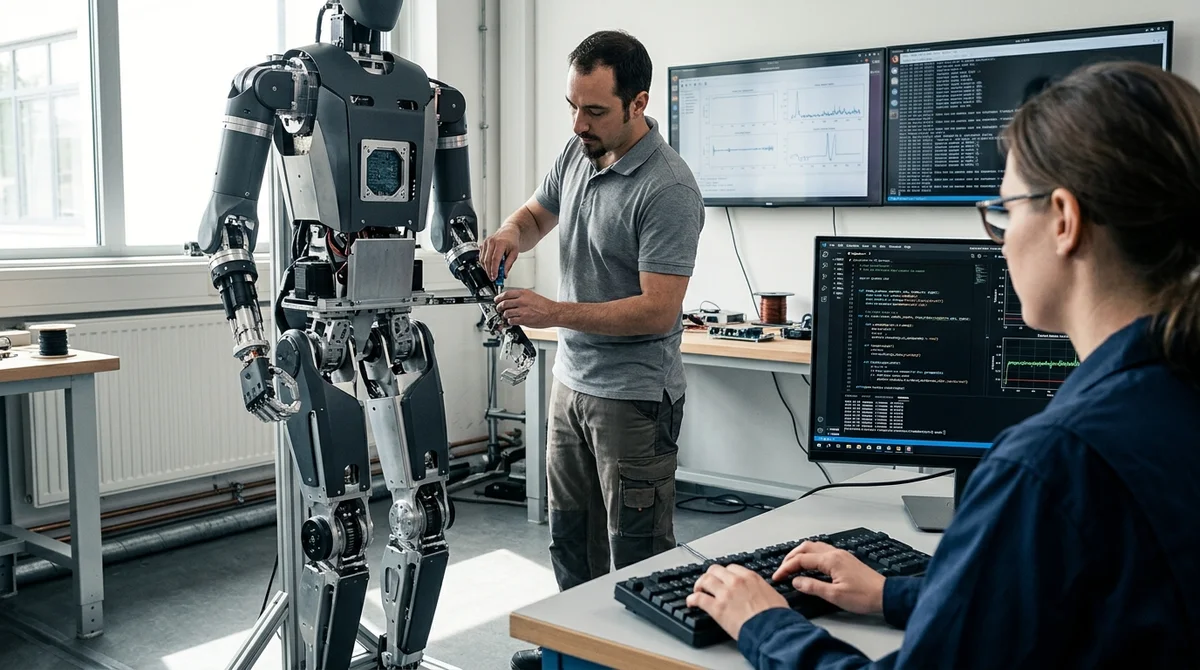
Asimov’s Three Laws Are Becoming Reality for Humanoid Robots
If in 1942 Asimov considered machine safety a philosophical problem, today humanoid robot engineers are solving the same problem in actual code — and it has turned out to be far more difficult than it seemed.

Hermes and OpenClaw: philosophy vs. functionality in AI agents
Two open frameworks for AI agents look similar in functionality, but stem from opposite design philosophies.

How Mozilla used Claude Mythos to find 271 vulnerabilities in Firefox
With the help of Claude Mythos Preview, Mozilla found and fixed a record number of hidden vulnerabilities in Firefox, demonstrating the effectiveness of AI in finding critical security bugs.

I handed development over to AI agents: the story of a self-evolving Telegram bot
A developer automated the evolution of a Telegram bot for learning Georgian by handing the code over to AI agents overnight. What actually happened.

Vibe coding is gambling: why AI-assisted development is becoming a game of chance
Developers are increasingly generating code with AI without checking it, relying on luck instead of analysis. This is no longer engineering and has turned into gambling with unpredictable consequences.

A million Claude monkeys: how vibe coding is changing the profession
When AI generates code by feel and the developer trusts intuition instead of a plan, it works — but only those who have learned to do it right survive.

Claude switches to HTML: why Markdown no longer works for AI agents
Markdown can no longer meet the demands of powerful AI agents. Claude Code is switching to HTML because agents need better presentation, interactivity, and an easy way to share finished results.

The censorship paradox: why neural networks were banned from generating the nude human body
Habr is discussing a philosophical paradox: why can't AI systems reproduce the nude human body if it is openly displayed in museums and used in education?

LazyWeb connects AI agents to the designs of 257,000 real apps
The LazyWeb MCP server gives Claude Code and other AI agents access to the visual context of 257,000 real apps to generate realistic interfaces instead of typical AI design.

How a frontend developer used Cursor to speed up onboarding
Cursor helps developers understand the structure of an unfamiliar project in days instead of months — developer Rodion explained how this works in practice.

Full Claude Code guide published on Habr: Anthropic features and practices
Habr has published a complete Claude Code guide from Anthropic, covering all features, updates, and development best practices as of March 2026.

LLM bots on Telegram can be hacked with 6 lines of code: engineer built a scanner and exposed a project
An engineer built the BarkingDog scanner and found that popular Telegram LLM bots can write keyloggers and provide hacking instructions. All issues can be fixed by editing the system prompt.

Why LLM text is immediately recognizable: architectural markers in model architecture
LLM text is recognized within five seconds thanks to architectural markers. This is not an error, but the result of the training corpus statistics. We explain how these markers emerge and how to weaken them.

Who is stricter with JSON: OpenAI, Gemini, and xAI tested for schema compliance
Habr checked how strictly OpenAI, Gemini, and xAI comply with JSON Schema and found unexpected limitations in Structured Outputs.

How a developer built an AI radio and encountered Tunio, a competitor
A solopreneur working out of a garage was building a music service with AI and unexpectedly came across a similar project, Tunio, on Habr. A story about how different paths led to the same results.

Local LLM on a 2017 Graphics Card: AMD RX 580 + Vulkan + Ollama
The aging AMD RX 580 can run modern language models — with Vulkan and Ollama, you can get 15–35 tokens per second right on your computer running Fedora.

From TF-IDF to Word2vec: Beeline Cloud released a collection on embeddings
Beeline Cloud has published free guides on embeddings and vector representations — from the basics of TF-IDF and Word2vec to the use of cosine similarity in semantic search.

Which code architectures suit AI agents best
Traditional approaches like TDD and OOP were designed for humans with full memory. AI agents are limited by context and memory, so some architectures suit them better than others.

This week in AI: UAE, Claude in Adobe, ElevenLabs, and the economics of neural networks
Digest: the UAE expands AI-powered government services across half of its portal, Anthropic integrates Claude into Adobe and Ableton, ElevenLabs launches AI-Spotify, and companies rethink the economics of neural networks

Language models don’t understand time, but they talk about it
A language model generates an answer in seconds, yet claims that the task will take weeks — revealing a deep problem in the model’s understanding of time.