Generalist robot adapts in real time: 99% success rate in manufacturing
Startup Generalist built a robot that works in manufacturing with 99% accuracy. The secret: the company collects data from inexpensive sensors on workers’ wrists, observes their real movements, and trains the machine to adapt. Even if the environment changes, the robot copes.
AI-processed from Habr AI; edited by Hamidun News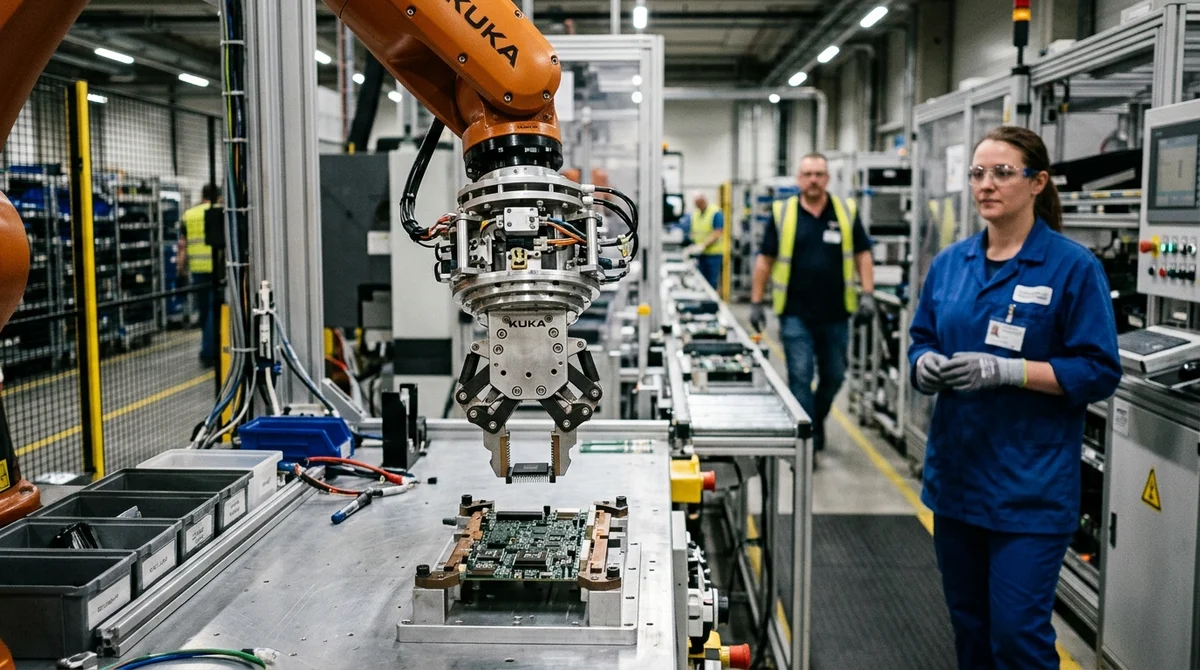
Robots on factory floors have worked like clockwork for years: learn the program, execute it perfectly a million times over. But reality is chaotic. Generalist startup promises to change that: their robot works with 99% accuracy even when everything goes off plan. The company was founded by a scientist from Google DeepMind, and Nvidia invested in it.
Why Old Robots Got Lost
Industrial robotic arms are perfect executors. Give them a program like "grab the part, screw in the bolt, put it in the box" — and they'll do it perfectly, without errors, a thousand times a day. The problem is that reality never matches the scenario.
The part lies at the wrong angle. A worker moved the table a few centimeters. An object ended up on the conveyor that's not in the program.
A robot programmed for specific coordinates and movements simply freezes or breaks expensive equipment trying to execute the instruction despite reality. This is the quiet crisis of the industry: robots are everywhere, but they only work in ideal factory conditions. Some wrench on the floor — and the entire automation stops.
Generalist's Solution: Learning from Humans
The company uses a simple but brilliant approach. They take cheap wearable sensors — inertial and motion sensors like fitness bracelets, but specialized for hands. They attach them to the wrists of regular workers.
Those workers do their job as usual. The sensors don't record video or instructions — they capture the pure physics of actions. Every joint angle, every acceleration, every touch of an object.
A worker grabs a part at the right angle? The sensor recorded it. Need to adapt to a new object?
The sensor saw how the human did it. Over months, these sensors collect millions of hours of real movements. Then Generalist fine-tunes the robot's neural networks: this movement pattern means "I'm grabbing the part at an angle."
And this one — "I'm adapting to an obstacle." The robot starts not just copying a learned program, but reproducing the logic of action.
- Data is collected in real-world conditions, not in a lab
- Sensors are cheaper than installing cameras throughout the factory
- The robot learns to adapt through examples, not through programming
- 99% success is achieved even when the environment changes
What This Means
If this works at scale, the industry will completely re-equip. Cheap, universal robots will stand where rigid automation couldn't be used before. Small production runs, areas with frequent changes, places where flexibility is needed. For workers, this means a shift: less routine operations, more management, tuning, preparation.
Want to stop reading about AI and start using it?
AI News is a curated feed of AI/tech news. Hamidun Academy teaches you to use AI systematically in your work.
The AI world, distilled — once a week
Seven stories that actually mattered, hand-picked. No noise, no reposts, no press releases.
Done! Check your inbox for a confirmation.