OlmoEarth v1.1: Allen AI releases satellite models that cost 3x less to run
Allen AI has released OlmoEarth v1.1, a new family of models for analyzing satellite data. The headline result: compute costs fall 3x with no loss in quality. The technical change is a rework of how satellite images are tokenized. The models already run in real-world projects: tracking forest loss, monitoring mangrove forests and identifying crop types around the world.
AI-processed from Hugging Face Blog; edited by Hamidun News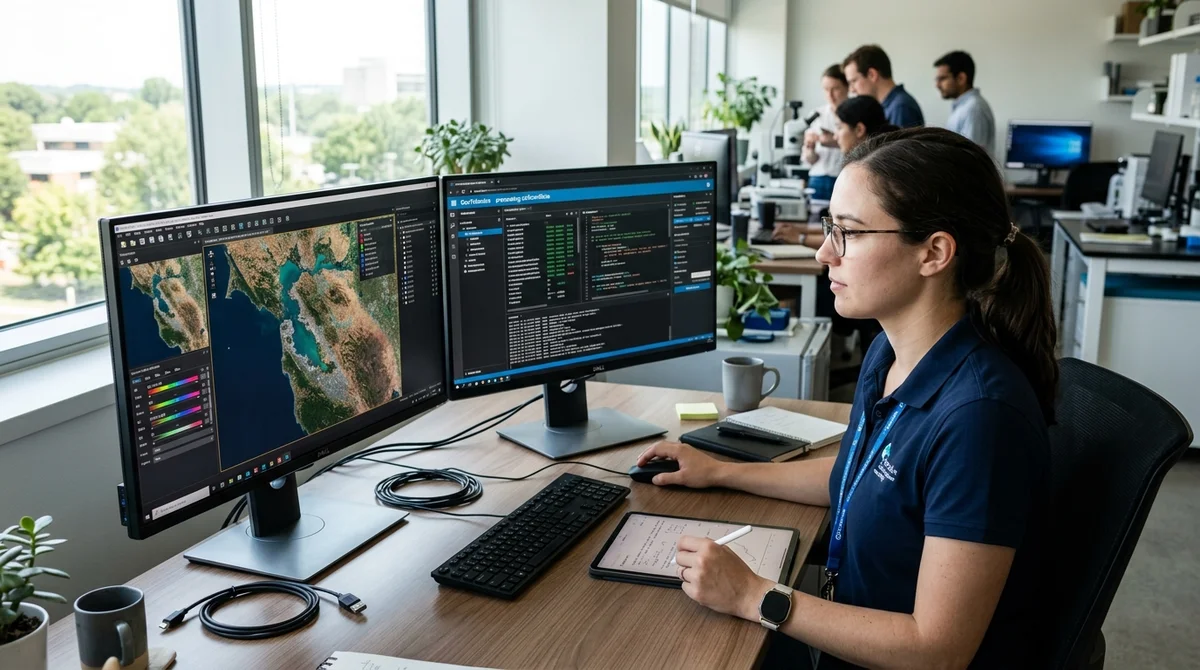
Allen AI has introduced OlmoEarth v1.1, an updated family of transformer models for analyzing Sentinel-2 satellite imagery. The main result: compute costs dropped 3x, while output quality stays at the level of the previous version.
How efficiency changed
OlmoEarth v1 came out in November 2025 and quickly drew the attention of researchers and developers. The model performed well: accurate classification of forest imagery, reliable identification of crop types, mangrove tracking. But there was a bottleneck: the compute cost of inference was a significant barrier to deployment in countries with limited budgets.
OlmoEarth v1.1 comes in three sizes: Base, Tiny and Nano. Allen AI managed to preserve performance while significantly reducing compute costs. This should make the model more accessible to companies and research groups that want to refresh satellite maps of the planet frequently.
The technical fix: reworked tokenization
The key to the efficiency gain is how satellite data is encoded into tokens for the transformer. In the original OlmoEarth v1, each satellite resolution (there were three: 10m, 20m and 60m) was encoded separately. Sentinel-2 data has the shape [H, W, T, D=12], where H and W are spatial dimensions, T is the number of time steps and D is the number of spectral bands. Each image patch at each time step produced 3 separate tokens.
Allen AI overhauled the approach: all resolutions are now merged into a single token per patch per time step. That immediately cut the token count 3x. This matters for transformers because their compute cost grows quadratically with sequence length: half as many tokens means four times less memory and time.
But there was a risk. When the team first simply merged the tokens, quality fell by 10 percentage points on the m-eurosat benchmark (land-type recognition). Crudely merging different spectral bands destroyed relevant relationships in the data.
Allen AI solved the problem by reworking its pretraining method. The model now learns from a single token, yet retains an understanding of the relationships between different spectral bands despite their merging.
What this delivers in practice
Inference on OlmoEarth v1.1 is 70% cheaper and faster than on the original version. For developers, that means paying cloud providers less for GPUs, updating maps faster and experimenting with new datasets more cheaply.
For researchers, the new version is valuable for a different reason. It is a controlled experiment: only one thing changes, the token design, while everything else (datasets, training approach, core architecture) stays the same. Experiments like this help show which components are truly critical:
- Which aspects of the transformer architecture affect the result
- How the quality of the pretraining dataset matters
- Which pretraining methods are most effective
- How to balance model size against quality
What's next
The models are already deployed in real projects around the world. Partner companies use OlmoEarth to track forest degradation in the tropics, monitor changes in mangrove forests and identify crop types. Each of these applications is critical for conservation and land-use planning.
Allen AI has open-sourced not only the models but also the training code. This lets researchers reproduce the results, fully understand the details of the pretraining method and develop their own architecture variants based on the published approach. The models are available in three sizes (Base, Tiny, Nano), so users can pick the best trade-off between quality and speed for a given task.
What this means
Satellite AI is moving from a narrow research niche to a mass-use tool. Cheaper means more accessible, which means faster deployment. For companies building services on satellite data, this opens a new price tier: millions of images can be processed more economically and global maps updated more often. For developing economies, where environmental monitoring is critical but budgets are limited, this may be a decisive factor.
Key Questions Answered
How efficiency changed?
OlmoEarth v1 came out in November 2025 and quickly drew the attention of researchers and developers. The model performed well: accurate classification of forest imagery, reliable identification of crop types, mangrove tracking. But there was a bottleneck: the compute cost of inference was a significant barrier to deployment in countries with limited budgets. OlmoEarth v1.1 comes in three sizes: Base, Tiny and Nano. Allen AI managed to preserve performance while significantly reducing compute costs. This should make the model more accessible to companies and research groups
What are the key details on The technical fix: reworked tokenization?
The key to the efficiency gain is how satellite data is encoded into tokens for the transformer. In the original OlmoEarth v1, each satellite resolution (there were three: 10m, 20m and 60m) was encoded separately. Sentinel-2 data has the shape [H, W, T, D=12], where H and W are spatial dimensions, T is the number of time steps and D is the number of spectral bands. Each image patch at each time step produced 3 separate tokens. Allen AI overhauled the approach: all resolutions are now merged into a single token per patch per time step. That immediately cut the token count 3x
What this delivers in practice?
Inference on OlmoEarth v1.1 is 70% cheaper and faster than on the original version. For developers, that means paying cloud providers less for GPUs, updating maps faster and experimenting with new datasets more cheaply. For researchers, the new version is valuable for a different reason. It is a controlled experiment: only one thing changes, the token design, while everything else (datasets, training approach, core architecture) stays the same. Experiments like this help show which components are truly critical: Which aspects of the transformer architecture affect the resul
Ship AI Faster with Founders, Engineers & Weekly Architecture Reviews
Inside Vibe Club (hamidun.com/club) — weekly live masterminds with Zhemal Khamidun, Tech Radar, full LMS access, and 370+ production Claude Code skills.
The AI world, distilled — once a week
Seven stories that actually mattered, hand-picked. No noise, no reposts, no press releases.
Done! Check your inbox for a confirmation.