How Robots Could Save China From a Demographic Crisis: A Barclays Forecast
Barclays has published an analysis concluding that deploying humanoid robots and automated systems could offset up to 60% of China's expected workforce decline by 2035. As the country's population shrinks rapidly, adopting robotics may become a critical factor in keeping China competitive.
AI-processed from Bloomberg Tech; edited by Hamidun News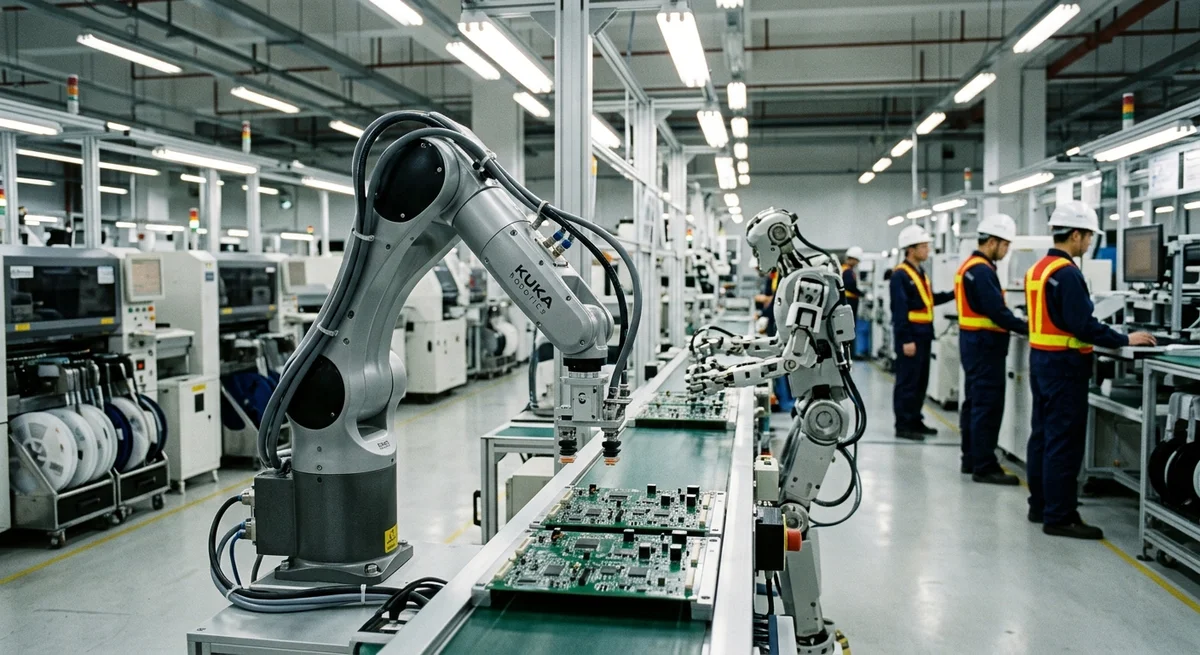
Investment bank Barclays has published an analysis concluding that deploying humanoid robots and automation systems could offset up to 60% of China's expected workforce decline by 2035, helping the country preserve its industrial capacity in global markets.
China's Demographic Dead End
China is undergoing the fastest decline in its working-age population in history. Decades of the one-child policy did irreparable damage to the country's demographic structure. The birth rate has fallen so far that deaths now exceed births. By 2035, China will lose tens of millions of young workers, exactly when the country would badly need to expand production.
The paradox is plain: China, which for years relied on cheap young labor, suddenly cannot produce the same volume of goods. Rural youth move to the cities or are never born at all. Factories are left without hands.
Robots as a Way Out
That is what led Barclays to its conclusion on robotics. Humanoid robots and automated systems are already appearing in Chinese production, from electronics assembly lines to logistics centers. The technology is imperfect but predictable: machines work without days off and do not demand wages that rise with inflation. The cost of electricity and maintenance is a known expense.
According to the analysts' calculations, heavy Chinese investment in building and deploying robotic systems could offset a significant share of the losses.
These sectors will be the first to automate:
- Electronics and semiconductors
- Automotive manufacturing and assembly
- Logistics and packaging
- Construction and infrastructure
- Food processing
The Social Cost
But the optimistic estimates assume that China will not simply buy robots, but will retrain hundreds of millions of workers for new roles. That requires investment in education, retraining and social programs for displaced workers. The government will need to sustain domestic demand, or the mass of unemployed people will become an explosive social problem. And if robots really do replace half of the working-age population, wages in the remaining professions will fall and inequality will only worsen.
What It Means
The Barclays forecast shows that a technological answer to the demographic crisis is possible, but not guaranteed. Robots could save the Chinese economy from collapse, but only alongside the right policy and large-scale retraining. For the rest of the world, it is a signal: Chinese industry will remain dominant, but its model will shift even further from wage labor toward full automation.
- Oct 31, 2026Author puts his script before an AI jury: the verdict cost 850 thousand tokens
- Oct 29, 2026OvisOCR3: an 0.8B-parameter model that reads documents better than specialized systems
- Oct 29, 2026Tencent releases Youtu-Parsing-Omni: one model parses documents, audio and video
- Oct 28, 2026Liquid AI releases LFM2.5-24B-A2B: an agent model with 2B active parameters
Key Questions Answered
What are the key details on China's Demographic Dead End?
China is undergoing the fastest decline in its working-age population in history. Decades of the one-child policy did irreparable damage to the country's demographic structure. The birth rate has fallen so far that deaths now exceed births. By 2035, China will lose tens of millions of young workers, exactly when the country would badly need to expand production. The paradox is plain: China, which for years relied on cheap young labor, suddenly cannot produce the same volume of goods. Rural youth move to the cities or are never born at all. Factories are left without hands.
What are the key details on Robots as a Way Out?
That is what led Barclays to its conclusion on robotics. Humanoid robots and automated systems are already appearing in Chinese production, from electronics assembly lines to logistics centers. The technology is imperfect but predictable: machines work without days off and do not demand wages that rise with inflation. The cost of electricity and maintenance is a known expense. According to the analysts' calculations, heavy Chinese investment in building and deploying robotic systems could offset a significant share of the losses. These sectors will be the first to automate:
What are the key details on The Social Cost?
But the optimistic estimates assume that China will not simply buy robots, but will retrain hundreds of millions of workers for new roles. That requires investment in education, retraining and social programs for displaced workers. The government will need to sustain domestic demand, or the mass of unemployed people will become an explosive social problem. And if robots really do replace half of the working-age population, wages in the remaining professions will fall and inequality will only worsen.
Test Frontier LLMs & Autonomous Agents in One Workspace
Run Claude Opus 5.5, GPT-6, Gemini 3.1, and DeepSeek side-by-side in Nomad AI (nomadnet.ai) — unified model routing, deep research, and multimodal workflows under one subscription.
The AI world, distilled — once a week
Seven stories that actually mattered, hand-picked. No noise, no reposts, no press releases.
Done! Check your inbox for a confirmation.