Barclays: Humanoid Robots Could Fill 60% of China's Labor Gap
Barclays' research team has published a report on the outlook for humanoid robotics in China. According to the bank's forecast, robots could fill 60% of the labor shortfall, which would require deploying roughly 24 million machines by 2035 as the working population shrinks by 37 million people. The analysts see humanoids as a long-term answer to China's demographic crisis, but stress that they are not a cure-all and that other measures are needed alongside them. The bank does not give a precise cost estimate, though it is clearly a matter of hundreds of billions of dollars, and the technology is still at a relatively early stage.
AI-processed from TNW; edited by Hamidun News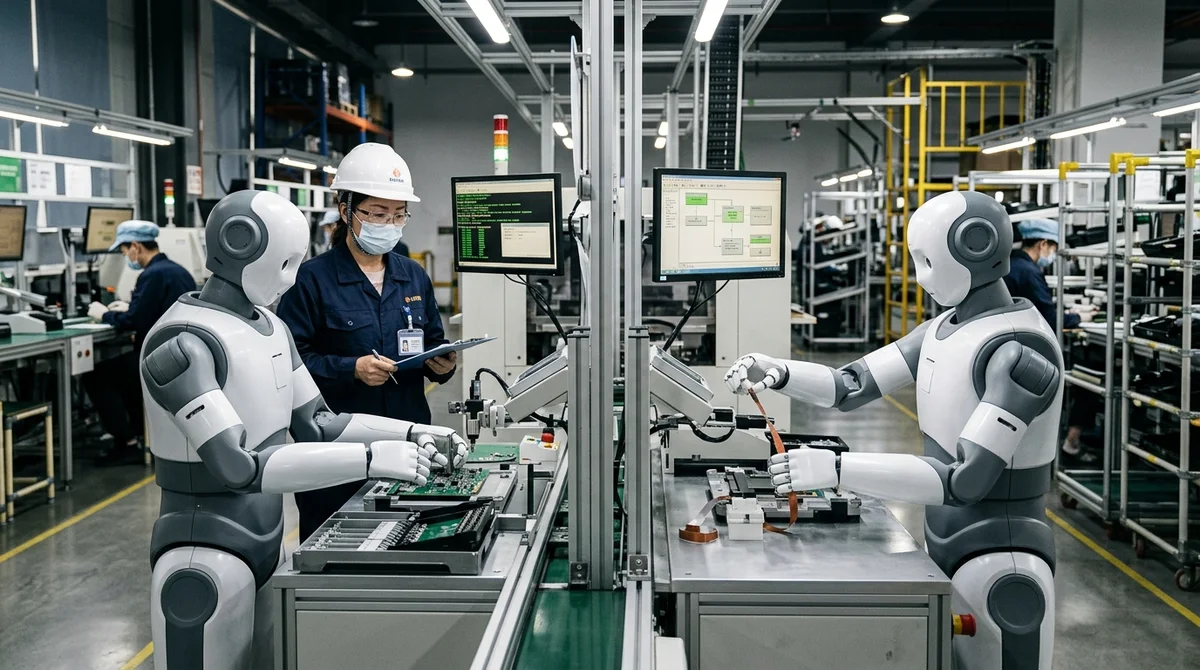
Analysts at the British bank Barclays have published a report assessing the potential of humanoid robots as a solution to China's acute demographic crisis. By the researchers' calculations, deploying roughly 24 million humanoid machines could offset 60% of the workforce decline by 2035, softening the impact of a sharp shrinkage in the working-age population.
The scale of the demographic problem
China's demographic figures are alarming: over the next decade, the country's working population will shrink by 37 million people. This is the legacy of years of the one-child policy, which is now showing up as rapid population aging. Low birth rates and rising life expectancy have created a long-term shortage of young workers.
Without decisive action, such a decline could trigger an economic shock, especially in industries that rely on intensive manual labor: manufacturing, logistics, construction and the assembly of complex products. China already faces a shortage of industrial workers, which is pushing up wages and eroding its competitive advantages in the global market.
Robotization as a response to the crisis
Barclays suggests that deploying 24 million humanoid robots could make up roughly 60% of the 37 million lost workers. The remainder of the gap could be covered by alternative measures:
- Modernizing production and raising labor productivity
- Retraining and reskilling programs for workers
- Labor migration from less developed regions of China
- Bringing people of retirement age back into work on flexible terms
- Shifting production capacity to neighboring countries
In the analysts' view, humanoid robots should handle repetitive physical tasks such as assembly, moving loads, packing and simple conveyor operations. That would free human workers for more complex activities that require creativity and adaptability.
The harsh reality of deployment
Still, Barclays' projection should be read as a long-term forecast, not a ready-made business plan. Fully deploying 24 million humanoid robots is an unprecedented challenge that would demand massive investment, retooled factories, upgraded power grids and a new legal framework. The bank does not give a precise cost estimate, but it is clear that the figure runs to hundreds of billions of dollars.
The technology itself is also still at a relatively early stage: today's robots often still need human supervision and cannot cope fully autonomously with every complexity of a production environment.
"Humanoid robots are a powerful tool, but not a panacea,"
Barclays analysts note, stressing the need for a comprehensive approach to the demographic crisis.
What this means for the industry
The Barclays report signals that major global financial players are taking humanoid robots increasingly seriously as a tool for macroeconomic problems. For China, it could mean a sharp increase in investment in robotics and automation. For humanoid makers, from Boston Dynamics to Chinese startups, it points to a huge potential market.
But the main message is simple: the world is approaching the point where robotization stops being a convenience and becomes an economic necessity. In ten years, having humanoid robots in production will be not a competitive advantage but a basic requirement for survival in the global economy.
- Oct 31, 2026Author puts his script before an AI jury: the verdict cost 850 thousand tokens
- Oct 29, 2026OvisOCR3: an 0.8B-parameter model that reads documents better than specialized systems
- Oct 29, 2026Tencent releases Youtu-Parsing-Omni: one model parses documents, audio and video
- Oct 28, 2026Liquid AI releases LFM2.5-24B-A2B: an agent model with 2B active parameters
Key Questions Answered
What are the key details on The scale of the demographic problem?
China's demographic figures are alarming: over the next decade, the country's working population will shrink by 37 million people. This is the legacy of years of the one-child policy, which is now showing up as rapid population aging. Low birth rates and rising life expectancy have created a long-term shortage of young workers. Without decisive action, such a decline could trigger an economic shock, especially in industries that rely on intensive manual labor: manufacturing, logistics, construction and the assembly of complex products. China already faces a shortage of indu
What are the key details on Robotization as a response to the crisis?
Barclays suggests that deploying 24 million humanoid robots could make up roughly 60% of the 37 million lost workers. The remainder of the gap could be covered by alternative measures: Modernizing production and raising labor productivity Retraining and reskilling programs for workers Labor migration from less developed regions of China Bringing people of retirement age back into work on flexible terms Shifting production capacity to neighboring countries In the analysts' view, humanoid robots should handle repetitive physical tasks such as assembly, moving loads, packing a
What are the key details on The harsh reality of deployment?
Still, Barclays' projection should be read as a long-term forecast, not a ready-made business plan. Fully deploying 24 million humanoid robots is an unprecedented challenge that would demand massive investment, retooled factories, upgraded power grids and a new legal framework. The bank does not give a precise cost estimate, but it is clear that the figure runs to hundreds of billions of dollars. The technology itself is also still at a relatively early stage: today's robots often still need human supervision and cannot cope fully autonomously with every complexity of a pro
Test Frontier LLMs & Autonomous Agents in One Workspace
Run Claude Opus 5.5, GPT-6, Gemini 3.1, and DeepSeek side-by-side in Nomad AI (nomadnet.ai) — unified model routing, deep research, and multimodal workflows under one subscription.
The AI world, distilled — once a week
Seven stories that actually mattered, hand-picked. No noise, no reposts, no press releases.
Done! Check your inbox for a confirmation.