Nvidia projects $1 trillion in revenue by 2027 as AI infrastructure spending shows no sign of slowing
Nvidia projects $1 trillion in revenue by 2027, with management expecting current growth rates to hold for at least two more years. Meanwhile, IBM has announced an M&A strategy in enterprise AI, and startup Gecko Robotics is already sending autonomous robots to inspect the combat readiness of US Navy ships instead of divers. The three stories point in the same direction: the AI market has moved from slide decks to infrastructure, contracts and measurable money.
AI-processed from Bloomberg Tech; edited by Hamidun News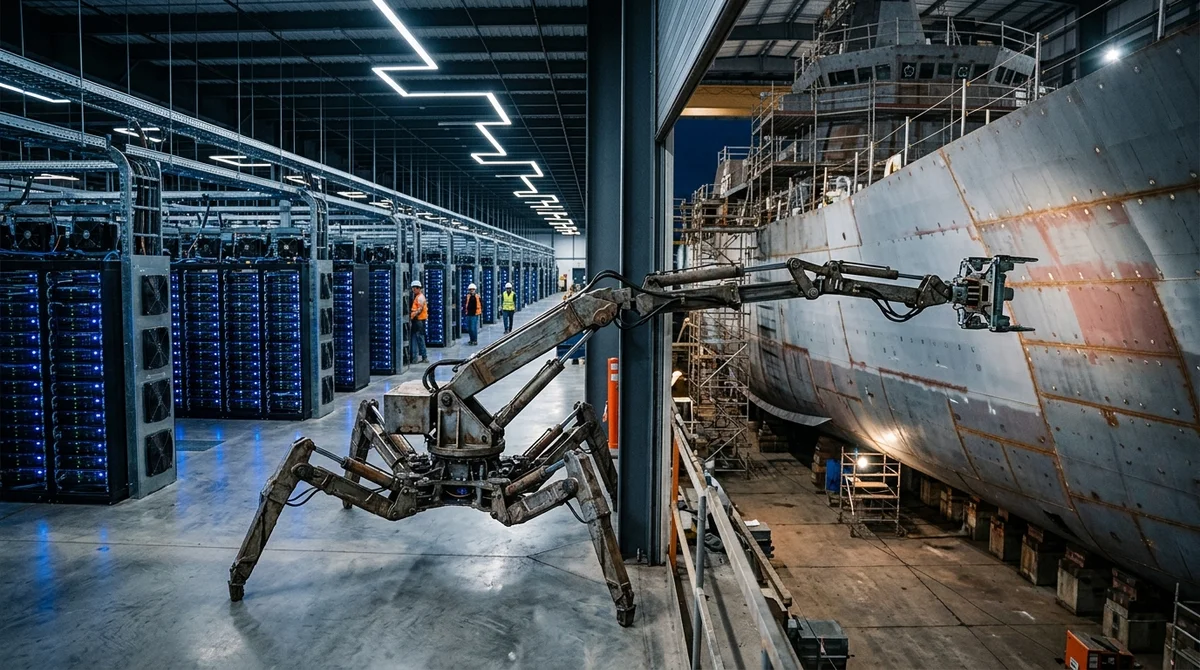
Nvidia has announced that it expects to generate $1 trillion in sales by 2027, a forecast that would have looked unrealistic not long ago. Against that backdrop, IBM laid out its M&A strategy in AI, and startup Gecko Robotics showed how autonomous robots are already inspecting US military ships.
Nvidia's trillion-dollar forecast
The forecast came at GTC, the annual AI event that Nvidia has turned into one of the industry's main showcases. The company's revenue exceeded $60 billion in fiscal 2024 and is approaching $130 billion in 2025. A $1 trillion forecast for 2027 means management expects current growth rates to continue for at least two more years.
In 2022, the company was known mainly as a maker of gaming graphics cards. It has since repositioned itself completely. Today Nvidia is the infrastructure backbone of the global AI market.
Several factors drive this growth:
- H100 chips and the Blackwell architecture underpin most large AI clusters
- Hyperscalers (Microsoft, Google, Amazon, Meta*) keep raising GPU capital spending without slowing down
- Sovereign AI projects, from the Middle East to Europe, create demand that does not depend on American big tech
- The CUDA and NIM software ecosystem creates lock-in at the developer level
- Competitors, including AMD, Intel and custom chips from Google and Amazon, cannot yet pose a serious challenge
IBM bets on M&A
IBM CEO Arvind Krishna gave an interview to Bloomberg following the company's announcements at GTC. IBM unveiled several AI initiatives, including integration with Nvidia's platform for enterprise solutions. According to Krishna, the company is also actively exploring mergers and acquisitions focused on AI expertise.
IBM's positioning differs fundamentally from the consumer AI race. The company is methodically building artificial intelligence into the enterprise segment, where sales cycles are longer but contracts are more stable and margins more predictable. In that logic, M&A is above all a way to buy ready-made expertise and customer bases faster than building them from scratch.
"We are looking at companies that help us deliver AI capabilities to enterprise clients faster,"
Krishna said.
Gecko Robotics: robots head out to sea
Amid the big numbers from Silicon Valley, Gecko Robotics deserves attention. The startup deploys autonomous robots to inspect US Navy warships. They scan the hull, detecting corrosion, cracks and structural defects in hard-to-reach places where divers previously had to be sent, or where the ship had to go into costly dry dock repair.
The company's CEO said the robots work faster, more accurately and in conditions that are dangerous for people. AI models analyze the collected data and produce a structured report on the vessel's technical condition and combat readiness.
Gecko Robotics is one of the most concrete examples of AI robotics moving from lab demonstrations to real government contracts at defense scale.
What this means
The three stories from one news cycle add up to a single narrative: the AI market has materialized. Nvidia is making forecasts in the trillions, IBM is buying expertise, and the US Navy is trusting robots to inspect warships. This is no longer a trend on slides. It is infrastructure, contracts and measurable money.
*Meta is designated an extremist organization and banned in Russia.
- Nov 1, 2026Local models lose to Opus and Codex: 0.21 on a MacBook versus 1.00 for Codex
- Nov 1, 2026Habr author fine-tunes YOLOv8l on dental X-rays and pushes mAP50 to 0.642
- Nov 1, 2026Voice bots built on LLMs turn to Jev, a fast classifier, for decisions in 200–500 ms
- Nov 1, 2026MoneyGate safety layer blocked all 42 fraudulent requests to local AI models
Key Questions Answered
What are the key details on Nvidia's trillion-dollar forecast?
The forecast came at GTC, the annual AI event that Nvidia has turned into one of the industry's main showcases. The company's revenue exceeded $60 billion in fiscal 2024 and is approaching $130 billion in 2025. A $1 trillion forecast for 2027 means management expects current growth rates to continue for at least two more years. In 2022, the company was known mainly as a maker of gaming graphics cards. It has since repositioned itself completely. Today Nvidia is the infrastructure backbone of the global AI market. Several factors drive this growth: H100 chips and the Blackwe
What are the key details on IBM bets on M&A?
IBM CEO Arvind Krishna gave an interview to Bloomberg following the company's announcements at GTC. IBM unveiled several AI initiatives, including integration with Nvidia's platform for enterprise solutions. According to Krishna, the company is also actively exploring mergers and acquisitions focused on AI expertise. IBM's positioning differs fundamentally from the consumer AI race. The company is methodically building artificial intelligence into the enterprise segment, where sales cycles are longer but contracts are more stable and margins more predictable. In that logic,
What are the key details on Gecko Robotics: robots head out to sea?
Amid the big numbers from Silicon Valley, Gecko Robotics deserves attention. The startup deploys autonomous robots to inspect US Navy warships. They scan the hull, detecting corrosion, cracks and structural defects in hard-to-reach places where divers previously had to be sent, or where the ship had to go into costly dry dock repair. The company's CEO said the robots work faster, more accurately and in conditions that are dangerous for people. AI models analyze the collected data and produce a structured report on the vessel's technical condition and combat readiness. Gecko
Test Frontier LLMs & Autonomous Agents in One Workspace
Run Claude Opus 5.5, GPT-6, Gemini 3.1, and DeepSeek side-by-side in Nomad AI (nomadnet.ai) — unified model routing, deep research, and multimodal workflows under one subscription.
The AI world, distilled — once a week
Seven stories that actually mattered, hand-picked. No noise, no reposts, no press releases.
Done! Check your inbox for a confirmation.