Nvidia's founder expects $1 trillion in AI hardware revenue by the end of 2027
Jensen Huang believes Nvidia will earn at least $1 trillion from AI hardware by December 31, 2027. The forecast came from the GTC 2026 stage, not from a financial filing, and that is telling in itself: the company is clearly betting that the boom in data centers, accelerators and large corporate AI purchases will continue. Huang's figure is an estimate by the company's founder, not a formal forecast from a finance department.
AI-processed from 3DNews AI; edited by Hamidun News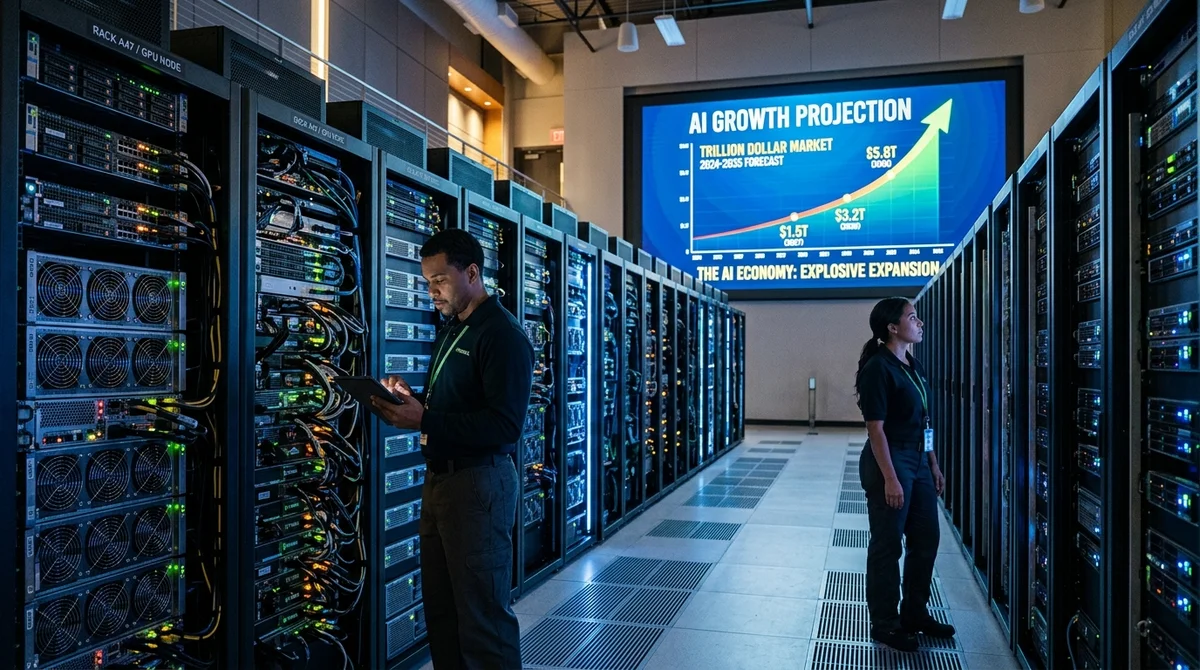
At the GTC 2026 opening, Jensen Huang put forward an ambitious estimate of Nvidia's future sales: by December 31, 2027, he said, the company could bring in at least $1 trillion in revenue from AI hardware. For the market this is not just a big number but a marker of how fast corporations keep pouring money into the computing infrastructure used to train and run AI models.
A forecast from the stage
The statement did not come at a quarterly earnings call, where investors expect formal guidance, but right at the GTC 2026 opening. That makes Huang's remark especially telling: he was not speaking in the dry language of a financial document but at a technology event, where people usually discuss products, architectures and roadmaps. When Nvidia's chief puts such a figure on the conference's main stage, it looks like a show of confidence that demand for AI infrastructure will stay very high for at least several more quarters.
In essence, Huang set out an expectation that in under two years Nvidia could collect a trillion dollars on the hardware side of the AI market alone. He is not talking about subscriptions, advertising or cloud services, but about the physical base on which modern models run: accelerators, servers, networking components and related systems. That emphasis matters because it shows where the biggest money in the AI value chain is concentrated today.
Where the scale comes from
The reason for the estimate is simple: big tech companies, cloud providers and a growing number of ordinary corporations keep building and expanding data centers for AI workloads. Models are getting heavier, inference is no longer a side load, and AI features are becoming a basic part of products. Against that backdrop Nvidia sells not a single chip but an entire stack of computing infrastructure, which lets the company look at the market in terms of hundreds of billions rather than individual good quarters.
- Accelerators for training and running models
- Server platforms and ready-made racks
- Networking to link large clusters
- Upgrades of existing data centers for AI workloads
An additional factor is the shift in demand from experiments to production deployment. Where many companies once tested generative models in pilot mode, budgets now more often go to long-term purchases. That changes the scale of decisions: instead of a few racks, businesses order whole clusters, along with power, cooling, network topology and headroom for future model releases. For Nvidia this means not one-off sales but a steady wave of infrastructure orders.
Why the market is listening
Even for Nvidia, a trillion dollars by the end of 2027 sounds like a statement about the size of the entire next phase of the AI boom. If this figure is even close to reality, the largest customers already treat infrastructure as a mandatory asset rather than an experimental line item. It also raises the pressure on competitors: every other manufacturer will have to prove it can offer comparable performance, availability and ecosystem for enterprise customers.
It is worth remembering, though, that this is the estimate of the company's founder, not a formal forecast from its finance department. The outcome will depend on the pace at which new capacity comes online, customers' willingness to sustain capital spending, supply chain constraints, and how fast the market moves from training models to mass inference. But the very fact that such a figure was stated publicly from the GTC 2026 stage sets a new bar of expectations for the entire AI hardware sector.
What it means
For the market the signal is simple: Nvidia believes peak demand for AI hardware has not yet passed. For businesses, it means the infrastructure around models remains one of the most expensive and strategically important layers of the whole AI economy.
- Nov 1, 2026Local models lose to Opus and Codex: 0.21 on a MacBook versus 1.00 for Codex
- Nov 1, 2026Habr author fine-tunes YOLOv8l on dental X-rays and pushes mAP50 to 0.642
- Nov 1, 2026Voice bots built on LLMs turn to Jev, a fast classifier, for decisions in 200–500 ms
- Nov 1, 2026MoneyGate safety layer blocked all 42 fraudulent requests to local AI models
Key Questions Answered
What are the key details on A forecast from the stage?
The statement did not come at a quarterly earnings call, where investors expect formal guidance, but right at the GTC 2026 opening. That makes Huang's remark especially telling: he was not speaking in the dry language of a financial document but at a technology event, where people usually discuss products, architectures and roadmaps. When Nvidia's chief puts such a figure on the conference's main stage, it looks like a show of confidence that demand for AI infrastructure will stay very high for at least several more quarters. In essence, Huang set out an expectation that in
Where the scale comes from?
The reason for the estimate is simple: big tech companies, cloud providers and a growing number of ordinary corporations keep building and expanding data centers for AI workloads. Models are getting heavier, inference is no longer a side load, and AI features are becoming a basic part of products. Against that backdrop Nvidia sells not a single chip but an entire stack of computing infrastructure, which lets the company look at the market in terms of hundreds of billions rather than individual good quarters. Accelerators for training and running models Server platforms and
Why the market is listening?
Even for Nvidia, a trillion dollars by the end of 2027 sounds like a statement about the size of the entire next phase of the AI boom. If this figure is even close to reality, the largest customers already treat infrastructure as a mandatory asset rather than an experimental line item. It also raises the pressure on competitors: every other manufacturer will have to prove it can offer comparable performance, availability and ecosystem for enterprise customers. It is worth remembering, though, that this is the estimate of the company's founder, not a formal forecast from its
Test Frontier LLMs & Autonomous Agents in One Workspace
Run Claude Opus 5.5, GPT-6, Gemini 3.1, and DeepSeek side-by-side in Nomad AI (nomadnet.ai) — unified model routing, deep research, and multimodal workflows under one subscription.
The AI world, distilled — once a week
Seven stories that actually mattered, hand-picked. No noise, no reposts, no press releases.
Done! Check your inbox for a confirmation.