Uber and Motional relaunch robotaxis in Las Vegas, doubling down on autonomous transport
Uber is bringing robotaxis back to Las Vegas, relaunching the service with Motional, a company backed by Hyundai investment. For riders, it is one more option inside the familiar Uber app. For the market, it signals that major platforms are once again speeding up the shift of driverless rides from pilots to regular service. If the model works, Uber will strengthen its role as an aggregator not just of drivers, but of autonomous fleets too.
AI-processed from Bloomberg Tech; edited by Hamidun News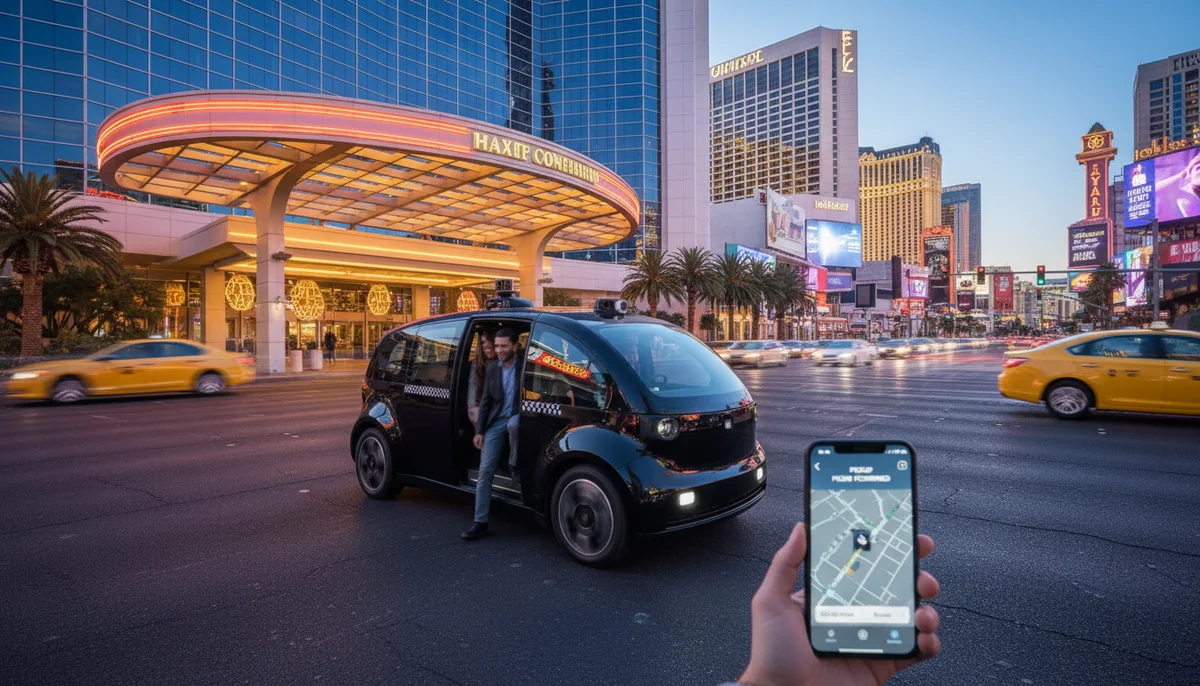
Uber is bringing robotaxis back to Las Vegas with Motional, a Hyundai-backed company. For riders, the change is simple: the Uber app will offer more trips that an autonomous vehicle, rather than a human driver, can complete.
Return to Las Vegas
The relaunch matters on its own. The driverless taxi market moved past the era of splashy presentations long ago. Today, every return to a city means a company is ready to prove itself again in real-world operation: routes, pickups and drop-offs, handling traffic, and adapting to passenger habits. For Uber, it is also a test of how naturally robotaxis fit into a ride-hailing interface people already know. That is why passengers won't be the only ones watching this launch — competitors will be too.
For Motional, the Uber partnership offers fast access to rider demand without having to build its own mass-market consumer channel. For Uber, it is a way to expand its offering without developing the entire autonomous stack in-house. This arrangement is increasingly becoming the market's default: one company handles the app, billing, and demand, while the other handles the driverless technology and the fleet. In this model, Las Vegas serves as a convenient venue for testing a commercial use case, not just an engineering pilot.
A platform for autonomous rides
Uber's core idea right now isn't simply to add another novelty service to its app menu. The company is gradually turning its app into a universal storefront for different forms of urban mobility, where riders don't need to know who is actually handling the trip — a human driver or an autonomous system. If booking and payment stay familiar, the barrier to mass adoption of robotaxis drops significantly. This way, Uber takes the edge off the technology's novelty for a mainstream audience.
What Uber gets from this model:
- more ride options within a single app
- the ability to distribute demand across different fleet types
- another reason for users to stay in its ecosystem
- data on where and when demand for autonomous rides is strongest
For Motional, this is a strategic move as well. Hyundai's backing gives the project industrial weight: the driverless service looks less like a small lab's experiment and more like a product supported by automotive manufacturing expertise and a long-term investment horizon. At the same time, success is now measured not only by the quality of the self-driving system, but by how reliably the service works day to day: when a car is easy to hail, pickup times are predictable, and the ride meets user expectations.
The market enters its scaling phase
The news that more autonomous cars are showing up in the Uber app may sound like a technical detail, but it actually describes an important shift. The winner is no longer just whoever has the best in-car algorithms, but also whoever controls the gateway to the customer. If a user opens one app and sees different types of rides there, the platform starts setting the rules for demand allocation, pricing, display priority, and user experience. That significantly strengthens Uber's position in the future economics of driverless transport.
Las Vegas is a telling choice for a reason. Cities like this are valuable to autonomous transport companies because they let them test a service in a live environment with steady passenger traffic, without having to jump straight to the most complex national scale. If the relaunch goes smoothly, Uber will gain another argument for its platform strategy, and Motional will get confirmation that its technology is ready not just for demos, but for regularly carrying ordinary passengers at the tap of a button.
What it means
Robotaxis are increasingly shifting from a standalone tech show to an ordinary layer inside familiar ride-hailing services. For the market, this signals that the competition is moving from one-off demos to a systemic question: who can integrate autonomous cars into everyday urban logistics fastest and make them an almost invisible part of the standard user experience. For passengers, the key criterion won't be the word "robotaxi," but how predictable and convenient the ride actually is.
- Nov 1, 2026Local models lose to Opus and Codex: 0.21 on a MacBook versus 1.00 for Codex
- Nov 1, 2026Adobe's EditAgent judge picks a usable edit 81.3% of the time, versus 74.8% for EditScore
- Nov 1, 202616 models tested on 7 search tools: Exa averaged 10.5 out of 14, SearXNG about 3
- Nov 1, 2026Google's StreamVibe video agent beats other models by 10.7% on response timing and quality
Key Questions Answered
What are the key details on Return to Las Vegas?
The relaunch matters on its own. The driverless taxi market moved past the era of splashy presentations long ago. Today, every return to a city means a company is ready to prove itself again in real-world operation: routes, pickups and drop-offs, handling traffic, and adapting to passenger habits. For Uber, it is also a test of how naturally robotaxis fit into a ride-hailing interface people already know. That is why passengers won't be the only ones watching this launch — competitors will be too. For Motional, the Uber partnership offers fast access to rider demand without
What are the key details on A platform for autonomous rides?
Uber's core idea right now isn't simply to add another novelty service to its app menu. The company is gradually turning its app into a universal storefront for different forms of urban mobility, where riders don't need to know who is actually handling the trip — a human driver or an autonomous system. If booking and payment stay familiar, the barrier to mass adoption of robotaxis drops significantly. This way, Uber takes the edge off the technology's novelty for a mainstream audience. What Uber gets from this model: more ride options within a single app the ability to dist
What are the key details on The market enters its scaling phase?
The news that more autonomous cars are showing up in the Uber app may sound like a technical detail, but it actually describes an important shift. The winner is no longer just whoever has the best in-car algorithms, but also whoever controls the gateway to the customer. If a user opens one app and sees different types of rides there, the platform starts setting the rules for demand allocation, pricing, display priority, and user experience. That significantly strengthens Uber's position in the future economics of driverless transport. Las Vegas is a telling choice for a rea
Test Frontier LLMs & Autonomous Agents in One Workspace
Run Claude Opus 5.5, GPT-6, Gemini 3.1, and DeepSeek side-by-side in Nomad AI (nomadnet.ai) — unified model routing, deep research, and multimodal workflows under one subscription.
The AI world, distilled — once a week
Seven stories that actually mattered, hand-picked. No noise, no reposts, no press releases.
Done! Check your inbox for a confirmation.