Trassir and Matller helped Ivanisovo increase packing throughput by 20%
The Ivanisovo greenhouse complex implemented digital operations analytics based on Trassir cameras and Matller computer vision algorithms and achieved a 20% increase in packing throughput. The system helps identify bottlenecks on the line in real time, measure actual delays between stages, and speed up the process without expanding capacity or investing in new equipment.
AI-processed from CNews AI; edited by Hamidun News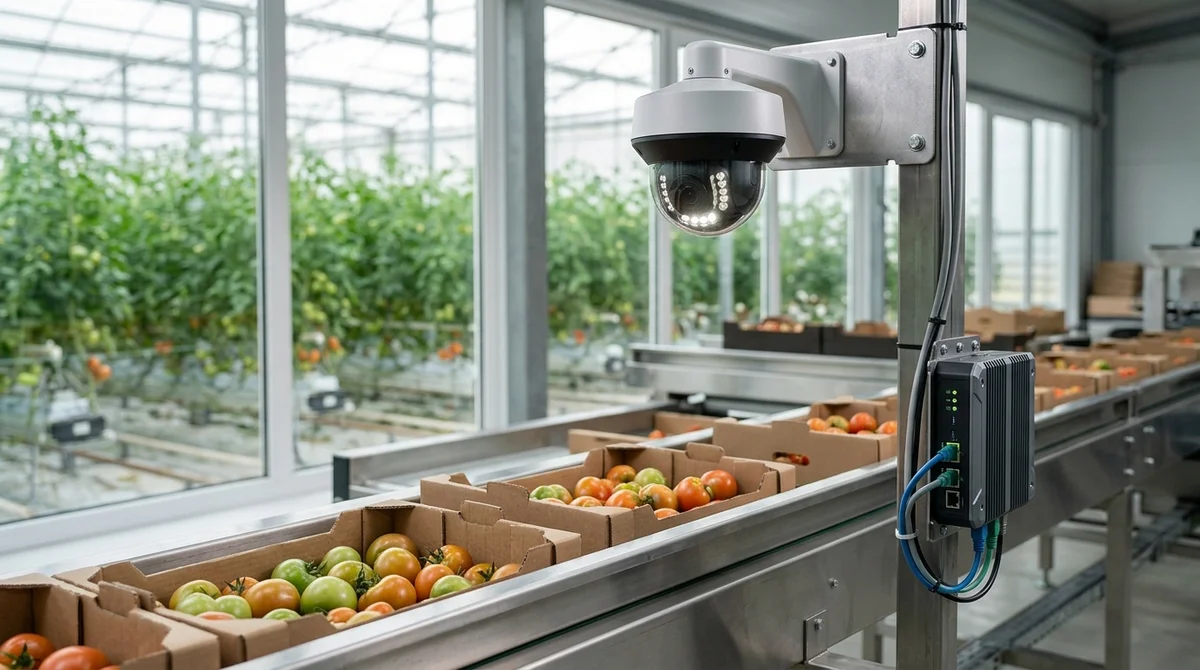
The Ivanisovo greenhouse complex reported a 20% increase in packaging productivity following the implementation of digital operations analytics based on Trassir video surveillance and Matller computer vision. The key point is that the result was achieved without expanding capacity and without additional investment in equipment.
How the system works
At the core of the project is a combination of cameras, a video surveillance platform, and algorithms that analyze packaging line operations in real time, not retroactively. This approach transforms ordinary video into production data: the system identifies sequences of operations, records timing deviations, and helps identify where the process slows down. For agricultural enterprises, this is particularly valuable because packaging requires not only overall speed but also a consistent rhythm that affects shipments, package quality, and shift scheduling.
Essentially, the complex gained a tool that shows the real picture of the production area without manual measurements and guesswork. Managers and line supervisors can rely not on subjective assessments but on operational metrics: how long each stage takes, where bottlenecks occur, how pace changes throughout the shift. This is an important distinction from traditional video surveillance, which is primarily used for monitoring and incident analysis.
Here, video becomes a source for management decisions, and computer vision becomes a way to quickly identify bottlenecks.
Where the growth came from
The companies have not disclosed the specific changes that contributed to the final 20% improvement. However, in projects of this type, results typically emerge not from a single major restructuring but from a series of small improvements that previously went unnoticed. When analytics reveal where a line loses seconds and minutes, an enterprise can reorder operations, balance workload among employees, and eliminate unnecessary pauses between stages.
This increases the throughput of an already-existing line. For Ivanisovo, this is particularly telling: the productivity increase was achieved without purchasing new machines, meaning the improvement came primarily from better process organization and more precise control of operations. For the greenhouse complex, this is not abstract optimization but a way to extract more from already-functioning infrastructure.
Packaging in agriculture often comes down not to equipment shortage but to the rhythm of manual and semi-automated operations, worker coordination, and timely product supply. If these elements are uneven, a line loses pace even when capacity is nominally sufficient. This is why digital operations-level analytics can deliver significant results where conventional capacity expansion seems like the only option.
- delays between the completion of one operation and the start of the next
- uneven employee workload on the line
- repetitive actions that don't add value to the packaging
- local bottlenecks due to waiting for containers, products, or confirmations
- discrepancies between regulations and actual workflow
For business, the value extends beyond faster packaging. When an enterprise has a clear operational picture, shift planning becomes easier, capacity can be assessed more accurately, and the impact of changes can be verified more quickly. Such an analytics loop also reduces dependence on manual observation: instead of spending weeks collecting data and debating the cause of a slowdown, the team gets facts almost immediately. This shortens the time between problem detection and concrete management decisions.
What it means
The Ivanisovo case shows that computer vision in industry and agriculture increasingly works not as a showcase for innovation but as a tool for operational efficiency. If an enterprise can boost output by double-digit percentages without new equipment and expanded facilities, demand for such systems will grow not only among large factories but also among companies with narrow, rhythm-sensitive processes.
Need AI working inside your business — not just in your newsfeed?
I build production AI for companies — custom CRM, internal tools, autonomous agents, workflow automation. Owned by you, shaped to your process, no per-seat tax. Built by Zhemal Khamidun, CPO of AlpinaGPT (AI platform, 6,000+ users).
The AI world, distilled — once a week
Seven stories that actually mattered, hand-picked. No noise, no reposts, no press releases.
Done! Check your inbox for a confirmation.