Nomagic deployed a VLA model in warehouse robots and halved operator callouts
Warsaw-based Nomagic deployed a vision-language-action (VLA) model in real warehouse operations at commercial clients, and it halved the frequency of 'stalls' that require operator assistance. The company's new AI lab is led by a former Google DeepMind researcher. The team is betting on a 'mastery before generality' strategy: first perfect specific warehouse tasks — grasping, sorting, moving goods — and only then think about broader applicability.
AI-processed from TNW; edited by Hamidun News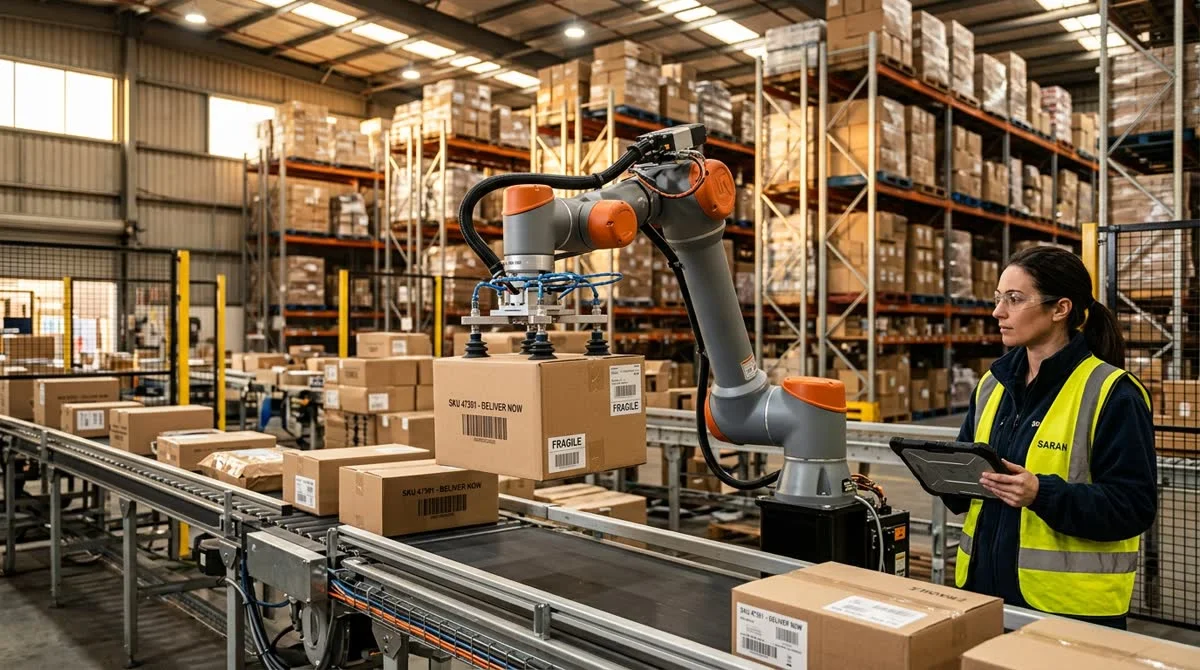
Nomagic, a Polish company, deployed a vision-language-action (VLA) model in real warehouse operations with commercial clients in July 2026 — and recorded approximately a twofold reduction in cases where the robot required operator intervention. In parallel, the company launched its own AI lab led by a former Google DeepMind researcher.
What is a VLA model and why does a warehouse robot need it
Vision-language-action models are neural networks that combine three components in a single architecture: computer vision (what the robot sees in front of it), context understanding (what task needs to be solved with this object), and action planning (how exactly to control the manipulator). Unlike classical programming, where rules are manually written for each product type or non-standard scenario, a VLA model makes decisions dynamically — the same way a person would handle an unfamiliar object without opening an instruction manual.
Until recently, VLA models existed primarily in the laboratory: they were tested on limited sets of objects in a controlled environment. Nomagic — a Warsaw-based company specializing in manipulators for warehouse logistics — moved this technology into real-world conditions.
- Model type: vision-language-action (VLA)
- Company: Nomagic, Warsaw, Poland
- Result: ~50% reduction in frequency of operator intervention requests
- AI lab: launched in 2026, led by a former Google DeepMind researcher
- Strategy: "mastery before generality" — first mastery in specific tasks, then universality
Why Nomagic bets on mastery, not universality
In the robotics race, one narrative dominates: create a universal agent capable of acting in any environment and with any objects. This is what Physical Intelligence, Google DeepMind, and several other major labs are striving for. Nomagic consciously chose a different path.
The new AI lab team is led by a former Google DeepMind researcher — someone well acquainted with the race for generalizability from the inside. Nevertheless, within Nomagic, the team deliberately narrows its focus: deep mastery of a specific set of warehouse operations — grasping, transferring, and sorting heterogeneous items at industrial speed — is more important than the ability to handle arbitrary tasks.
The rationale is pragmatic: a customer building an automated fulfillment center doesn't need a robot that can open doors or make coffee. They need a system that, at three in the morning when a shipment with non-standard packaging arrives, doesn't "freeze" waiting for an operator.
What changed in warehouse operations
The key metric in robotic fulfillment is "human-in-the-loop rate": the share of situations in which the system cannot handle itself and requests human assistance. Each such call is a conveyor delay, additional operational costs, and a limitation on scaling without increasing staff.
According to Nomagic, deploying the VLA model reduced this metric by approximately half on commercial customer sites. Critically important: this concerns the same physical equipment — the robots were not replaced. The twofold increase in autonomy was achieved solely through the new "brain."
For the industry, this is an important signal: VLA models have crossed the threshold where they can be not only demonstrated at exhibitions, but also deployed in real operation with measurable commercial results.
What this means
Nomagic did what the robotics industry has been promising for years: moved an AI model of a new generation from a research environment into production and achieved a concrete, measurable result. The "mastery first" strategy may prove to be a shorter path to truly autonomous warehouses than developing a universal agent.
Need AI working inside your business — not just in your newsfeed?
I build production AI for companies — custom CRM, internal tools, autonomous agents, workflow automation. Owned by you, shaped to your process, no per-seat tax. Built by Zhemal Khamidun, CPO of AlpinaGPT (AI platform, 6,000+ users).
The AI world, distilled — once a week
Seven stories that actually mattered, hand-picked. No noise, no reposts, no press releases.
Done! Check your inbox for a confirmation.