Russian scientists propose AI data center cooling that could cut power use by up to 22%
Russian scientists have developed a cooling approach for data centers running AI workloads. Instead of dumping waste heat from server racks, the system feeds it into an adsorption cooling cycle. The design is built on mesoporous silica gel. According to the study, the scheme could cut the energy consumption of cooling systems by up to 22%. That matters most for dense GPU racks and new sites with heavy compute loads.
AI-processed from CNews AI; edited by Hamidun News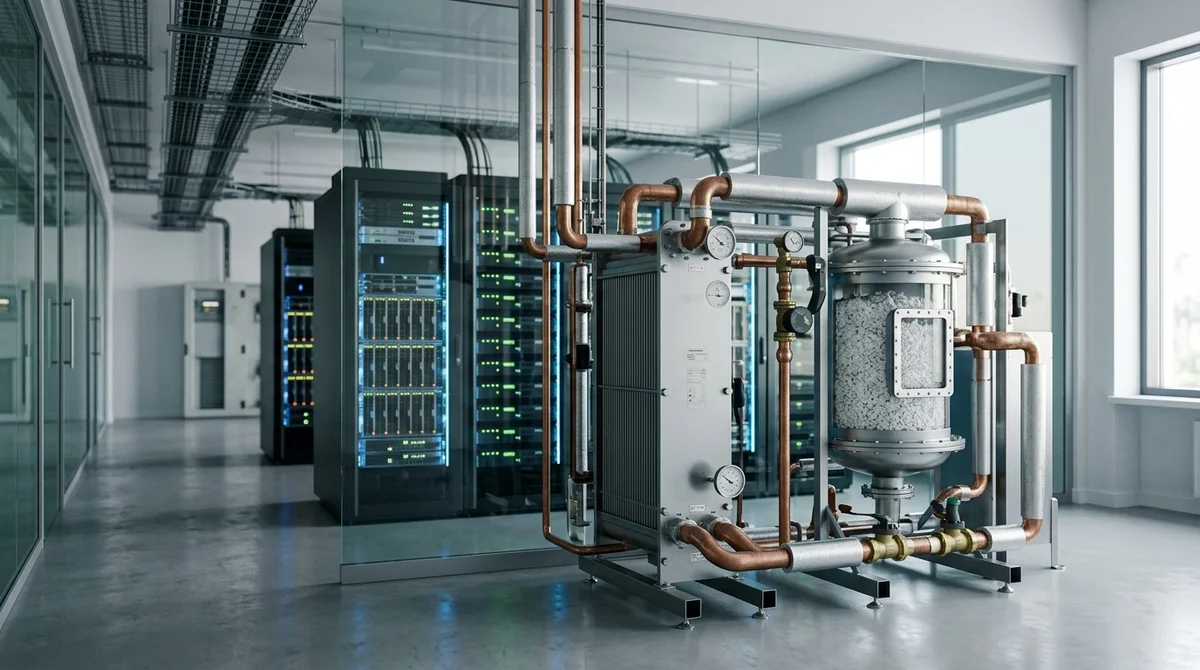
Russian researchers have proposed a new way to cool data centers packed with dense server racks for artificial intelligence workloads. Rather than simply venting excess heat outside, the system reuses it, which could cut cooling energy consumption by up to 22%.
How the scheme works
The core idea is to treat heat from AI servers not as a byproduct to get rid of at any cost, but as a useful resource. The approach relies on adsorption cooling using structures based on mesoporous silica gel.
This material has a large internal surface area and suits processes that depend on efficiently binding and releasing a working medium during the cooling cycle. That makes it an interesting candidate for energy-efficient engineering systems.
In simplified terms, the scheme works like this: high-density server racks generate a lot of heat, and that heat is routed into a cooling loop where it helps drive the adsorption cycle. This takes part of the load off the more energy-hungry components of traditional chiller infrastructure.
This is especially relevant for data centers running AI accelerators, where cooling is increasingly one of the biggest drivers of operating costs. The denser the hardware, the more any engineering optimization pays off.
Where the savings come from
Conventional data center cooling systems often draw significant power because they must continuously remove heat from servers and keep equipment running in a stable regime. In the new scheme, part of that energy isn't spent from scratch; it's recovered from heat already accumulated inside the facility.
According to the study, this shift in logic — from "dump the heat" to "reuse the heat" — is what creates the potential for savings of up to 22%. It matters most where thermal load stays high almost constantly.
- Reuse of waste heat from server racks
- Reduced load on traditional compressor-based cooling components
- Higher efficiency in scenarios with densely packed AI hardware
- Potential reduction in electricity operating costs
That said, the 22% figure is not a universal guarantee for every data center. Actual efficiency will depend on rack density, the architecture of the facility's engineering systems, ambient temperature, and how deeply the new scheme is integrated into existing infrastructure.
Still, the scale of the potential savings shows why the market is increasingly looking not just for more powerful chips, but also for new ways to manage the heat they produce. For operators, this is no longer a theoretical topic but a question of scaling economics.
Where it applies
The development is most interesting for sites where a growing share of compute goes to training and running AI models. GPU servers and other accelerators generate very high heat loads per unit of floor space, so standard cooling approaches start to hit a wall on operating costs.
If materials and loops that reuse internal heat can solve part of that problem, the economics of new halls and racks become noticeably more attractive. This matters especially for projects where every additional megawatt of capacity quickly turns into recurring expenses.
It's also important to note that this is not yet a mass-market, off-the-shelf product you could install in any server room tomorrow. It's a technological approach backed by research. The usual next steps are pilot deployments, reliability testing under continuous load, maintenance cost assessment, and comparison with alternatives such as liquid cooling or more efficient chillers.
But the direction looks practical: it addresses a real pain point in AI infrastructure rather than offering abstract optimization for the sake of a slide deck. If pilots confirm the calculations, interest in such systems will quickly move beyond the lab.
What it means
As AI data centers grow, cooling is becoming as important a part of compute strategy as the choice of GPU or network architecture. If technologies like adsorption cooling based on mesoporous silica gel deliver the claimed effect in real-world operation, operators will be able to build denser, more economical sites without a proportional rise in electricity bills.
For the market, this is a signal: the fight for AI efficiency is no longer happening only at the level of models and chips, but also at the level of engineering infrastructure.
Key Questions Answered
How the scheme works?
The core idea is to treat heat from AI servers not as a byproduct to get rid of at any cost, but as a useful resource. The approach relies on adsorption cooling using structures based on mesoporous silica gel. This material has a large internal surface area and suits processes that depend on efficiently binding and releasing a working medium during the cooling cycle. That makes it an interesting candidate for energy-efficient engineering systems. In simplified terms, the scheme works like this: high-density server racks generate a lot of heat, and that heat is routed into a
Where the savings come from?
Conventional data center cooling systems often draw significant power because they must continuously remove heat from servers and keep equipment running in a stable regime. In the new scheme, part of that energy isn't spent from scratch; it's recovered from heat already accumulated inside the facility. According to the study, this shift in logic — from "dump the heat" to "reuse the heat" — is what creates the potential for savings of up to 22%. It matters most where thermal load stays high almost constantly. Reuse of waste heat from server racks Reduced load on traditional
Where it applies?
The development is most interesting for sites where a growing share of compute goes to training and running AI models. GPU servers and other accelerators generate very high heat loads per unit of floor space, so standard cooling approaches start to hit a wall on operating costs. If materials and loops that reuse internal heat can solve part of that problem, the economics of new halls and racks become noticeably more attractive. This matters especially for projects where every additional megawatt of capacity quickly turns into recurring expenses. It's also important to note
Test Frontier LLMs & Autonomous Agents in One Workspace
Run Claude Opus 5.5, GPT-6, Gemini 3.1, and DeepSeek side-by-side in Nomad AI (nomadnet.ai) — unified model routing, deep research, and multimodal workflows under one subscription.
The AI world, distilled — once a week
Seven stories that actually mattered, hand-picked. No noise, no reposts, no press releases.
Done! Check your inbox for a confirmation.