World's First Wind-Powered Undersea Data Center Goes Live in Shanghai
The world's first undersea data center, Shanghai Lingang, has started operating off the coast of Shanghai. The 24 MW joint project of HiCloud Technology and the state-owned China Communications Construction uses wind power to cool its servers. The undersea facility needs 40% less water and consumes less electricity than land-based equivalents, offering a response to the energy crunch caused by the AI boom.
AI-processed from Guardian; edited by Hamidun News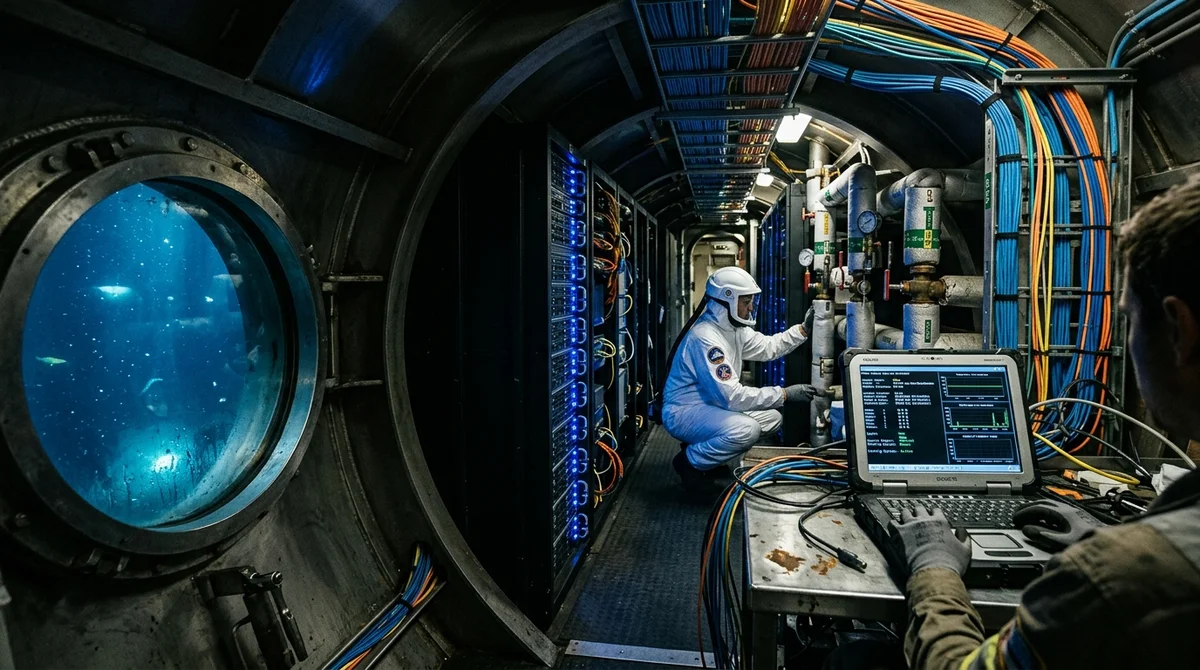
The world's first wind-powered undersea data center has started operating off the coast of Shanghai. It tackles one of the AI boom's central problems: the enormous amounts of electricity and water that servers consume.
How it works
The Shanghai Lingang undersea datacentre project launched in May this year. It was developed jointly by HiCloud Technology and the state-owned China Communications Construction. The facility has a capacity of 24 megawatts, roughly equivalent to 10,000 mid-range servers.
The underwater installation sits 10 kilometers from the coast at a depth of about 300 meters. Wind turbines onshore and on offshore platforms generate electricity, which reaches the equipment through a subsea cable. Cold seawater acts as a natural coolant for processors and hard drives, which is far cheaper and more efficient than traditional air-conditioning systems.
The servers are housed in protected containers isolated from the marine environment. An automated control system manages cooling and power supply and monitors equipment status in real time.
Why undersea data centers are more efficient
Traditional land-based data centers spend heavily on energy just for cooling. On average, air-conditioning systems consume 30-40% of a facility's total electricity. Undersea installations address this through natural seawater cooling.
The resource savings are significant:
- 40% less fresh water for cooling, which matters in water-scarce regions
- 30-35% less electricity spent on maintaining optimal temperature
- A smaller land footprint, which is critical for densely populated China
- Natural seawater cooling lowers capital expenditure on chillers
- A smaller carbon footprint thanks to wind power
China's energy crunch and the AI boom
China faces an acute electricity shortage as demand for AI computing power surges. Major tech companies and the state are investing billions in domestic AI models, from chatbots to computer vision, facial recognition and autonomous driving systems. This requires vast numbers of servers running 24/7 without interruption.
The Chinese government is actively developing alternative energy sources (solar, wind, hydro) and looking for innovative ways to site data centers. Undersea installations help solve two problems at once: they save energy and do not compete with agriculture for land.
Shanghai Lingang is a demonstration project, but its success could trigger a wave of undersea investment along China's Pacific and Yellow Sea coasts.
What this means
Undersea data centers are no longer science fiction but an engineering answer to a real problem at the scale of the AI boom. If Shanghai Lingang proves the model viable, other countries can be expected to copy the idea. It is especially interesting for coastal areas with strong wind generation, from Scandinavia and the United Kingdom to Southeast Asia and Australia.
For Russia, this may be a relevant option for its Far Eastern seas and for building its own computing capacity for AI and local LLMs.
For now, Shanghai Lingang is proving the concept, but within 3-5 years such projects may become the standard for energy-hungry data centers worldwide. This is not just a trend but a necessity in the age of AI.
- Nov 1, 2026Google's StreamVibe video agent beats other models by 10.7% on response timing and quality
- Nov 1, 2026New test catches hidden AI agent collusion by measuring how a partner reacts to a paraphrase
- Nov 1, 2026Illinois compiled 12 151 open problems and tested whether AI can solve them
- Oct 31, 2026AI engineer writes a single reward function for agent teams: win rate climbs from 51% to 90%
Key Questions Answered
How it works?
The Shanghai Lingang undersea datacentre project launched in May this year. It was developed jointly by HiCloud Technology and the state-owned China Communications Construction. The facility has a capacity of 24 megawatts, roughly equivalent to 10,000 mid-range servers. The underwater installation sits 10 kilometers from the coast at a depth of about 300 meters. Wind turbines onshore and on offshore platforms generate electricity, which reaches the equipment through a subsea cable. Cold seawater acts as a natural coolant for processors and hard drives, which is far cheaper
Why undersea data centers are more efficient?
Traditional land-based data centers spend heavily on energy just for cooling. On average, air-conditioning systems consume 30-40% of a facility's total electricity. Undersea installations address this through natural seawater cooling. The resource savings are significant: 40% less fresh water for cooling, which matters in water-scarce regions 30-35% less electricity spent on maintaining optimal temperature A smaller land footprint, which is critical for densely populated China Natural seawater cooling lowers capital expenditure on chillers A smaller carbon footprint thanks
What are the key details on China's energy crunch and the AI boom?
China faces an acute electricity shortage as demand for AI computing power surges. Major tech companies and the state are investing billions in domestic AI models, from chatbots to computer vision, facial recognition and autonomous driving systems. This requires vast numbers of servers running 24/7 without interruption. The Chinese government is actively developing alternative energy sources (solar, wind, hydro) and looking for innovative ways to site data centers. Undersea installations help solve two problems at once: they save energy and do not compete with agriculture f
Test Frontier LLMs & Autonomous Agents in One Workspace
Run Claude Opus 5.5, GPT-6, Gemini 3.1, and DeepSeek side-by-side in Nomad AI (nomadnet.ai) — unified model routing, deep research, and multimodal workflows under one subscription.
The AI world, distilled — once a week
Seven stories that actually mattered, hand-picked. No noise, no reposts, no press releases.
Done! Check your inbox for a confirmation.