Singapore brings AI into primary school, and Asia debates whether it helps
Singapore wants to introduce children to AI as early as primary school, but its cautious rollout has only fueled the debate. Critics note that AI gives fast answers and short-term results, yet may weaken retention, replace real learning and deepen dependence on screens. Against this backdrop, a different idea is gaining volume: teach such tools not to younger schoolchildren but to adults, for specific work tasks.
AI-processed from Habr AI; edited by Hamidun News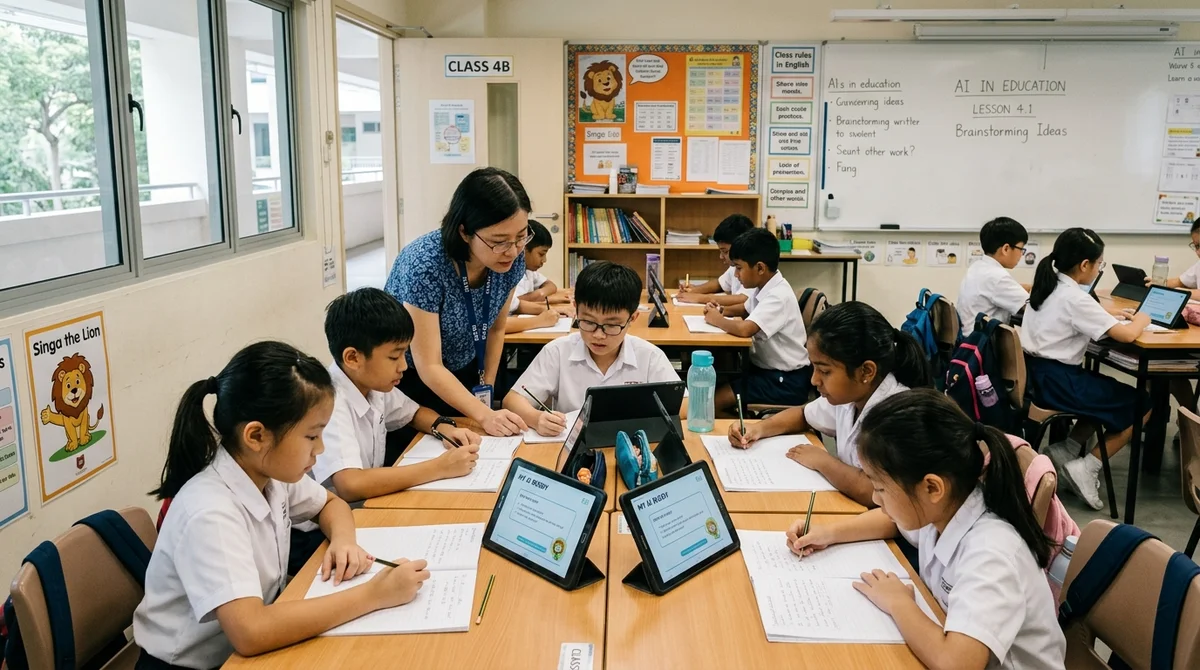
Singapore plans to introduce children to AI as early as the fourth year of primary school, with the caveat that use will be limited and supervised by the teacher. Alongside similar initiatives across Asia, this raises an uncomfortable question again: does AI help children learn, or does it remove too early the mental effort on which learning depends?
Why the debate has intensified
The trigger was a statement by Singapore's education minister: pupils are to be introduced to AI in primary school, but in a "strictly controlled" format and with minimal use. Meanwhile, Beijing is already pushing AI courses for primary and secondary pupils under its national AI Plus program. For governments, this looks like an attempt to keep pace in the technology race and prepare children in advance for a labor market where generative models will likely become an everyday tool.
"Under strict control and with minimal use."
But it is in Asia that this debate is especially sharp. The region spent many years building economic growth on strong schooling, discipline and high academic standards. Asian countries regularly top the PISA rankings in mathematics, reading and science, and Singapore already posts one of the best results in the world even without AI in schools. So the question here is not only about fashion for a new technology, but about whether education systems will start breaking something that already worked better than most.
Where the system stalls
There are already early signals. In South Korea, an AI-based learning program was scrapped just four months after launch because of resistance from teachers, parents and the students themselves. In Japan, a pilot at one primary school caused more anxiety than a sense of progress. Against this backdrop, the gap is widening between the political desire to look modern and schools' actual readiness to build in such tools without harming basic skills.
The criticism is not only about cultural conservatism. The core is a contradiction: AI promises convenience and fast results, while learning requires repetition, friction, mistakes and building understanding on your own. Research cited by participants in the debate shows that ChatGPT users may perform better on a task in the moment but retain the material worse later. In one test, after 45 days these participants scored markedly lower than those who learned through ordinary study groups and traditional methods.
Who benefits more from AI
The main argument against early adoption is not that AI is useless, but that for children the cost of error is too high. If the technology really does reduce the effort needed for deep learning, schools risk replacing learning with an imitation of it: there will be answers, but no lasting understanding. The beneficiaries may also be not so much pupils as ed-tech companies, for which schools become an almost guaranteed market.
By this logic, teaching AI to adults with a practical goal looks far more convincing, for example older prisoners in Singapore, for whom such skills may help find work after release. Here the goal is clear and measurable, and the learners are already cognitively formed and can use the tool as an add-on rather than a substitute for thinking. This is a very different scenario: not early digital socialization, but concrete preparation for returning to the labor market and to life after isolation.
- Practical digital literacy for adults
- Skills that help with employment after release
- Controlled use of AI as a work tool
- Focus on those who need the technology for a specific profession
Another fear persists too: that children not taught AI will supposedly end up uncompetitive. But as automation advances, more than technical skills is valued. Critical thinking, communication, attention, the ability to argue, to articulate a position and to understand other people matter no less. These qualities are the hardest to develop through machines, and they become more important when answers can be generated in seconds. So school can give children far more if it first strengthens basic cognitive and social skills.
What this means
The dispute over Singapore shows that the question is no longer whether AI will appear in education, but at what stage and for what purpose. For primary school, the arguments for caution currently look stronger: it matters more for children to learn to think, remember and work things out themselves than to get, ahead of time, one more tool that makes everything easier.
- Nov 1, 2026Local models lose to Opus and Codex: 0.21 on a MacBook versus 1.00 for Codex
- Nov 1, 2026Kimi scores 96.2% on a 1C database analytics test and emerges as a fallback if Claude access is blocked
- Nov 1, 2026OpenAI Rewrites GPT Behavior Rules: Five Values and a Chain of Command
- Nov 1, 2026Google admits AI Mode cuts search revenue, shares fall 15%
Key Questions Answered
Why the debate has intensified?
The trigger was a statement by Singapore's education minister: pupils are to be introduced to AI in primary school, but in a "strictly controlled" format and with minimal use. Meanwhile, Beijing is already pushing AI courses for primary and secondary pupils under its national AI Plus program. For governments, this looks like an attempt to keep pace in the technology race and prepare children in advance for a labor market where generative models will likely become an everyday tool. "Under strict control and with minimal use." But it is in Asia that this debate is especially
Where the system stalls?
There are already early signals. In South Korea, an AI-based learning program was scrapped just four months after launch because of resistance from teachers, parents and the students themselves. In Japan, a pilot at one primary school caused more anxiety than a sense of progress. Against this backdrop, the gap is widening between the political desire to look modern and schools' actual readiness to build in such tools without harming basic skills. The criticism is not only about cultural conservatism. The core is a contradiction: AI promises convenience and fast results, whi
Who benefits more from AI?
The main argument against early adoption is not that AI is useless, but that for children the cost of error is too high. If the technology really does reduce the effort needed for deep learning, schools risk replacing learning with an imitation of it: there will be answers, but no lasting understanding. The beneficiaries may also be not so much pupils as ed-tech companies, for which schools become an almost guaranteed market. By this logic, teaching AI to adults with a practical goal looks far more convincing, for example older prisoners in Singapore, for whom such skills m
Ship AI Faster with Founders, Engineers & Weekly Architecture Reviews
Inside Vibe Club (hamidun.com/club) — weekly live masterminds with Zhemal Khamidun, Tech Radar, full LMS access, and 370+ production Claude Code skills.
The AI world, distilled — once a week
Seven stories that actually mattered, hand-picked. No noise, no reposts, no press releases.
Done! Check your inbox for a confirmation.