Lawrence Wong pledges AI will not cause unemployment in Singapore
Singapore promises to shield its labor market from AI. Prime Minister Lawrence Wong put on record in parliament a commitment that the development of artificial intelligence will not lead to unemployment, the clearest such pledge from a major Asian economy. The country is betting on retraining its workforce and creating new jobs.
AI-processed from TNW; edited by Hamidun News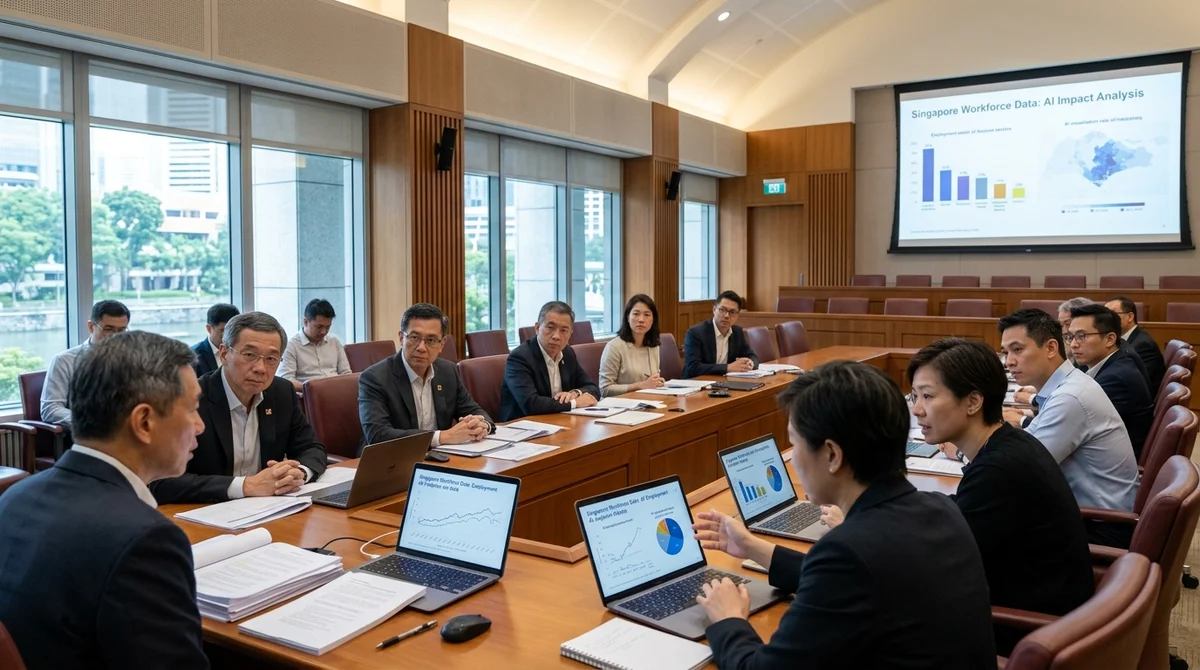
Singapore's parliament has made an explicit commitment that the development of artificial intelligence will not lead to unemployment in the country. It is the most direct and public pledge from a major Asian economy at a time when AI is already beginning to reshape the labor market in a deep way.
Prime Minister Wong's position
Prime Minister Lawrence Wong set out this position in a February address to parliament during the debate on the 2026 national budget. Wong came out directly against the "jobless economy" scenario, in which gross domestic product grows while the number of people in work shrinks. For a country of 5.7 million people living on a small island, economic stability is critical to well-being.
The prime minister stressed that, rather than displacing people with AI, Singapore is betting on mass retraining and on effectively adapting its workforce to new technologies.
How the state protects employment
Singapore is already developing several practical tools to keep people in demand in the age of AI. The government has launched large-scale retraining programs for workers whose occupations will be affected by artificial intelligence.
- Retraining programs for occupations being displaced
- Investment in education in new technologies
- Partnership between government, business and universities to create jobs
- Financial support during the transition period
- Focus on occupations that require uniquely human qualities
At the same time, investment is going into education in high-paying skills that AI is unlikely to be able to fully automate. Government, business and universities are working together to create jobs in new, fast-growing sectors of the economy.
Why now
For a small island state, social stability is not just good intentions; it is the foundation of economic prosperity. Mass unemployment caused by technology could quickly create social tension and a political crisis in a densely populated country. Singapore has historically chosen proactive policy, solving problems before they grow.
The parliamentary pledge is both a signal to citizens (we remember you) and to investors (develop AI responsibly).
"Singapore does not accept a model of economic growth that ignores
people's employment" — the gist of the prime minister's position.
What this means
Singapore is becoming a beacon for other economies on the question of AI and employment. If one of the most technology-friendly states can publicly pledge to protect jobs, it shows that not everything technologically possible should be done without regard for people. In the long term, this approach may become a competitive advantage in attracting talent and investment.
- Oct 31, 2026Author puts his script before an AI jury: the verdict cost 850 thousand tokens
- Oct 29, 2026OvisOCR3: an 0.8B-parameter model that reads documents better than specialized systems
- Oct 29, 2026Tencent releases Youtu-Parsing-Omni: one model parses documents, audio and video
- Oct 28, 2026Liquid AI releases LFM2.5-24B-A2B: an agent model with 2B active parameters
Key Questions Answered
What are the key details on Prime Minister Wong's position?
Prime Minister Lawrence Wong set out this position in a February address to parliament during the debate on the 2026 national budget. Wong came out directly against the "jobless economy" scenario, in which gross domestic product grows while the number of people in work shrinks. For a country of 5.7 million people living on a small island, economic stability is critical to well-being. The prime minister stressed that, rather than displacing people with AI, Singapore is betting on mass retraining and on effectively adapting its workforce to new technologies.
How the state protects employment?
Singapore is already developing several practical tools to keep people in demand in the age of AI. The government has launched large-scale retraining programs for workers whose occupations will be affected by artificial intelligence. Retraining programs for occupations being displaced Investment in education in new technologies Partnership between government, business and universities to create jobs Financial support during the transition period Focus on occupations that require uniquely human qualities At the same time, investment is going into education in high-paying ski
Why now?
For a small island state, social stability is not just good intentions; it is the foundation of economic prosperity. Mass unemployment caused by technology could quickly create social tension and a political crisis in a densely populated country. Singapore has historically chosen proactive policy, solving problems before they grow. The parliamentary pledge is both a signal to citizens (we remember you) and to investors (develop AI responsibly). "Singapore does not accept a model of economic growth that ignores people's employment" — the gist of the prime minister's position
Ship AI Faster with Founders, Engineers & Weekly Architecture Reviews
Inside Vibe Club (hamidun.com/club) — weekly live masterminds with Zhemal Khamidun, Tech Radar, full LMS access, and 370+ production Claude Code skills.
The AI world, distilled — once a week
Seven stories that actually mattered, hand-picked. No noise, no reposts, no press releases.
Done! Check your inbox for a confirmation.