Artist Molly Crabapple calls generative AI the biggest art heist in history
Artist Molly Crabapple has raised the central question around generative AI once again: can an industry be built on billions of images collected without their creators' consent? At the heart of the dispute are lawsuits against Midjourney, Stability AI and DeviantArt, open letters to publishers, and growing alarm that the illustration market is losing commissions before it has clear rules. In her Guardian column, Crabapple calls what is happening around training models on other people's work the biggest art heist in history. The piece shifts the debate away from image quality and toward a more uncomfortable question: who paid for the data the whole industry grew on? For critics, the current market model is asymmetric. Tech companies get raw material almost for free, while authors compete with systems trained on their own portfolios.
AI-processed from Guardian; edited by Hamidun News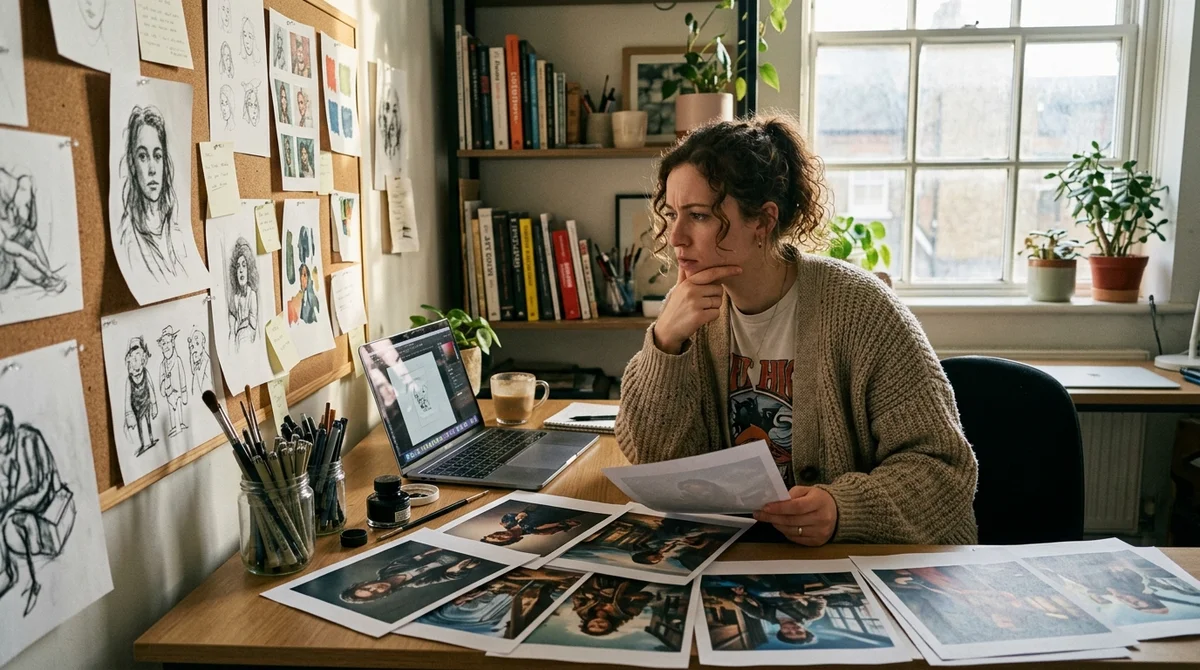
Artist and journalist Molly Crabapple, in a column for the Guardian, called what is happening around training models on other people's work the biggest art heist in history. The text brings the debate back not to image quality, but to a more uncomfortable question: who paid for the data on which the entire industry grew?
Where the conflict came from
The dispute did not begin with abstract fears, but with very concrete resemblances. In 2022–2023, artists began finding images online that looked suspiciously like their style; sometimes it was enough to type an artist's name into a prompt. AP reported that Kelly McKernan, Karla Ortiz and Sarah Andersen filed a lawsuit against Stability AI, Midjourney and DeviantArt, alleging that their works and millions of other images were used to train models without consent and without payment. For artists, this is not an experiment with a new brush, but the commercial repackaging of labor already done.
The heart of the dispute is not only the generators themselves, but the data chain behind them. AP linked the AI image boom to the LAION dataset, which indexed huge volumes of publicly available pictures. At a US Senate hearing in 2023, Ben Brooks, head of public policy at Stability AI, acknowledged that no payment arrangement for artists existed at the time. For critics, that is enough to call the current market model asymmetric: tech companies get raw material almost for free, while authors face competition from systems trained on their own portfolios.
How artists responded
Lawsuits were not the only response. In May 2023, the Center for Artistic Inquiry and Reporting published an open letter calling for limits on the use of AI illustration in media; it was backed by journalists, editors, authors and artists. The letter says image generators are trained on millions of protected works without the creators' knowledge or consent, and that the output is already pushing people out of editorial commissions. Crabapple became one of the faces of this campaign, and her current column essentially continues the same line.
"This is effectively the biggest art heist in history."
- Use of others' work without consent
- No payment and no credit
- Cheap imitations of recognizable styles
- Editorial illustration replaced by machine-made images
- Disappearance of entry-level commissions for young artists
The cost to the market
Crabapple's most painful argument concerns economics, not aesthetics. Illustration already lived on thin margins, and generative services gave editors and brands an ultra-cheap alternative available in minutes. The first to vanish are not star contracts but small commissions, where young authors built portfolios and learned to work with clients. If that layer of the market dissolves, the industry loses not only current income but also its future professionals.
Statements from the tech companies themselves add fuel. In 2024, Mira Murati said that some creative jobs may disappear, and allowed that some of them perhaps should not have existed in their previous form. To artists, such wording sounds like an admission of the logic of replacement: first the platform learns from human labor, then that same labor is declared redundant.
That is why the dispute over AI art long ago moved beyond questions of taste. It is now a question of who owns cultural raw material and who gets paid when that material is turned into a product.
What this means
Crabapple's column matters not because it offers a new legal argument, but because it again makes visible the cost of generative AI to the creative market. Until courts, publishers and platforms agree on rules for licensing, consent and compensation, part of the industry will see every model improvement as a faster form of seizing other people's work. And the longer that gap persists, the harder it will be to convince authors that AI is a tool of collaboration rather than a system of one-sided benefit.
- Oct 29, 2026Modal Passes $1B ARR and Hits a $16B Valuation on Demand for Sandboxes
- Oct 26, 2026Getty Images Says It Will File for Bankruptcy to Go Private; Shares Fall 68%
- Oct 26, 2026Getty Images files for bankruptcy to restructure as shares crash 68%
- Oct 26, 2026Getty Images prepares to file for bankruptcy: shares plunge 68% as owners put in $533 million
Key Questions Answered
Where the conflict came from?
The dispute did not begin with abstract fears, but with very concrete resemblances. In 2022–2023, artists began finding images online that looked suspiciously like their style; sometimes it was enough to type an artist's name into a prompt. AP reported that Kelly McKernan, Karla Ortiz and Sarah Andersen filed a lawsuit against Stability AI, Midjourney and DeviantArt, alleging that their works and millions of other images were used to train models without consent and without payment. For artists, this is not an experiment with a new brush, but the commercial repackaging of l
How artists responded?
Lawsuits were not the only response. In May 2023, the Center for Artistic Inquiry and Reporting published an open letter calling for limits on the use of AI illustration in media; it was backed by journalists, editors, authors and artists. The letter says image generators are trained on millions of protected works without the creators' knowledge or consent, and that the output is already pushing people out of editorial commissions. Crabapple became one of the faces of this campaign, and her current column essentially continues the same line. "This is effectively the biggest
What are the key details on The cost to the market?
Crabapple's most painful argument concerns economics, not aesthetics. Illustration already lived on thin margins, and generative services gave editors and brands an ultra-cheap alternative available in minutes. The first to vanish are not star contracts but small commissions, where young authors built portfolios and learned to work with clients. If that layer of the market dissolves, the industry loses not only current income but also its future professionals. Statements from the tech companies themselves add fuel. In 2024, Mira Murati said that some creative jobs may disap
Test Frontier LLMs & Autonomous Agents in One Workspace
Run Claude Opus 5.5, GPT-6, Gemini 3.1, and DeepSeek side-by-side in Nomad AI (nomadnet.ai) — unified model routing, deep research, and multimodal workflows under one subscription.
The AI world, distilled — once a week
Seven stories that actually mattered, hand-picked. No noise, no reposts, no press releases.
Done! Check your inbox for a confirmation.