Zine makers push back against AI as independent publishers defend handmade culture
AI has reached even zine culture, one of the most handmade and independent forms of self-publishing. Some creators use it for layout, HTML and digital publishing. Others put out anti-AI zines, run submissions through AI detectors, and argue over whether generative tools can coexist with a DIY ethic that values a slow, imperfect, fully human and handmade creative process.
AI-processed from Guardian; edited by Hamidun News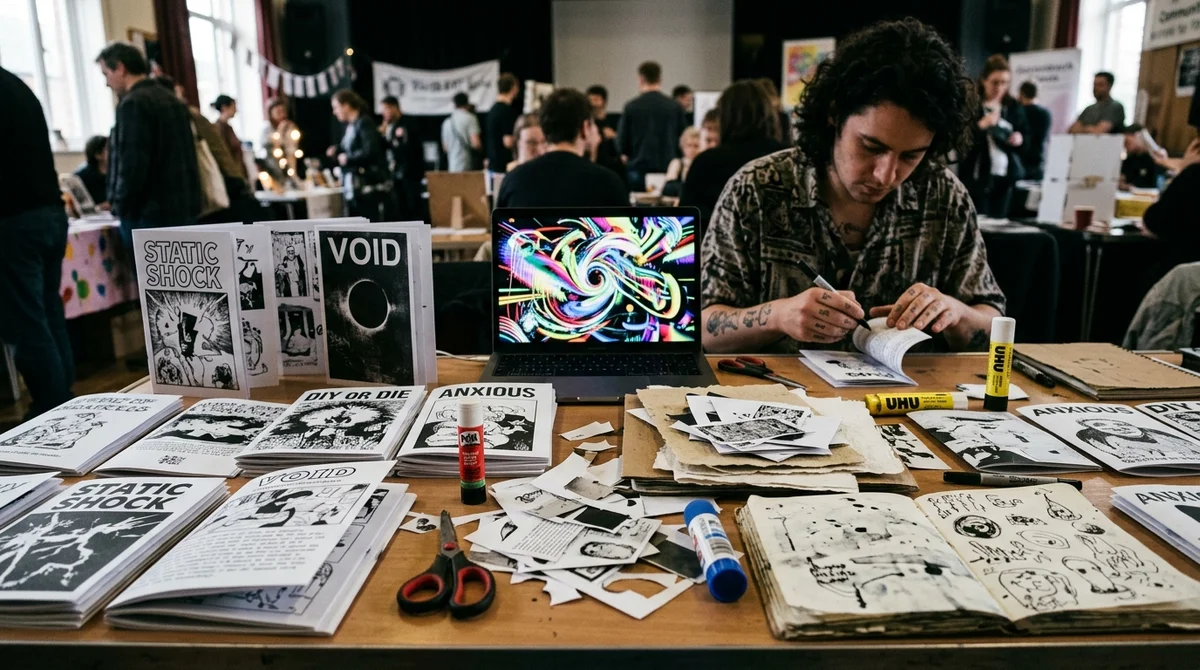
AI has reached one of the most handmade, low-budget forms of independent art: zines. For some creators, it's a handy tool for layout and publishing. For many others, the very idea of a machine taking part runs against the point of DIY culture.
Why the dispute flared up
For decades, zines have been part of the counterculture. The punk scene, queer activism, Black feminism and other movements ran through them, none of which needed big publishers or expensive printing. Their strength has always been accessibility: a sheet of paper, glue, scissors, a photocopier and a personal voice. That's why AI's arrival here reads not just as a new technology but as a blow to the genre's core logic. If a zine can be assembled from prompts and ready-made templates, many creators ask, what's left of the personal gesture?
Rachel Goldfinger, a Philadelphia artist and video editor who released the anti-AI zine I Should Be Allowed To Think, says the technology trains people out of thinking critically while making life harder for artists who already struggle to hold on to work. For her, zines are precisely the form where AI looks least appropriate, because they're supposed to be rough, handmade and pieced together on the fly. Her stance is about ethics as much as aesthetics: the slow process counts as part of the statement, not an obstacle to it.
Where AI is already in use
There's no outright ban, of course. Some designers and writers are already trying AI in digital zines, especially when the end product is an online publication rather than a printed object. They use the technology to generate images, rework layouts and speed up the technical side of the work. The Guardian cites a 97-page zine with a '90s aesthetic that designer Jesse Pimenta and writer Chase Batchelor made using Figma's AI tools. Another creator, IT engineer Steve Simkins, used ChatGPT to put together the HTML and publish a website for his photo zine, while keeping the content itself his own.
- Generating illustrations and visual elements
- Rearranging pages and blocks without lengthy manual layout
- Writing HTML and publishing a site for an online zine
- Speeding up routine production steps
For parts of the scene, this is more experiment than new norm. Jeremy Leslie, founder of the MagCulture shop and platform, says the AI zines he knows of mostly used the technology deliberately — to test its limits or to show how far it falls short of human creativity. Still, the fact that such work exists shows the debate is no longer about whether AI will come to zine culture, but whether it can fit in without losing the point.
How creators are responding
The harshest critics are answering not with social media posts but with new anti-AI zines. Australian artist Maddie Marshall spent a year on the 92-page zine Art v AI after her workplace started pressuring her to use such tools. London feminist publication Polyester has gone further: founder Ione Gamble says the team uses AI for neither images nor text, and now runs submissions through an AI detector to avoid publishing machine writing passed off as human.
Others on the scene take a more nuanced view. Zoe Thompson, creator of Sweet-Thang, thinks working with AI involves experimentation but almost no art, because the beauty of creative work comes precisely from its slowness. Even those who accept that the two approaches can coexist doubt it will be harmonious. Distributors, meanwhile, are more relaxed: if a work is genuinely interesting and alive, some outlets are willing to support it regardless of whether AI was used.
"I don't want to speed up the process.
For me, that takes away the whole point."
What it means
The zine debate neatly captures the central conflict of the generative AI era: the question is no longer whether the technology can do something, but where using it destroys the value of the process itself. For DIY culture this hits especially hard, because here manual labor isn't a cost — it's the content.
- Nov 1, 2026Local models lose to Opus and Codex: 0.21 on a MacBook versus 1.00 for Codex
- Nov 1, 2026Kimi scores 96.2% on a 1C database analytics test and emerges as a fallback if Claude access is blocked
- Nov 1, 2026OpenAI Rewrites GPT Behavior Rules: Five Values and a Chain of Command
- Nov 1, 2026Google admits AI Mode cuts search revenue, shares fall 15%
Key Questions Answered
Why the dispute flared up?
For decades, zines have been part of the counterculture. The punk scene, queer activism, Black feminism and other movements ran through them, none of which needed big publishers or expensive printing. Their strength has always been accessibility: a sheet of paper, glue, scissors, a photocopier and a personal voice. That's why AI's arrival here reads not just as a new technology but as a blow to the genre's core logic. If a zine can be assembled from prompts and ready-made templates, many creators ask, what's left of the personal gesture? Rachel Goldfinger, a Philadelphia ar
Where AI is already in use?
There's no outright ban, of course. Some designers and writers are already trying AI in digital zines, especially when the end product is an online publication rather than a printed object. They use the technology to generate images, rework layouts and speed up the technical side of the work. The Guardian cites a 97-page zine with a '90s aesthetic that designer Jesse Pimenta and writer Chase Batchelor made using Figma's AI tools. Another creator, IT engineer Steve Simkins, used ChatGPT to put together the HTML and publish a website for his photo zine, while keeping the cont
How creators are responding?
The harshest critics are answering not with social media posts but with new anti-AI zines. Australian artist Maddie Marshall spent a year on the 92-page zine Art v AI after her workplace started pressuring her to use such tools. London feminist publication Polyester has gone further: founder Ione Gamble says the team uses AI for neither images nor text, and now runs submissions through an AI detector to avoid publishing machine writing passed off as human. Others on the scene take a more nuanced view. Zoe Thompson, creator of Sweet-Thang, thinks working with AI involves exp
Test Frontier LLMs & Autonomous Agents in One Workspace
Run Claude Opus 5.5, GPT-6, Gemini 3.1, and DeepSeek side-by-side in Nomad AI (nomadnet.ai) — unified model routing, deep research, and multimodal workflows under one subscription.
The AI world, distilled — once a week
Seven stories that actually mattered, hand-picked. No noise, no reposts, no press releases.
Done! Check your inbox for a confirmation.