Google backs a Texas data center being prepared for power from a large gas plant
Google has invested in the Goodnight data center in Texas, where two of the six buildings, according to the permit application, could run on on-site gas generation. The filing cites emissions of more than 4.5 million tonnes a year, comparable to nearly a million gasoline cars. The story reflects a growing trend: AI campuses are increasingly built with local generation because power grids cannot keep up with demand.
AI-processed from Wired; edited by Hamidun News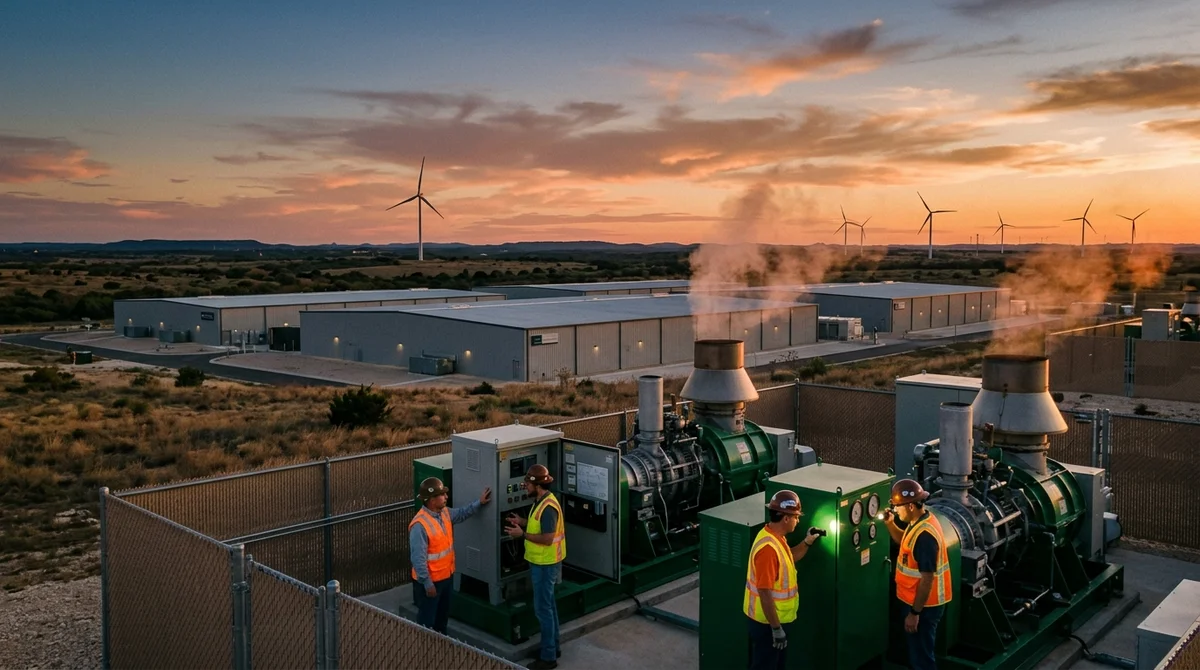
Google has invested in Goodnight, a new data center in Texas that, according to project documents, could partly run on its own gas generation. It is another sign that AI infrastructure increasingly depends not on a "green" agenda but on fast access to power.
How the project works
Goodnight is a campus in Armstrong County, Texas, being built by infrastructure company Crusoe with Google's participation. In November, Google announced $40 billion in investments in Texas AI infrastructure, and this site is part of that package. According to the environmental permit application, the site will have six buildings: the first four will connect to the shared power grid, while the fifth and sixth are planned to run on a private gas plant located on the campus itself.
The most contentious point is the scale of emissions. The documents cite more than 4.5 million tonnes of greenhouse gases a year. That is comparable to putting more than 970,000 gasoline cars on the road. Google notes that it does not yet have a final contract for gas power supply for this particular campus. But the project's design shows the option is already being considered seriously, which means it has become part of the new logic of building large AI facilities.
Why developers choose gas
Alongside gas generation, Goodnight also has about 265 megawatts of wind capacity declared. But the main takeaway is not that Google has abandoned renewable energy; it is that renewables alone are no longer enough to bring large data centers online on the required schedule. Developers run into long grid-interconnection queues and try to get electricity directly, bypassing infrastructure bottlenecks.
"Grid growth is not keeping up with demand from AI, so gas has become a critical bridge," says
Crusoe co-founder Cully Cavness.
Here is what makes this case telling:
- more than 900 megawatts of gas capacity is under consideration at the site;
- some buildings are to receive power not from the grid but from on-site generation;
- nearly 100 gigawatts of gas projects are being prepared for data centers in the US;
- similar campuses from other players are planned with even higher emissions.
This approach is called behind-the-meter power: the facility builds its own generation next to where the electricity is consumed. For AI companies, it is a way to avoid waiting years for a grid connection and to launch clusters for model training and inference faster. The problem is that almost everywhere the "bridge" turns out to be natural gas, not storage, solar plants or other low-carbon sources, which are harder to deploy at the required scale and pace.
Climate and politics
The story is especially sensitive for Google because the company was long one of Big Tech's main symbols of climate pledges. Amid the AI boom, that is getting harder: over the past five years, Google's total emissions have risen noticeably, although the company says emissions from its data centers fell 12 percent last year. It is also pursuing alternative scenarios: another Texas site, in Haskell County, is promised to be built next to a new solar plant and an energy storage system.
The political backdrop is shifting too. The White House recently convened the largest tech companies to discuss how to add new power capacity without putting pressure on consumers. For the market, though, that is more a signal than a real mechanism. Meanwhile, US senators have begun asking AI companies and data center operators to explain why they increasingly choose gas over renewable sources for new campuses.
What this means
Demand for AI computing is growing faster than power grids and clean generation. So even companies with strict climate goals are starting to consider on-site gas plants as a fast way to bring new capacity online. For the market, this is bad news in terms of emissions, but an important marker of what the race for AI infrastructure looks like in practice.
- Nov 1, 202616 models tested on 7 search tools: Exa averaged 10.5 out of 14, SearXNG about 3
- Nov 1, 2026Google's StreamVibe video agent beats other models by 10.7% on response timing and quality
- Nov 1, 2026OpenAI Rewrites GPT Behavior Rules: Five Values and a Chain of Command
- Nov 1, 2026Voice bots built on LLMs turn to Jev, a fast classifier, for decisions in 200–500 ms
Key Questions Answered
How the project works?
Goodnight is a campus in Armstrong County, Texas, being built by infrastructure company Crusoe with Google's participation. In November, Google announced $40 billion in investments in Texas AI infrastructure, and this site is part of that package. According to the environmental permit application, the site will have six buildings: the first four will connect to the shared power grid, while the fifth and sixth are planned to run on a private gas plant located on the campus itself. The most contentious point is the scale of emissions. The documents cite more than 4.5 million
Why developers choose gas?
Alongside gas generation, Goodnight also has about 265 megawatts of wind capacity declared. But the main takeaway is not that Google has abandoned renewable energy; it is that renewables alone are no longer enough to bring large data centers online on the required schedule. Developers run into long grid-interconnection queues and try to get electricity directly, bypassing infrastructure bottlenecks. "Grid growth is not keeping up with demand from AI, so gas has become a critical bridge," says Crusoe co-founder Cully Cavness. Here is what makes this case telling: more than 9
What are the key details on Climate and politics?
The story is especially sensitive for Google because the company was long one of Big Tech's main symbols of climate pledges. Amid the AI boom, that is getting harder: over the past five years, Google's total emissions have risen noticeably, although the company says emissions from its data centers fell 12 percent last year. It is also pursuing alternative scenarios: another Texas site, in Haskell County, is promised to be built next to a new solar plant and an energy storage system. The political backdrop is shifting too. The White House recently convened the largest tech c
Test Frontier LLMs & Autonomous Agents in One Workspace
Run Claude Opus 5.5, GPT-6, Gemini 3.1, and DeepSeek side-by-side in Nomad AI (nomadnet.ai) — unified model routing, deep research, and multimodal workflows under one subscription.
The AI world, distilled — once a week
Seven stories that actually mattered, hand-picked. No noise, no reposts, no press releases.
Done! Check your inbox for a confirmation.