Google-linked data centers prepare record $5.7 billion high-yield bond sale
Google-linked data centers are preparing a $5.7 billion bond offering, which could become the largest high-yield placement for AI infrastructure. The deal shows that the market is increasingly willing to finance not only models and chips but also the physical foundation of the boom: server capacity, cooling, power, new data center sites and long-term resources for large cloud services.
AI-processed from Bloomberg Tech; edited by Hamidun News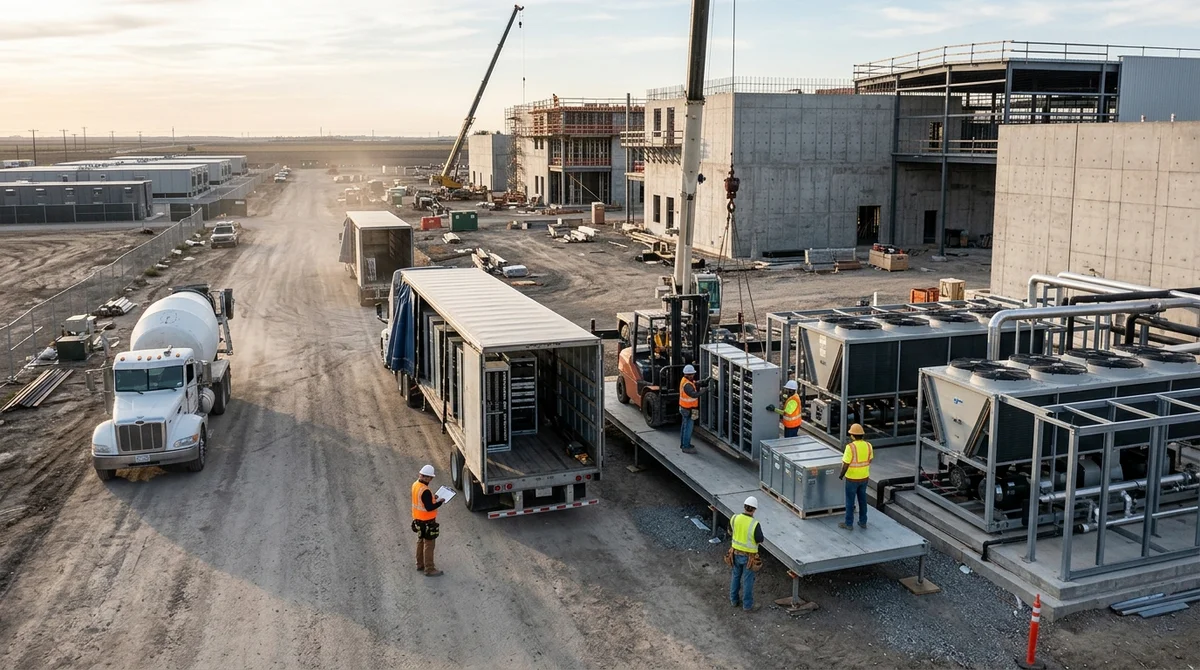
Google-linked data centers are preparing a $5.7 billion high-yield bond offering. If the deal closes at the stated size, it will be the largest issue of its kind to finance infrastructure for the artificial intelligence boom.
Why this is a record
This is not just a large debt offering but a symbol of a new stage in the AI race. Not long ago, the main investors in artificial intelligence were considered to be model developers and chipmakers. Now attention has shifted to a less visible but critically important part of the chain: the data centers that provide compute, data storage and power for AI services. The more actively companies launch new models and enterprise products, the higher the demand for racks, servers, cooling and power capacity.
The $5.7 billion figure shows how capital-intensive this market has become. For the industry, it is not just a way to borrow money but a signal that investors are ready to finance infrastructure even through the riskier bond segment. When deals of this scale happen in high-yield bonds, the market is effectively saying: demand for compute is so high that a record amount of debt capital can be raised for it now, rather than stretching construction over years.
Where the money will go
The logic of the deal is clear: the AI boom requires not only models but also a physical base for them. Data centers need new buildings, accelerators, networking equipment, cooling systems and grid connections. Even when a project is built around demand from large customers such as Google, expansion still requires huge upfront investment that does not pay back right away. With AI infrastructure, the money is needed in advance: demand appears quickly, while bringing new capacity online takes months and sometimes years.
- Building and expanding sites for server halls
- Buying infrastructure for dense AI workloads
- Strengthening cooling and power supply systems
- Preparing capacity for long-term use by large customers
That is why the debt capital market is becoming one of the main tools for AI construction. Operators' own funds are often insufficient, and bank financing does not always cover projects of this scale and pace. Tapping the bond market lets them raise a large sum quickly and align financing with real demand from cloud platforms, model developers and enterprise customers. For the market, it is also a convenient test of investor appetite for the next wave of AI assets.
What the market is watching
There is a flip side to this story, though. High-yield bonds cost more than ordinary debt because investors demand a risk premium. This means the parties to the deal are betting on the AI boom continuing and on demand for capacity staying high long enough to service this volume of borrowing without squeezing project economics. If growth slows or the cost of money rises further, the burden on operators will increase.
For Google this is also an important marker, even if the deal formally involves data centers linked to the company rather than a direct offering by Alphabet itself. The more capital the market is willing to channel into infrastructure around the largest cloud and AI players, the stronger their ecosystem becomes. At the same time, it raises the barrier to entry for smaller competitors: building a modern AI-ready data center without access to large capital is becoming harder.
What this means
The AI market is finally ceasing to be only a story about models and chatbots. The main contest is increasingly shifting to infrastructure: whoever has land, electricity, cooling, servers and access to money gains a strategic advantage. The record attempt to raise $5.7 billion shows that the next phase of the AI boom will be decided not only in labs but also on data center construction sites. That is why financial deals around data centers are becoming as important an indicator of the AI market as new model releases.
- Nov 20, 2026GitLab makes Duo Agent Platform credits last up to 2x longer
- Nov 20, 2026Superhuman opens Go to 20 third-party agents as the assistant passes 1 million users
- Nov 20, 2026Anthropic raised $104.8 billion in its IPO, but its infrastructure commitments total $1 trillion
- Nov 20, 2026Abundant runs 2 million sandboxes a month and pays for average usage, not peak
Key Questions Answered
Why this is a record?
This is not just a large debt offering but a symbol of a new stage in the AI race. Not long ago, the main investors in artificial intelligence were considered to be model developers and chipmakers. Now attention has shifted to a less visible but critically important part of the chain: the data centers that provide compute, data storage and power for AI services. The more actively companies launch new models and enterprise products, the higher the demand for racks, servers, cooling and power capacity.
Where the money will go?
The logic of the deal is clear: the AI boom requires not only models but also a physical base for them. Data centers need new buildings, accelerators, networking equipment, cooling systems and grid connections. Even when a project is built around demand from large customers such as Google, expansion still requires huge upfront investment that does not pay back right away.
What the market is watching?
There is a flip side to this story, though. High-yield bonds cost more than ordinary debt because investors demand a risk premium. This means the parties to the deal are betting on the AI boom continuing and on demand for capacity staying high long enough to service this volume of borrowing without squeezing project economics. If growth slows or the cost of money rises further, the burden on operators will increase.
Test Frontier LLMs & Autonomous Agents in One Workspace
Run Claude Opus 5.5, GPT-6, Gemini 3.1, and DeepSeek side-by-side in Nomad AI (nomadnet.ai) — unified model routing, deep research, and multimodal workflows under one subscription.
The AI world, distilled — once a week
Seven stories that actually mattered, hand-picked. No noise, no reposts, no press releases.
Done! Check your inbox for a confirmation.