Google pushes ahead with a gas-powered AI data center in Texas despite its climate goals
Google has confirmed its involvement in the Goodnight project in Armstrong County, Texas, where Crusoe is building a data center campus and a 933 MW gas power plant. Cleanview estimates the facility could emit up to 4.5 million tons of CO2 a year, more than all of San Francisco. Google says it does not yet have a contract for the plant itself. Still, the story shows how the race for AI capacity is already reshaping Big Tech's climate agenda.
AI-processed from Guardian; edited by Hamidun News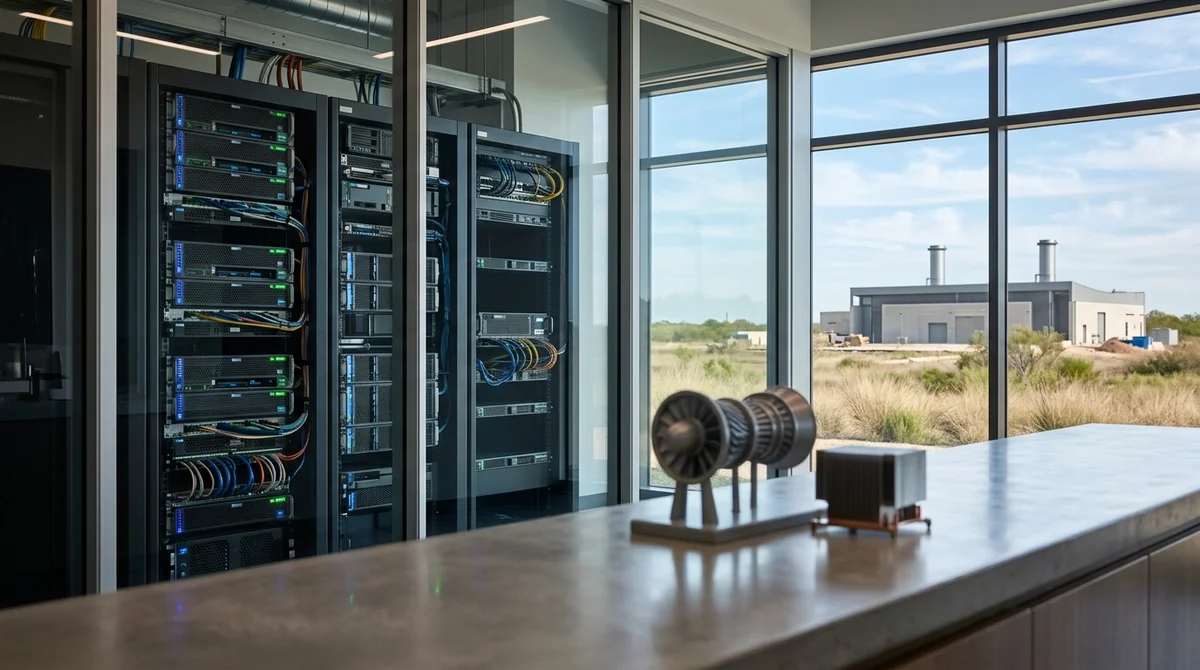
Google has confirmed a partnership on the Goodnight data center in Texas, where a large gas power plant is planned next door. For a company that spent years marketing itself as a clean energy leader, it looks like a notable reversal driven by the AI race.
The Goodnight project
The campus sits in Armstrong County in northern Texas, and Google is developing it with Crusoe Energy. According to Cleanview, Crusoe filed paperwork in January to build a 933 MW gas power plant directly on the site of the future campus. The permit application states that the plant will run off-grid and power at least two buildings. Satellite imagery cited by the research firm shows that construction is already underway.
The most striking figure in this story is the emissions estimate. If the plant comes online in the configuration described, it could emit up to 4.5 million tons of CO2 a year. For comparison, that is more than the annual emissions of all of San Francisco.
Google, however, has not confirmed how much electricity it plans to buy from the plant. A company spokesperson said there is no contract for this Texas plant yet and that negotiations are still ongoing.
A reversal in climate strategy
The shift stands out against Google's earlier commitments. Back in 2020, the company set a goal of reaching net zero and running its operations on carbon-free energy by 2030. For years, Google invested in wind, solar, geothermal, and nuclear power, and championed the idea of 24/7 carbon-free energy.
But as AI workloads grew, that framework started to come apart. In its 2023 report, Google acknowledged that it no longer maintains operational carbon neutrality as previously defined, and later materials began describing its climate targets as "moonshots" — ambitions with no firm guarantee of success.
The numbers also undercut the narrative. In 2024, Google reported that its greenhouse gas emissions had risen 48% compared with 2019, citing data center energy consumption as one of the reasons. According to Cleanview, Google's data centers consumed 30.8 million megawatt-hours of electricity in 2024 alone — roughly double the figure from four years earlier. Against that backdrop, a gas plant without carbon capture looks less like an exception and more like a newly acceptable part of the energy mix.
The race for power
The Texas story matters beyond this one project. It shows how quickly AI is turning energy into a strategic constraint for Big Tech. Google is ramping up capital spending, building new sites, and experimenting with a range of power sources at the same time: wind and solar, gas, batteries, geothermal, and nuclear.
Cleanview researchers track 63 Google data center projects across 20 US states, and in many cases the company is no longer simply buying power from the grid but designing data centers paired with their own on-site generation.
What we know about the current scale:
- Google has announced a $40 billion investment in cloud and AI infrastructure in Texas through 2027
- The new Goodnight campus is just one part of that expansion
- Loads on the order of 800–1000 MW are being considered for Google's new sites
- The company also has clean energy projects in the region, including a wind farm partnership
- Other tech giants are already weighing similar gas-based setups for AI data centers
What it means
The AI boom is no longer clashing with climate policy only in theory — it is already rewriting that policy through concrete infrastructure decisions. If even Google, long seen as the most disciplined clean energy player among the tech giants, is willing to lean on gas to bring data centers online faster, that sends a signal to the whole industry: right now, available capacity matters more than past environmental pledges.
- Nov 1, 202616 models tested on 7 search tools: Exa averaged 10.5 out of 14, SearXNG about 3
- Nov 1, 2026Google's StreamVibe video agent beats other models by 10.7% on response timing and quality
- Nov 1, 2026OpenAI Rewrites GPT Behavior Rules: Five Values and a Chain of Command
- Nov 1, 2026Voice bots built on LLMs turn to Jev, a fast classifier, for decisions in 200–500 ms
Key Questions Answered
What are the key details on The Goodnight project?
The campus sits in Armstrong County in northern Texas, and Google is developing it with Crusoe Energy. According to Cleanview, Crusoe filed paperwork in January to build a 933 MW gas power plant directly on the site of the future campus. The permit application states that the plant will run off-grid and power at least two buildings. Satellite imagery cited by the research firm shows that construction is already underway. The most striking figure in this story is the emissions estimate. If the plant comes online in the configuration described, it could emit up to 4.5 million
What are the key details on A reversal in climate strategy?
The shift stands out against Google's earlier commitments. Back in 2020, the company set a goal of reaching net zero and running its operations on carbon-free energy by 2030. For years, Google invested in wind, solar, geothermal, and nuclear power, and championed the idea of 24/7 carbon-free energy. But as AI workloads grew, that framework started to come apart. In its 2023 report, Google acknowledged that it no longer maintains operational carbon neutrality as previously defined, and later materials began describing its climate targets as "moonshots" — ambitions with no fi
What are the key details on The race for power?
The Texas story matters beyond this one project. It shows how quickly AI is turning energy into a strategic constraint for Big Tech. Google is ramping up capital spending, building new sites, and experimenting with a range of power sources at the same time: wind and solar, gas, batteries, geothermal, and nuclear. Cleanview researchers track 63 Google data center projects across 20 US states, and in many cases the company is no longer simply buying power from the grid but designing data centers paired with their own on-site generation. What we know about the current scale: G
Test Frontier LLMs & Autonomous Agents in One Workspace
Run Claude Opus 5.5, GPT-6, Gemini 3.1, and DeepSeek side-by-side in Nomad AI (nomadnet.ai) — unified model routing, deep research, and multimodal workflows under one subscription.
The AI world, distilled — once a week
Seven stories that actually mattered, hand-picked. No noise, no reposts, no press releases.
Done! Check your inbox for a confirmation.