Falcon Tech explained how machine vision for cities grew into a network of 4,000 systems
Falcon Tech showed how a parking monitoring project grew into an urban video analytics platform. The company says its system already runs in Moscow on 4,000+ systems and detects events with more than 98% accuracy in real time. Next are monitoring of transport infrastructure, incidents and environmental parameters to reduce the share of manual monitoring.
AI-processed from Habr AI; edited by Hamidun News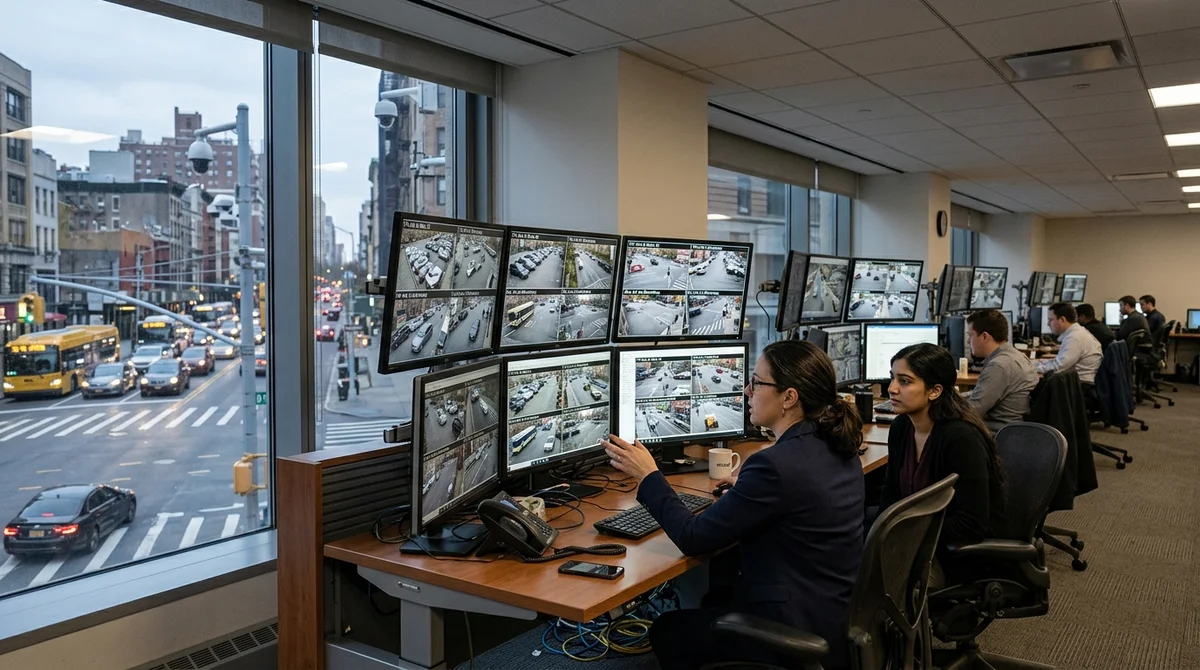
Falcon Tech shared how its computer vision system for cities has evolved from parking control into a large-scale video analytics platform already in use in Moscow. According to the company, a network of over 4,000 hardware-software complexes helps detect violations, assess infrastructure load, and transmit data to city services, with the system supported by a team of over 140 specialists.
From Parking to Platform
The project started in 2017 with a fairly practical task: the city needed not just another stream of video from cameras, but a working tool for managing parking space. It was necessary to understand whether a spot was occupied, who parked on a lawn or disabled spot, and how to collect evidence without paper-based routine. In 2017–2019, the company assembled its first 100 complexes that not only filmed the street but automatically generated events for further verification and response.
The main challenge turned out to be not the recognition itself, but real-world city conditions. Cameras hang at different angles, at night frames are washed out by headlights, in winter objects are partially covered by snow, and rain and fog sharply degrade image quality. A separate effort went into recognizing license plates and reducing false positives.
In an article, the company writes that in 2024 it began working directly on government contracts with GKU "AMPP," and the overall scale of the system exceeded 4,000 complexes with recognition accuracy above 98%.
"Most violations don't happen because someone decided to deliberately
break the rules, but because everyone got used to the fact that no one watches here."
Where Vision Helps
As the project grew, it became clear that the basic architecture was suitable not only for parking. Falcon Tech effectively converted a point solution into a universal urban video analytics platform that can be adapted for transportation infrastructure, industrial facilities, and other scenarios where streaming data and quick problem signals are important. Now the company is betting not on a single niche but on a product line to avoid dependence on one segment and to leverage the already-developed stack in related tasks.
This approach is also important for deployment: it's easier for a customer to grow an already-installed system than to build a new one from scratch for each use case.
- monitoring parking spot occupancy and parking rule violations;
- detection of fire, smoke, crowd gatherings, and other incidents;
- analysis of transportation facility load and urban infrastructure;
- industrial and facility monitoring based on the same architecture;
- future modules for analyzing pedestrian flows, environmental conditions, and event forecasting.
The company particularly emphasizes that this is not just about surveillance and fines. The point of such a system is to reduce manual oversight, give the city a more complete picture of what is happening, and turn video into management data. As an example, benefits for city improvement are cited: in 2023, according to the article, repairs of 1,100 courtyards were funded with fine revenues, and in 2025, over 10 billion rubles earned from paid parking were directed to city work. The next step is to add more modules related to safety, transportation, and environmental monitoring.
What This Means
Falcon Tech's story shows how AI in the urban environment is moving from demonstrations to infrastructure: value is created not by the camera alone or a neural network alone, but by a combination of models, hardware, integrations, and a clear response scenario. This is also a way to build new services on top of already-functioning urban infrastructure. For the market, this is an important signal: computer vision in the city is becoming not an experiment, but a basic digital layer that can scale to transportation, construction, safety, and urban planning.
Want to stop reading about AI and start using it?
AI News is a curated feed of AI/tech news. Hamidun Academy teaches you to use AI systematically in your work.
The AI world, distilled — once a week
Seven stories that actually mattered, hand-picked. No noise, no reposts, no press releases.
Done! Check your inbox for a confirmation.