Wiren Board connected machine vision, WMS, and the conveyor system in a 41-destination sorting line
A warehouse launched an automatic 41-destination sorting line that processes up to 4,000–5,000 boxes per hour. The key part of the project was not the conveyor itself, but the integration of three independent systems: machine vision, WMS, and line control. An operator interface and remote access were also added to speed up fault tracking and service the facility without downtime.
AI-processed from Habr AI; edited by Hamidun News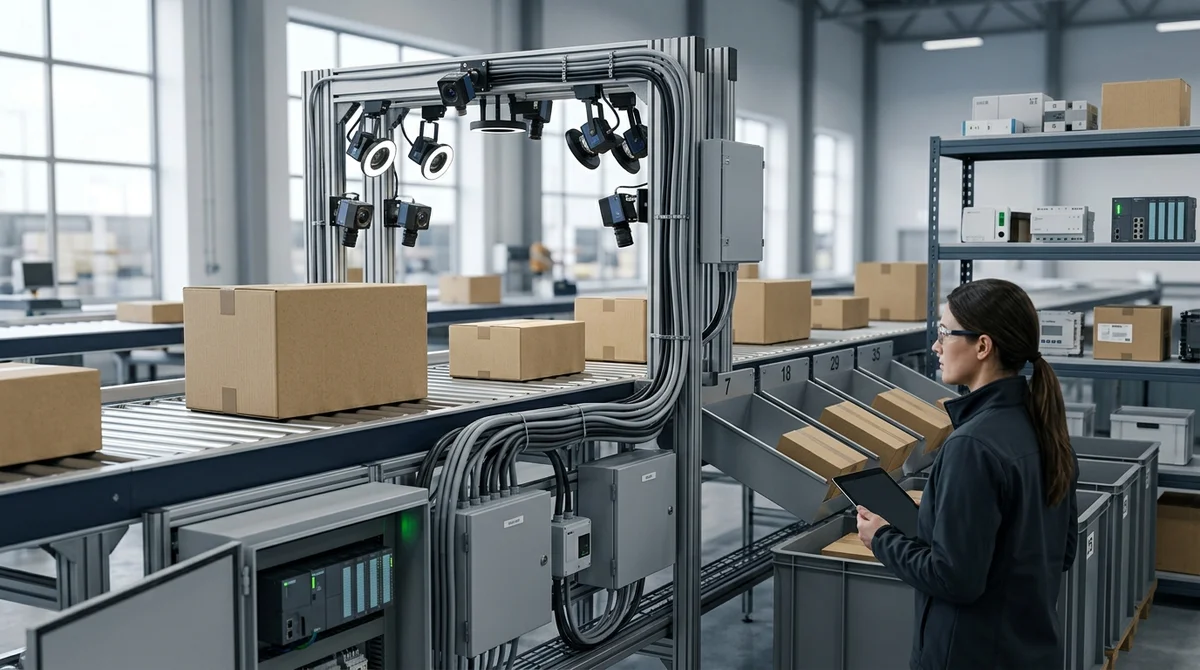
On one of the distribution warehouses, an automatic sorting line was launched with 41 sorting destinations and throughput of up to 5,000 boxes per hour. The key task of the project was not only mechanization of the flow, but ensuring that machine vision, WMS, and conveyor management system work as a single contour.
How the line works
The line itself solves a typical task for a large warehouse: receive a box, determine where it should go next, and send it to the correct channel without manual re-sorting. For the business, this directly affects shipment speed, error count, and shift load. When the flow moves thousands of boxes per hour, even a small delay at each stage quickly becomes a bottleneck for the entire distribution center.
The throughput of 4,000–5,000 boxes per hour looks like a characteristic of the conveyor itself, but in practice it depends on the consistency of all components. If the camera is slow with recognition, the WMS doesn't return the route, or the controller doesn't receive the command in time, the box will go to the wrong place. This is why the project hinged not on a single mechanism, but on precise synchronization of data and actions between independent systems in a single cycle.
Where the challenge was
The integrator had to connect three independent layers, each with its own logic, interfaces, and pace of operation. Machine vision identifies the box and reads its parameters, WMS knows the warehouse accounting rules and destination address, and the conveyor management system controls the physical movement of the flow. Each can work normally on its own, but value appears only when there are no gaps in data and timing between them.
- Machine vision identifies the box and its parameters
- WMS returns the route and sorting point
- Conveyor controller sends commands to drives and sensors
- Operator interface shows statuses, errors, and manual actions
Beyond data exchange, the team had to create a custom user interface and enable remote access. This is not just a matter of operation, but system resilience: operators need a clear screen, and engineers need the ability to quickly connect, find the cause of the failure, and restore the line to working order without long downtime. At facilities like this, the service component often determines whether the solution will be convenient or turn into a constant source of manual workarounds.
What was added for operators
In the end, the project went beyond typical conveyor automation. At the warehouse, they assembled an integration in which recognition, accounting, and execution logic work sequentially and almost in real time. For the operator, this looks like a single system, although different products and subsystems work inside. It is precisely this approach that allows scaling the line, changing sorting rules, and maintaining the facility without rewriting the entire solution from scratch with each process change.
For logistics, this is an important signal: the benefit comes not only from automating individual sections, but from proper integration between them. The more precisely cameras, accounting, and automation are connected, the higher the actual throughput and the lower the cost of error. This is why such projects become not a showcase of technology, but a practical tool for warehouses where the volume of flow no longer leaves room for manual coordination. And this changes the economics of the warehouse.
What this means
The story of the 41-direction line shows where warehouse automation is heading: value is shifting from individual components to a combination of machine vision, accounting systems, and industrial control. For the market, this means growing demand for solutions that can not only sort boxes, but integrate the entire process into one managed digital chain. This is especially important for distribution centers, where every minute of downtime quickly turns into direct losses.
Need AI working inside your business — not just in your newsfeed?
I build production AI for companies — custom CRM, internal tools, autonomous agents, workflow automation. Owned by you, shaped to your process, no per-seat tax. Built by Zhemal Khamidun, CPO of AlpinaGPT (AI platform, 6,000+ users).
The AI world, distilled — once a week
Seven stories that actually mattered, hand-picked. No noise, no reposts, no press releases.
Done! Check your inbox for a confirmation.