Falcon Tech showed how Moscow's video monitoring system grew out of parking enforcement
Falcon Tech explained how its computer vision system for urban environments works. The solution started with parking enforcement and later grew into a scalable platform for Moscow that processes data from thousands of hardware-software systems. The system detects violations, assesses infrastructure usage, and reduces the volume of manual checks, but it must remain robust in different weather conditions, at night, and from difficult camera angles.
AI-processed from Habr AI; edited by Hamidun News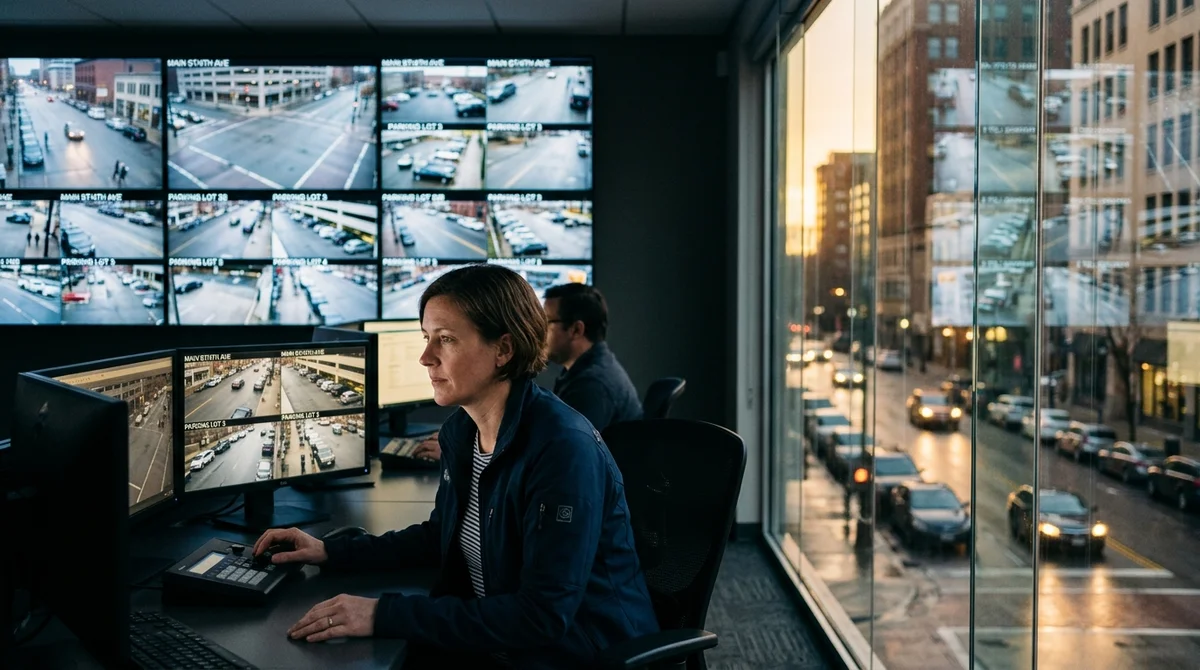
Falcon Tech showed what a "smart city" looks like without unnecessary theory: it's not a showcase with sensors, but a working video monitoring system that helps track parking, roads, and city infrastructure in real time. The company explained how a point task grew into a scalable platform for Moscow, capable of processing data streams from thousands of hardware-software complexes.
From parking to platform
The project's history didn't start with an attempt to digitize the entire city at once, but with a clear practical task: automate parking control and eliminate some manual checks. This kind of start matters in itself. Urban AI systems rarely take off as a "single circuit" from day one — they typically appear where you can quickly show results in numbers: less time spent on monitoring, faster incident detection, better visibility of the actual situation in an area.
Later, the local scenario transformed into a scalable solution. According to the company, the system is already in use in Moscow and works with data coming from thousands of hardware-software complexes. This changes the approach to urban analytics itself: instead of selective checks, there's now a constant stream of observations that can be used not only to react to individual incidents, but also to understand how different elements of the urban environment are loaded throughout the day.
How the system works
At the core of the solution is machine vision that analyzes the video stream and highlights events important for operators and city services. In such a scheme, a camera is only the first layer. Next, the system needs to recognize objects in the frame, understand the context of the scene, separate useful signal from noise, and deliver the result in a form convenient for use.
The more cameras and scenarios there are, the more important both model accuracy and the stability of the entire processing chain become. Looking at the application level, the value of the system is determined not by trendy terminology, but by the set of repeatable operations it can handle without constant human involvement. In an urban circuit this is especially important: there are few operators, many video streams, and events can't be missed even for a short time.
Therefore, the platform must simultaneously help with violation detection, account for traffic dynamics, and quickly raise alarms where human intervention is needed.
- Monitoring of parking zones and violation detection
- Counting and classification of objects in the frame
- Assessment of urban infrastructure load
- Automatic transfer of events for operator review
The main value here isn't that AI "sees the city," but that it removes the tedious task of watching video arrays from people. An operator doesn't need to constantly watch screens waiting for an event: the system itself highlights suspicious or significant episodes. Because of this, manual control doesn't disappear completely, but becomes targeted and noticeably more efficient, especially when dealing with thousands of data sources simultaneously.
Where difficulties arise
The most awkward part of such projects isn't the presentation, but the real environment. Urban video is almost never ideal: rain, snow, night shooting, glare, heavy traffic, object occlusions, and unstable camera angles quickly destroy the "laboratory" accuracy of models. That's why engineering work here goes not only around the neural network, but also around source signal quality, camera tuning, scenario selection, and constant error checking against real cases.
A separate problem is complex scenes where an object needs to be not just detected, but correctly interpreted. For an urban system, it's not enough to spot a car or person: you need to understand what's actually happening in the context of place and time. The same frame could mean a violation, a normal stop, or temporary congestion of a section.
That's why the maturity of such solutions is determined not by fancy demos, but by how stably they work in a heterogeneous urban environment and how carefully they reduce false positives.
What this means
Falcon Tech's case shows that a "smart city" today is above all an applied observation and analysis infrastructure, not an abstract set of AI promises. If the system truly handles Moscow's scale and data stream from thousands of complexes, then computer vision becomes for the city not an experiment, but a working tool that helps spot problems faster and use human resources more rationally.
Need AI working inside your business — not just in your newsfeed?
I build production AI for companies — custom CRM, internal tools, autonomous agents, workflow automation. Owned by you, shaped to your process, no per-seat tax. Built by Zhemal Khamidun, CPO of AlpinaGPT (AI platform, 6,000+ users).
The AI world, distilled — once a week
Seven stories that actually mattered, hand-picked. No noise, no reposts, no press releases.
Done! Check your inbox for a confirmation.