Elon Musk explains how Macrohard will combine xAI and Tesla to build software
Elon Musk has revealed details of Macrohard, a joint xAI and Tesla project meant to mimic the work of a software company. It pairs Grok, a "high-level navigator," with a Tesla agent that can analyze the screen in real time and act on its own through the keyboard and mouse on a computer. The companies plan to run it on Tesla AI4 chips and Nvidia servers.
AI-processed from 3DNews AI; edited by Hamidun News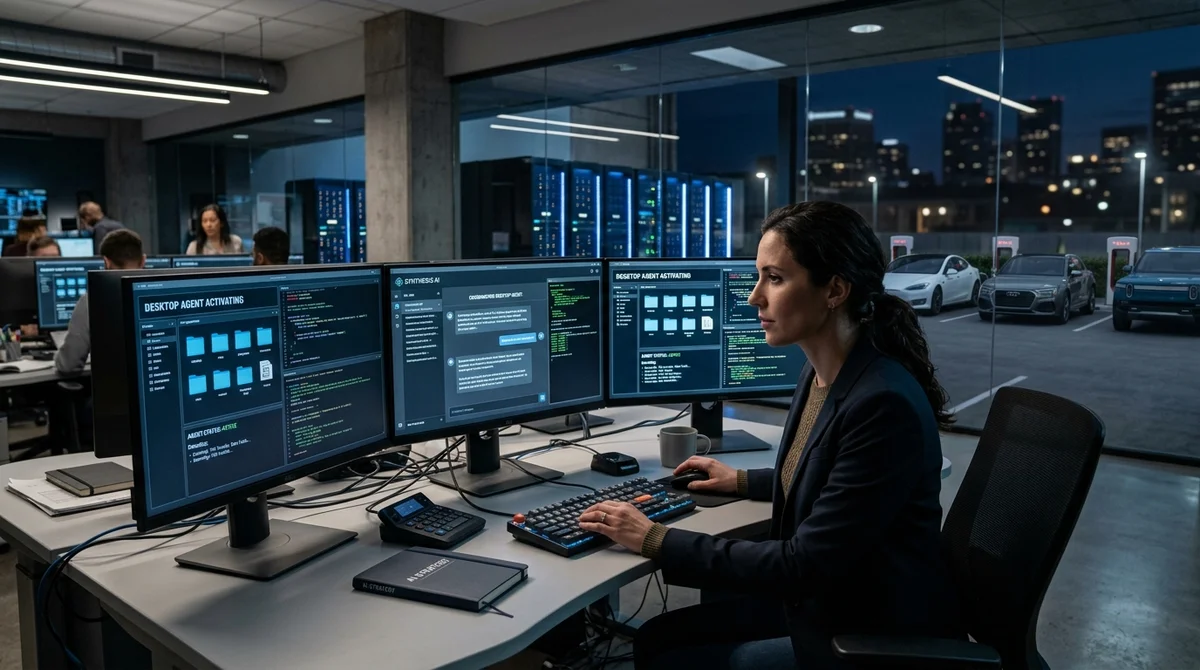
On March 12, 2026, Elon Musk explained in detail for the first time what lies behind the name Macrohard. According to him, it is a joint xAI and Tesla project that is meant not just to help write code, but to reproduce the key functions of an entire software company, from understanding a task to acting on a computer.
How Macrohard works
As Musk describes it, the system is built from two parts. The first is xAI's Grok large language model, which handles high-level logic and serves as a kind of coordinator. The second is an AI agent developed by Tesla that can analyze the image on a computer screen in real time and interact with the interface the way a human does: through the keyboard and mouse. This is no longer a classic chatbot or an ordinary coding assistant, but a "brain plus executor" pairing designed for long chains of actions.
- Grok sets the overall goal and the sequence of steps
- The Tesla agent sees what is happening on screen in real time
- The system can press keys and control the mouse
- The project aims to replicate workflows inside a software team
This design shows that Macrohard is conceived as a tool not only for generating text or code, but for doing applied work in interfaces. Where ordinary AI assistants stop at a suggestion, this one bets on action: open a window, read its contents, pick the right element, make changes and move to the next step. That is why Musk describes the project not as yet another model, but as a system that can reproduce the functions of a whole company.
Why xAI and Tesla
The name Macrohard was long taken as a joke aimed at Microsoft, but it now has a quite practical meaning. Musk claims the project can imitate the functions not of a single employee, but of an entire organization. xAI filed a trademark application for Macrohard in the US back in August 2025, so this is not a random meme but a formalized product being prepared as a separate line of business.
"It allows emulating the functions of entire companies."
The companies plan to run Macrohard on Tesla's in-house AI4 chips paired with Nvidia server hardware. Musk justifies the choice on economic grounds: this combination delivers an acceptable cost at the required performance.
The logic of the two companies' cooperation is clear here. Tesla contributes hardware and experience in computer vision and agentic systems, while xAI supplies the Grok model and the infrastructure for the language layer. In January 2026, Tesla had already agreed to invest about $2 billion in xAI's equity, so the technological union comes with a direct financial link as well.
The context around Macrohard matters too. In February 2026, SpaceX acquired xAI in an all-stock deal: the rocket company was valued at $1 trillion and xAI at $250 billion, giving the combined entity a valuation of $1.25 trillion. Neither company is publicly traded yet, and as of March 2026 the SpaceX IPO was being prepared for the same year. Against this backdrop, Macrohard looks less like a side experiment and more like part of a larger bundle of AI, hardware, infrastructure and the restructuring of Musk's corporate assets.
What it means
Macrohard shows where the next layer of AI products is heading: from models that answer questions to systems that can look at a screen, make decisions and carry out work step by step. If Musk manages to get this pairing working, competition will no longer be only between chatbots, but between platforms that can partly replace entire product and engineering processes. For the enterprise software market, this is a direct signal: the agentic interface is becoming a new battleground.
- Nov 1, 202616 models tested on 7 search tools: Exa averaged 10.5 out of 14, SearXNG about 3
- Nov 1, 2026OpenAI Rewrites GPT Behavior Rules: Five Values and a Chain of Command
- Oct 29, 2026Gemini 4 Carbon tops independent rankings, but only cyber defenders can use it
- Oct 29, 2026Study: A Single Random Failure Makes AI Agents Abandon a Working Tool 11.6% of the Time
Key Questions Answered
How Macrohard works?
As Musk describes it, the system is built from two parts. The first is xAI's Grok large language model, which handles high-level logic and serves as a kind of coordinator. The second is an AI agent developed by Tesla that can analyze the image on a computer screen in real time and interact with the interface the way a human does: through the keyboard and mouse. This is no longer a classic chatbot or an ordinary coding assistant, but a "brain plus executor" pairing designed for long chains of actions. Grok sets the overall goal and the sequence of steps The Tesla agent sees
Why xAI and Tesla?
The name Macrohard was long taken as a joke aimed at Microsoft, but it now has a quite practical meaning. Musk claims the project can imitate the functions not of a single employee, but of an entire organization. xAI filed a trademark application for Macrohard in the US back in August 2025, so this is not a random meme but a formalized product being prepared as a separate line of business. "It allows emulating the functions of entire companies." The companies plan to run Macrohard on Tesla's in-house AI4 chips paired with Nvidia server hardware. Musk justifies the choice on
What it means?
Macrohard shows where the next layer of AI products is heading: from models that answer questions to systems that can look at a screen, make decisions and carry out work step by step. If Musk manages to get this pairing working, competition will no longer be only between chatbots, but between platforms that can partly replace entire product and engineering processes. For the enterprise software market, this is a direct signal: the agentic interface is becoming a new battleground.
Test Frontier LLMs & Autonomous Agents in One Workspace
Run Claude Opus 5.5, GPT-6, Gemini 3.1, and DeepSeek side-by-side in Nomad AI (nomadnet.ai) — unified model routing, deep research, and multimodal workflows under one subscription.
The AI world, distilled — once a week
Seven stories that actually mattered, hand-picked. No noise, no reposts, no press releases.
Done! Check your inbox for a confirmation.