Elon Musk admits the obvious: Optimus's biggest threat will come from China
On a recent call with investors, Elon Musk changed his tone. He no longer simply praises Tesla; he openly says China is the only real competitor in humanoid robotics. In his words, China's manufacturing base and development pace have left everyone else far behind. Musk also described the role of Grok, the AI from his company xAI. It will act as a "conductor" directing a fleet of Optimus robots and self-driving vehicles. Without powerful chips, he says, these machines would remain a pile of metal. The admission shows that the fight for the robotics market is turning into a duel between the US and China, where China has a head start in large-scale production.
AI-processed from 36Kr (36氪); edited by Hamidun News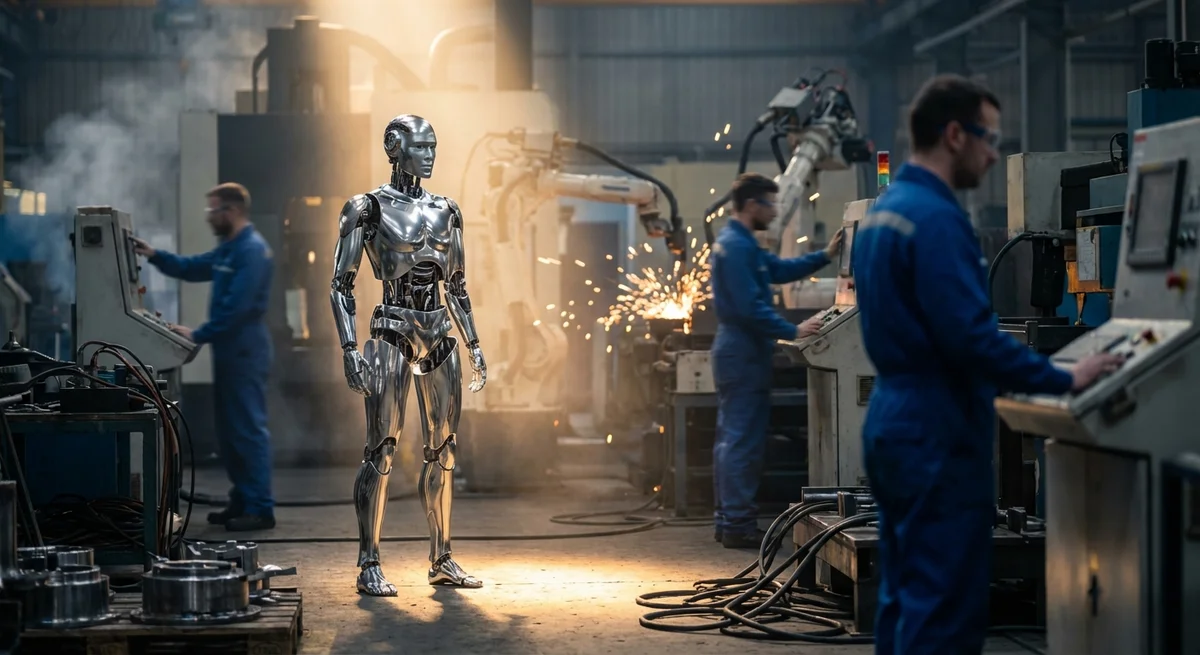
Elon Musk rarely concedes superiority to anyone, but when it comes to the physical embodiment of AI, his tone turns unexpectedly sober. On Tesla's latest earnings call, he said plainly that he sees no serious competitors in humanoid robot development outside one particular country. China's manufacturing power is now so great that even the ambitious Optimus project is starting to feel pursuers breathing down its neck. This is not a routine compliment to partners in the East but a statement of fact: while Silicon Valley builds models, Beijing builds factories.
The intrigue lies not only in the hardware but in who will control it. Musk has finally found a use for his unruly chatbot Grok. It is no longer just an AI with a questionable sense of humor for the social network X, but a potential "conductor" of Tesla's entire ecosystem. Musk's plan is ambitious: Grok is supposed to coordinate huge fleets of Optimus robots while also managing fleets of self-driving cars. In effect, xAI is building an operating system for reality, in which AI handles matter as easily as it handles text. There is a catch, though: this requires chips, and Musk says outright that without AI accelerators Optimus will remain a useless mannequin.
Why does China worry Musk so much? The answer lies in supply chains. We saw this with electric vehicles: while Western companies were still designing prototypes, Chinese factories were already stamping out batteries by the million. Robotics is repeating the pattern. Building a humanoid takes thousands of precision actuators, sensors and servo motors. Chinese industry can scale production of these components at a speed and price no startup in Austin or San Francisco can match. Musk understands that if Tesla does not speed up, Optimus may lose the battle for the mass market before its official release.
It is interesting to watch Tesla's positioning change. The company is moving further away from its image as a carmaker and turning into an AI giant focused on robotics. Musk is putting everything on the line, tying his companies' success into a single knot: chips from NVIDIA (or in-house designs), intelligence from xAI and the physical body from Tesla.
It is vertical integration on steroids. But China is playing the same game, and on its home turf, where the cost of failure is lower and access to resources is higher. For us this means one thing: over the next couple of years we will see an arms race in which, instead of missiles, the dexterity of metal fingers and the speed of visual data processing compete.
This whole futuristic ballet comes down to a prosaic problem: a shortage of semiconductors. Musk stressed that AI chips are a critical factor. If the US keeps tightening technology export controls and China finds a way to produce equivalents domestically, the balance of power could shift dramatically. For now Tesla holds the lead thanks to software, but in the world of atoms rather than bits, the winner is whoever can produce a million units a month without losing quality. Musk knows this, and his words about a "new level" of Chinese robotics are an alarm signal for every Western tech giant.
The key question: will Grok become the "brain" that saves Optimus from Chinese expansion, or will Beijing's manufacturing machine simply crush Tesla with sheer volume?
- Nov 1, 202616 models tested on 7 search tools: Exa averaged 10.5 out of 14, SearXNG about 3
- Nov 1, 2026OpenAI Rewrites GPT Behavior Rules: Five Values and a Chain of Command
- Oct 29, 2026Gemini 4 Carbon tops independent rankings, but only cyber defenders can use it
- Oct 29, 2026Study: A Single Random Failure Makes AI Agents Abandon a Working Tool 11.6% of the Time
Test Frontier LLMs & Autonomous Agents in One Workspace
Run Claude Opus 5.5, GPT-6, Gemini 3.1, and DeepSeek side-by-side in Nomad AI (nomadnet.ai) — unified model routing, deep research, and multimodal workflows under one subscription.
The AI world, distilled — once a week
Seven stories that actually mattered, hand-picked. No noise, no reposts, no press releases.
Done! Check your inbox for a confirmation.