Gecko Robotics wins $71M US Navy contract to build digital twins of warships
Gecko Robotics has signed a $71M contract with the US Navy. The company will send its wall-climbing robots aboard Pacific Fleet ships and build digital twins of them. The project starts with 18 vessels and is meant to help the fleet find maintenance problems faster, amid a maintenance crisis that costs the US military up to $20B a year. The robots collect data in hard-to-reach places and feed it to an AI platform, which assembles a digital twin of each ship.
AI-processed from TNW; edited by Hamidun News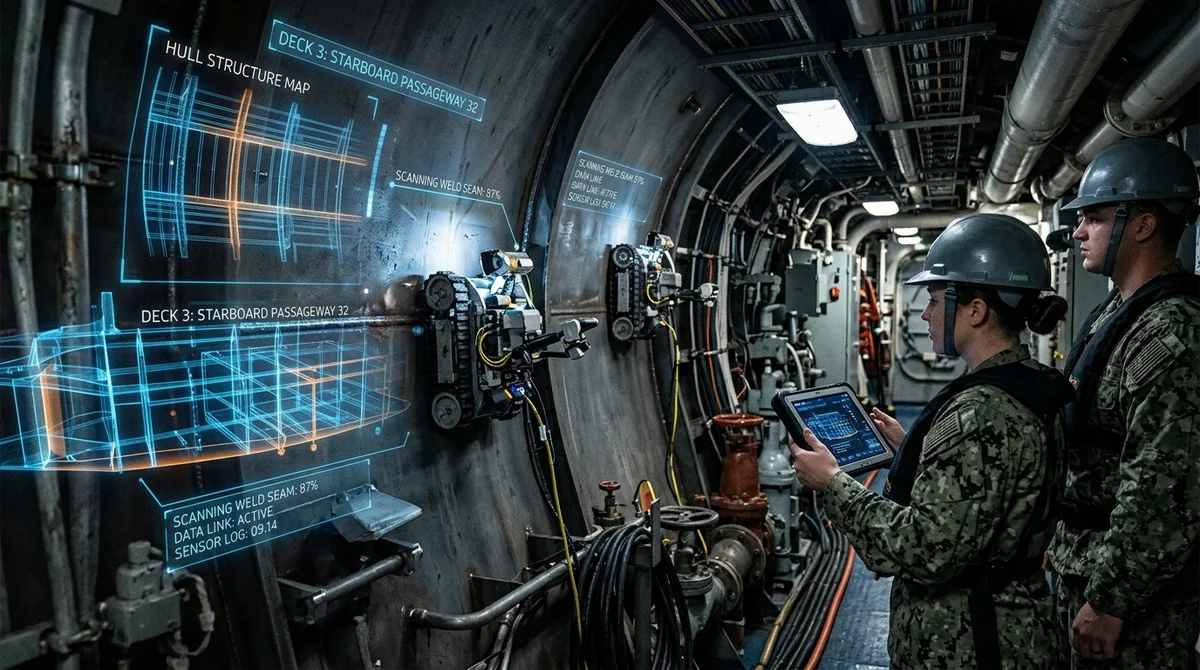
Gecko Robotics has won a $71M US Navy contract to build digital twins of Pacific Fleet ships. The project starts with 18 vessels and is meant to help the US fleet cope with a prolonged maintenance crisis that regularly leaves a significant share of its ships out of action.
The contract and its scale
Pittsburgh-based Gecko Robotics has won a major order from the US Navy. The project rests on robots that can move across vertical surfaces and an AI platform that will use the collected data to build digital twins of Pacific Fleet ships. The first phase covers 18 vessels.
For the startup, this is a notable defense contract. For the Navy, it is an attempt to move ship maintenance from a slow, reactive mode to a more precise model, where the condition of equipment is seen in current data rather than after the fact.
The deal is not just about buying another inspection tool. The US Navy is effectively investing in a decision-making system: if every ship has an up-to-date digital copy, repair crews and command can more quickly see what needs immediate attention, what can be scheduled ahead of time, and where resources do not need to be spent yet. Given the heavy load on the fleet, this approach looks less like an experiment with a fashionable technology and more like an attempt to return more ships to service without endlessly lengthening dock queues.
Why it is urgent
The urgency comes from the figures in the source material itself. The maintenance crisis the US Navy now faces costs the system up to $20B a year. Roughly 40% of the US fleet is unavailable for missions at any given time. Ships wait in queues for dry docks, and maintenance cycles drag on longer than the fleet can afford. For a military organization, that means not only higher costs but a direct drop in operational readiness, as demands for presence in different regions grow.
Digital twins are not here for pretty dashboards. Their value lies in relying on the actual condition of a specific ship rather than only on a calendar or standard schedule. If the model is updated regularly after inspections, the fleet has a chance to spot accumulating problems earlier, plan repair windows more precisely, and reduce the number of cases where a serious defect is found too late. Even a small speedup has a large effect here, because every extra day of downtime for such an asset is very expensive.
How the system will help
The headline of the news item highlights the most visible element of the project: robots that can climb walls and work inside warships. This matters beyond being an impressive piece of engineering. Such machines help collect data in hard-to-reach places and pass it to the AI platform, which then assembles the ship's digital twin. The brief description does not make clear which subsystems will be the priority at the start, but the combination of robot, model and analytics suits regular inspections without excess manual routine.
If the project works as the military expects, the system could help with several practical tasks:
- record the current condition of a ship's internal surfaces and structures
- compare inspection results and see changes between surveys
- identify earlier the areas that need repair or a deeper check
- set priorities more precisely among docking, shipyard work and ship availability
The main question now is not whether a digital twin can be built, but how quickly it starts saving time and money across the whole fleet. If the system gives command a more reliable picture of the condition of the first 18 ships, the project will have a strong argument for expansion. In defense, such decisions are usually judged not by how elegant the technology is, but by a very simple metric: how many units of equipment were returned to service sooner than the old approach would have allowed.
What it means
Gecko Robotics is moving from the category of interesting industrial startups into the zone of strategic contractors. For the AI market, it is another signal: the most valuable deployments today happen where a model is tied to physical infrastructure, expensive assets and a measurable effect, here in the form of reduced downtime for a military fleet.
Key Questions Answered
What are the key details on The contract and its scale?
Pittsburgh-based Gecko Robotics has won a major order from the US Navy. The project rests on robots that can move across vertical surfaces and an AI platform that will use the collected data to build digital twins of Pacific Fleet ships. The first phase covers 18 vessels. For the startup, this is a notable defense contract. For the Navy, it is an attempt to move ship maintenance from a slow, reactive mode to a more precise model, where the condition of equipment is seen in current data rather than after the fact. The deal is not just about buying another inspection tool. Th
Why it is urgent?
The urgency comes from the figures in the source material itself. The maintenance crisis the US Navy now faces costs the system up to $20B a year. Roughly 40% of the US fleet is unavailable for missions at any given time. Ships wait in queues for dry docks, and maintenance cycles drag on longer than the fleet can afford. For a military organization, that means not only higher costs but a direct drop in operational readiness, as demands for presence in different regions grow. Digital twins are not here for pretty dashboards. Their value lies in relying on the actual conditio
How the system will help?
The headline of the news item highlights the most visible element of the project: robots that can climb walls and work inside warships. This matters beyond being an impressive piece of engineering. Such machines help collect data in hard-to-reach places and pass it to the AI platform, which then assembles the ship's digital twin. The brief description does not make clear which subsystems will be the priority at the start, but the combination of robot, model and analytics suits regular inspections without excess manual routine. If the project works as the military expects, t
Test Frontier LLMs & Autonomous Agents in One Workspace
Run Claude Opus 5.5, GPT-6, Gemini 3.1, and DeepSeek side-by-side in Nomad AI (nomadnet.ai) — unified model routing, deep research, and multimodal workflows under one subscription.
The AI world, distilled — once a week
Seven stories that actually mattered, hand-picked. No noise, no reposts, no press releases.
Done! Check your inbox for a confirmation.