Mantis Biotech builds digital twins of humans to tackle the medical data shortage
Mantis Biotech wants to solve one of pharma's toughest problems: the shortage of high-quality data. The company gathers fragmented medical information and uses it to build synthetic datasets for human digital twins. The idea is to test hypotheses faster, supplement real-world samples and speed up drug research without relying solely on scarce, expensive data.
AI-processed from TechCrunch; edited by Hamidun News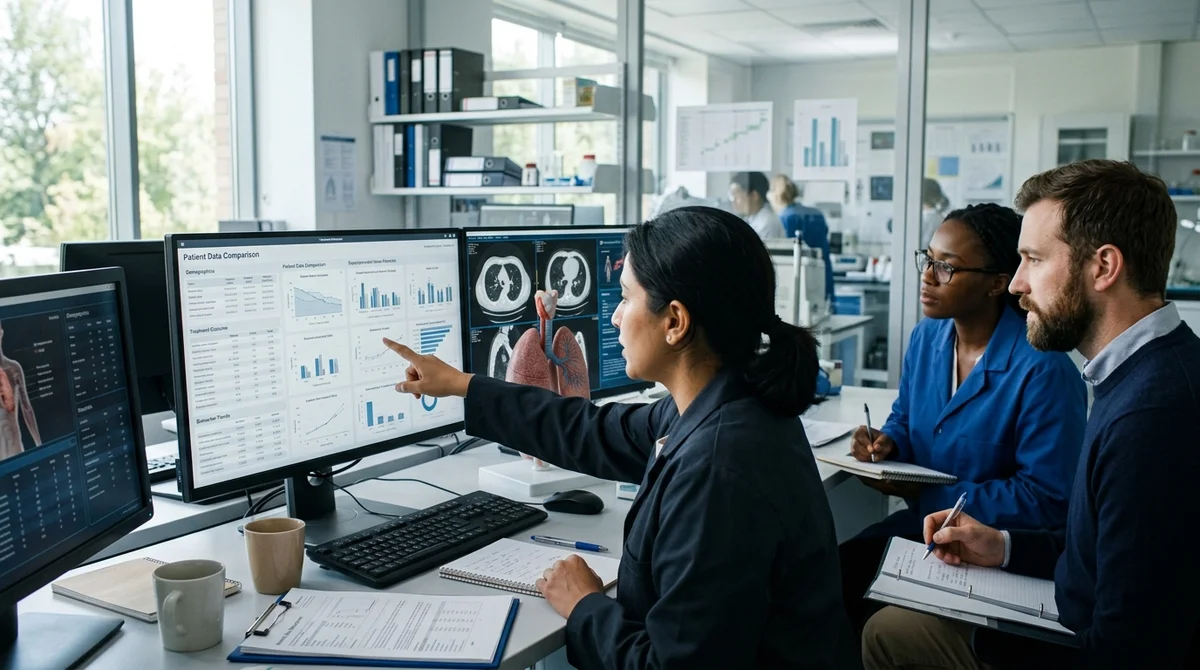
Mantis Biotech has offered its answer to one of the costliest problems in pharma and biomedicine: the shortage of high-quality, accessible data. The company collects fragmented information sources and turns them into synthetic datasets that can be used to build digital twins of humans.
What Mantis does
Mantis Biotech's approach centers on pulling different types of information about a person into a single digital environment: anatomy, physiology and behavior. From these pieces, the company builds synthetic datasets, which can then be used to create digital twins of the human body.
Such a twin is not the same as a living patient and is not an exact copy in the literal sense. It is better understood as a computational model that helps describe how the body is organized and how it might respond to various interventions.
The point is to turn poorly compatible medical data into a more cohesive foundation for research. In medicine, the necessary information is often stored in different databases, collected under different protocols and hard to carry over from one research context to another. If Mantis manages to standardize this layer and make it suitable for modeling, drug developers would get a new working tool before the costly stages of clinical testing.
Why twins are needed
For pharma, the data shortage is not an abstract problem but a direct limit on speed. Researchers may have a strong hypothesis about a disease mechanism or a molecule's action, yet run up against a lack of comparable datasets. In this logic, digital twins are not meant as a flashy AI showcase. They exist to check scenarios faster, compare models of the body's response and find weak spots in existing sets of observations.
- combine anatomical, physiological and behavioral data in one model
- supplement real medical samples with synthetic data
- test hypotheses before more expensive stages of development
- identify data gaps for specific diseases faster
- reduce dependence on rare or slowly growing datasets
If the approach works accurately enough, companies could use synthetic datasets as an intermediate layer between raw observations and applied conclusions. This matters most where real data is hard to collect because of cost, privacy or a limited number of suitable patients. In that scenario, the digital twin does not replace clinical reality. It is a way to extract more signal from it before the next round of costly studies.
The main question
Systems like this have an obvious limitation: the quality of the output always depends on the quality of the input. A synthetic dataset is only as useful as it is accurate in reflecting real biological processes. If the source data contains biases, gaps or weak representativeness, the model can reproduce the same errors in a more convincing, high-tech wrapper. That is why any discussion of synthetic data in medicine quickly runs into validation, quality control and trust in the results.
For Mantis, the main test will therefore be not data generation itself but trust in that data. Pharmaceutical companies and research teams will look at reproducibility, transparency and the practical usefulness of such models. In the end, the market will judge not the loudness of the term digital twin, but whether it actually helps cut the time and cost of research without sacrificing scientific reliability and without extra risk in later stages of development.
What it means
Mantis Biotech is betting on one of the most pragmatic directions for AI in medicine: data infrastructure, rather than yet another interface on top of a model. If the company succeeds in assembling reliable digital twins from fragmented medical sources, it could speed up drug development where the process is currently slowed by a lack of quality data.
It is an important signal for the market: the next wave of AI in healthtech may be built not around chatbots but around a better research base.
Key Questions Answered
What Mantis does?
Mantis Biotech's approach centers on pulling different types of information about a person into a single digital environment: anatomy, physiology and behavior. From these pieces, the company builds synthetic datasets, which can then be used to create digital twins of the human body. Such a twin is not the same as a living patient and is not an exact copy in the literal sense. It is better understood as a computational model that helps describe how the body is organized and how it might respond to various interventions. The point is to turn poorly compatible medical data int
Why twins are needed?
For pharma, the data shortage is not an abstract problem but a direct limit on speed. Researchers may have a strong hypothesis about a disease mechanism or a molecule's action, yet run up against a lack of comparable datasets. In this logic, digital twins are not meant as a flashy AI showcase. They exist to check scenarios faster, compare models of the body's response and find weak spots in existing sets of observations. combine anatomical, physiological and behavioral data in one model supplement real medical samples with synthetic data test hypotheses before more expensiv
What are the key details on The main question?
Systems like this have an obvious limitation: the quality of the output always depends on the quality of the input. A synthetic dataset is only as useful as it is accurate in reflecting real biological processes. If the source data contains biases, gaps or weak representativeness, the model can reproduce the same errors in a more convincing, high-tech wrapper. That is why any discussion of synthetic data in medicine quickly runs into validation, quality control and trust in the results. For Mantis, the main test will therefore be not data generation itself but trust in that
Test Frontier LLMs & Autonomous Agents in One Workspace
Run Claude Opus 5.5, GPT-6, Gemini 3.1, and DeepSeek side-by-side in Nomad AI (nomadnet.ai) — unified model routing, deep research, and multimodal workflows under one subscription.
The AI world, distilled — once a week
Seven stories that actually mattered, hand-picked. No noise, no reposts, no press releases.
Done! Check your inbox for a confirmation.