All3 raises $25M to automate construction with AI and walking robots
London startup All3 has raised $25M to automate construction from design through to building assembly. Its model rests on an AI architecture platform, modular factories and Mantis, a walking robot with a payload of more than 100 kg. Germany is the first commercial market. There, the company wants to show that physical AI can cut build times and costs, and reduce the industry's dependence on scarce manual labor.
AI-processed from TNW; edited by Hamidun News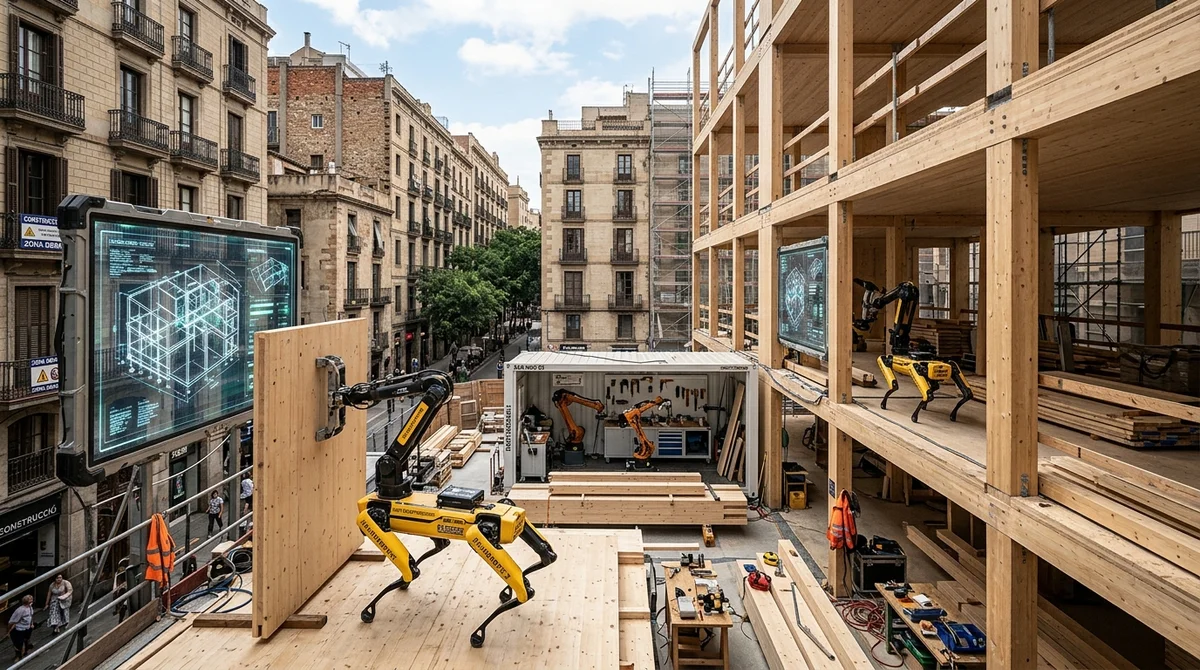
London startup All3 has raised $25M in seed funding for a platform that promises to automate construction from design to on-site assembly. The company is not betting on a single robotic tool. It wants to rebuild the whole construction process around AI, fabrication and its own walking robot, Mantis.
A bet on the whole cycle
Construction remains one of the largest industries in the world by money spent and one of the least automated. All3 builds its business on a simple idea: the problem is not one narrow stage, but the fact that the entire process is still a long chain of manual handoffs between architects, contractors, manufacturing, the building site and regulators. Rather than sell developers a standalone piece of software or a single robot, the startup wants to own the whole loop.
The All3 system has three connected parts:
- An AI platform turns a brief or a plot address into a building design that accounts for local codes, site constraints and the requirements of robotic production.
- Modular robotic factories produce custom elements from engineered timber composites with a stated precision of up to 0.2 mm.
- The Mantis walking robot handles installation, fastening, finishing operations and inspection directly on site.
- According to the company, this approach can cut costs by up to 30%, build times by up to 50% and the carbon footprint of materials by up to 25%.
The choice of material is deliberate too. All3 is betting on structural timber composites, which compare favorably with concrete and its high carbon footprint. That matters in Europe, where pressure comes both from a housing shortage and from climate requirements. However, the stated savings and emissions figures are so far based on the company's own models and have not yet been confirmed by an independent audit.
Where the money will go
The $25M round was led by RTP Global. SuperSeed, Begin Capital, s16vc and VNV Global also took part, and RTP Global partner Jelmer de Jong joined the All3 board. The company was founded by Rodion Shishkov. It has offices in Berlin and Zug, while research and development is based in London and Belgrade. The startup emerged from stealth only in mid-2025, but began testing its robotic system earlier.
Germany is the main launch market. All3 plans to bring its first commercial projects there, and the first site is due to break ground later in 2026. The company has already run more than 100,000 square meters of residential projects through its AI platform, which form a pipeline for 2026–2027. Germany is a logical choice: the country badly needs new housing, yet is forecast to build only about 175,000 homes in 2026 against a target of 400,000.
The main risk
What sets All3 apart from many contech startups is its level of vertical integration. The company does not want to automate only bricklaying, only design or only prefab production. It wants to replace almost the entire traditional chain of creating a building.
That is both its strength and its main risk. For this model to work, it is not enough to assemble a functioning stack of AI and robotics. It needs approvals across different jurisdictions, developer trust, component certification, and the ability to produce a fleet of robots that work reliably on real building sites, not in demo conditions.
"Europe needs its own physical AI champions," is how RTP
Global explains its bet on All3.
For investors, this sounds like a bet on a new industrial platform, not just another construction service. But the thesis will be tested in very down-to-earth terms: can the company actually deliver its first projects in Germany with results that match its promises on speed, price and quality? On a building site, mistakes cost more than in purely digital products, and the feedback loop is noticeably longer.
What this means
If All3 shows that AI can control not just a design on a screen but the physical assembly of a building, the market will get one of the strongest physical AI cases in Europe. If not, the story will be a reminder that automating construction end to end is much harder than automating individual operations. Either way, investor interest is already shifting from AI software to companies trying to rebuild real industries with heavy physics and long economics.
Key Questions Answered
What are the key details on A bet on the whole cycle?
Construction remains one of the largest industries in the world by money spent and one of the least automated. All3 builds its business on a simple idea: the problem is not one narrow stage, but the fact that the entire process is still a long chain of manual handoffs between architects, contractors, manufacturing, the building site and regulators. Rather than sell developers a standalone piece of software or a single robot, the startup wants to own the whole loop. The All3 system has three connected parts: An AI platform turns a brief or a plot address into a building desi
Where the money will go?
The $25M round was led by RTP Global. SuperSeed, Begin Capital, s16vc and VNV Global also took part, and RTP Global partner Jelmer de Jong joined the All3 board. The company was founded by Rodion Shishkov. It has offices in Berlin and Zug, while research and development is based in London and Belgrade. The startup emerged from stealth only in mid-2025, but began testing its robotic system earlier. Germany is the main launch market. All3 plans to bring its first commercial projects there, and the first site is due to break ground later in 2026. The company has already run mo
What are the key details on The main risk?
What sets All3 apart from many contech startups is its level of vertical integration. The company does not want to automate only bricklaying, only design or only prefab production. It wants to replace almost the entire traditional chain of creating a building. That is both its strength and its main risk. For this model to work, it is not enough to assemble a functioning stack of AI and robotics. It needs approvals across different jurisdictions, developer trust, component certification, and the ability to produce a fleet of robots that work reliably on real building sites,
Test Frontier LLMs & Autonomous Agents in One Workspace
Run Claude Opus 5.5, GPT-6, Gemini 3.1, and DeepSeek side-by-side in Nomad AI (nomadnet.ai) — unified model routing, deep research, and multimodal workflows under one subscription.
The AI world, distilled — once a week
Seven stories that actually mattered, hand-picked. No noise, no reposts, no press releases.
Done! Check your inbox for a confirmation.