Nvidia restarts H200 production for China after winning sales licenses for multiple customers
Nvidia is preparing new H200 shipments to China. The company has received sales licenses covering many customers and is already restarting production. It is an important signal for the AI infrastructure market, because this is not about a single contract but about a broader recovery of commercial operations. If the process moves quickly, Chinese buyers will get more predictability in their procurement.
AI-processed from Bloomberg Tech; edited by Hamidun News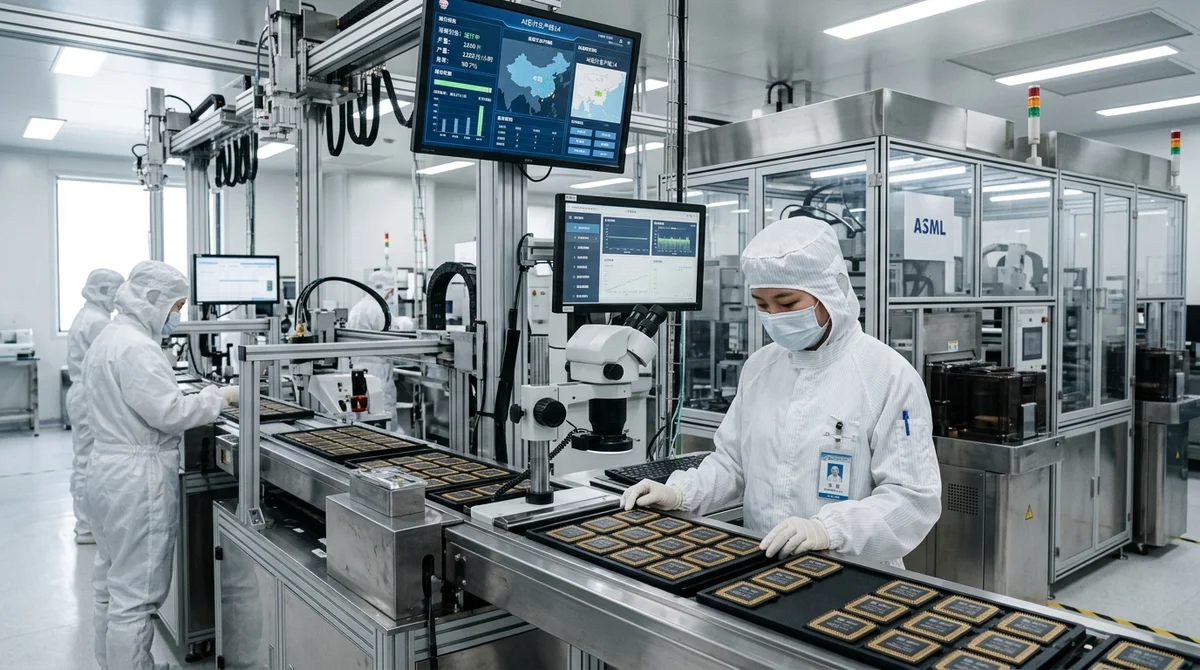
Nvidia is preparing to restart production of H200 accelerators for China after receiving sales licenses covering many customers. It is one of the most important signals in recent months for the AI infrastructure market: the company is showing it can expand its presence in China again, not on a one-off basis but in a broader commercial format.
What Nvidia announced
During a presentation, CEO Jensen Huang said Nvidia had received licenses to sell H200 "for many customers in China" and was already in the process of "restarting our production." The wording matters for two reasons. First, it does not refer to a single agreed contract but to several buyers. Second, the company is not talking about plans on paper but about moving to operational action: if production is being restarted, there is already expected demand and internal planning behind future shipments.
"We have received permits for many customers in
China and are restarting production."
For a semiconductor business this is a significant moment: between "we can sell" and actual shipments lie component procurement, capacity allocation, assembly, testing and logistics. Huang's statement therefore reads as a signal to the market that the company sees a reasonably predictable window for working with Chinese customers. Given how sensitive the topic of AI accelerator exports remains, even such a restrained comment carries far more weight for investors, partners and large buyers than an ordinary PR update.
Why China matters
China remains one of the largest markets for AI computing infrastructure. Local cloud platforms, research teams and corporate data centers keep building products on large models, which means they need accelerators for training, inference and scaling services.
When Nvidia can sell H200 not to one customer but to several at once, it matters beyond quarterly revenue. It affects the developer ecosystem, the purchasing plans of server vendors and the pace at which new AI services are deployed.
The production restart matters not only as corporate news but as a practical marker for the whole supply chain. When a manufacturer publicly puts a product back on schedule, it usually means preparation for orders and synchronization of assembly, logistics and server partners, not just a permit on paper. In the coming quarters, this could produce several noticeable effects for suppliers and large buyers:
- some previously postponed deals will move back into an active phase
- Chinese customers will have more predictability in planning clusters
- Nvidia's partners will be able to plan server configurations and deliveries more precisely
- developers will have a chance to build roadmaps around specific hardware rather than around scarcity
The H200 itself is an accelerator for heavy AI workloads, in demand where companies want to train models faster or serve more inference requests without a sharp rise in latency. So the news concerns more than chips as physical goods. It concerns the speed of launching new models, the expansion of AI products and the ability to keep compute costs under control when demand for capacity is growing faster than companies' in-house infrastructure.
What happens next
That said, the restart announcement does not mean the market will instantly see large volumes of shipments. The production cycle in this segment is long, and sales depend on licensing terms, component availability and Nvidia's internal allocation of capacity across regions and customer categories. Put simply, the company has signaled that the door is open, but a real flow of goods still has to pass through it. That is why the coming months will matter as much as the announcement itself: they will show how quickly permits turn into actual deliveries.
For Chinese companies it is also a question of choosing an architecture and the pace of developing their own products. If H200 supplies are indeed restored for a broad range of customers, some teams will be able to return to the more familiar Nvidia stack, long considered the industry standard for AI development. That lowers adaptation costs, simplifies moving models between environments and makes growth plans less dependent on the temporary workarounds the market typically uses when access to the needed hardware is limited.
What this means
If Nvidia is indeed ramping up H200 production for licensed sales in China, this is not just local commercial news. It is a sign that the chain linking regulatory approval, customer demand and AI hardware output is starting to work again, which gives the market more clarity where it has long been lacking.
- Nov 2, 2026TensorFold 1.2.0 boosts Qwen3.8-27B throughput on M3 Ultra by 44.2% at 16 streams
- Nov 1, 2026Local models lose to Opus and Codex: 0.21 on a MacBook versus 1.00 for Codex
- Nov 1, 2026Habr author fine-tunes YOLOv8l on dental X-rays and pushes mAP50 to 0.642
- Nov 1, 2026Voice bots built on LLMs turn to Jev, a fast classifier, for decisions in 200–500 ms
Key Questions Answered
What Nvidia announced?
During a presentation, CEO Jensen Huang said Nvidia had received licenses to sell H200 "for many customers in China" and was already in the process of "restarting our production." The wording matters for two reasons. First, it does not refer to a single agreed contract but to several buyers. Second, the company is not talking about plans on paper but about moving to operational action: if production is being restarted, there is already expected demand and internal planning behind future shipments. "We have received permits for many customers in China and are restarting prod
Why China matters?
China remains one of the largest markets for AI computing infrastructure. Local cloud platforms, research teams and corporate data centers keep building products on large models, which means they need accelerators for training, inference and scaling services. When Nvidia can sell H200 not to one customer but to several at once, it matters beyond quarterly revenue. It affects the developer ecosystem, the purchasing plans of server vendors and the pace at which new AI services are deployed. The production restart matters not only as corporate news but as a practical marker fo
What happens next?
That said, the restart announcement does not mean the market will instantly see large volumes of shipments. The production cycle in this segment is long, and sales depend on licensing terms, component availability and Nvidia's internal allocation of capacity across regions and customer categories. Put simply, the company has signaled that the door is open, but a real flow of goods still has to pass through it. That is why the coming months will matter as much as the announcement itself: they will show how quickly permits turn into actual deliveries. For Chinese companies it
Test Frontier LLMs & Autonomous Agents in One Workspace
Run Claude Opus 5.5, GPT-6, Gemini 3.1, and DeepSeek side-by-side in Nomad AI (nomadnet.ai) — unified model routing, deep research, and multimodal workflows under one subscription.
The AI world, distilled — once a week
Seven stories that actually mattered, hand-picked. No noise, no reposts, no press releases.
Done! Check your inbox for a confirmation.