Nvidia's H200 Export Deal With China Stalls at Trump-Xi Summit
Trump flew to Beijing with Nvidia CEO Jensen Huang and met Xi Jinping, but talks on H200 chip shipments produced no results. The export approval granted in December 2025 exists only on paper: not a single chip has shipped in six months. The US continues to control semiconductors through a system of local restrictions.
AI-processed from AI News; edited by Hamidun News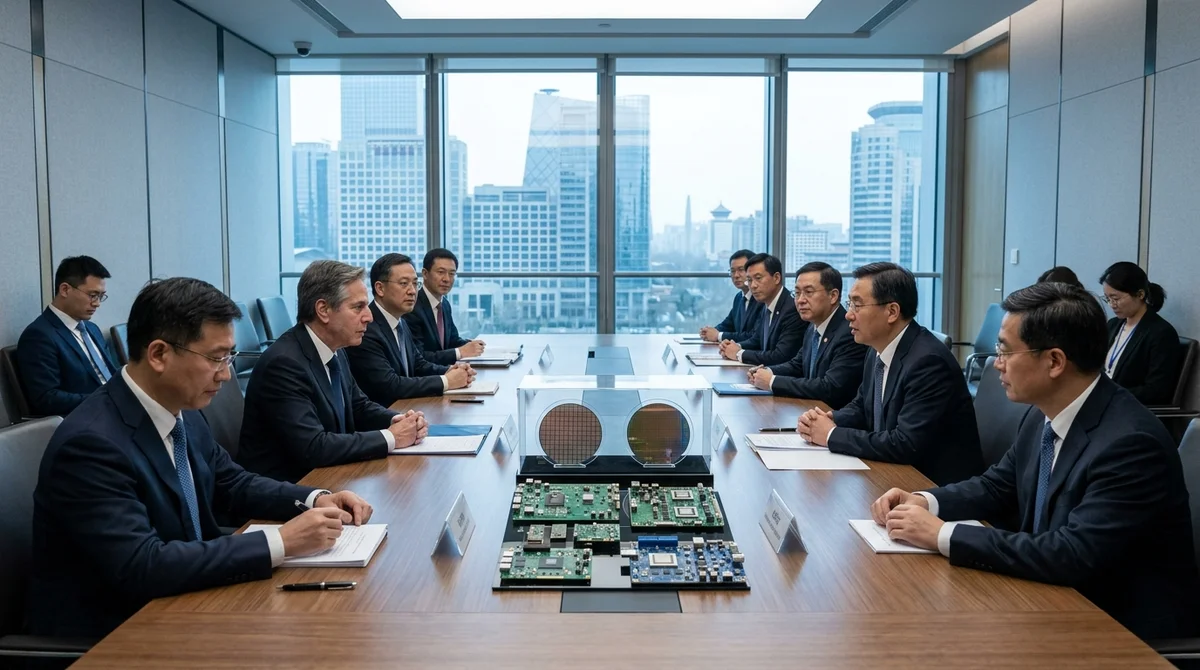
Trump flew to Beijing with Nvidia CEO Jensen Huang and promised reporters changes in the trade of high-tech chips. But no actual deals materialized, and the process is at a standstill: not a single H200 chip has reached China since the export was officially approved.
An Approval That Approved Nothing
In December 2025, the Trump administration took an unprecedented step and allowed Nvidia to export H200 AI chips to China. Observers read it as a rare easing after four years of trade wars and sweeping sanctions on AI technology exports.
At the in-person summit in Beijing, Trump repeated his signal to the world that "something may happen" on opening up access to semiconductors, and added drama by bringing Jensen Huang along as an adviser. But the theatrics clash sharply with market reality.
Not One Chip in Six Months
In the six months since the approval was signed, not a single H200 chip has shipped to China. US Trade Representative Jamieson Greer confirmed to Bloomberg that national semiconductor controls remain fully in force and that nothing has been eased in practice.
The US maintains a multilayered system of local control mechanisms that effectively block real sales despite the formal approval:
- Nvidia's US subsidiaries must obtain separate authorization even after the export is approved
- Every individual chip goes through the government licensing system
- Suppliers and manufacturers fear violating the letter of the law and getting fined
- Any new presidential executive order can revoke the approval within a single day
- Penalties for noncompliance can reach billions of dollars per corporation
Political Theater and Real Interests
Jensen Huang was no random guest at the summit. He runs the company that generates most of the profit in the global AI industry and holds a critical position in AI infrastructure supply chains worldwide.
By bringing him to the meeting with Xi Jinping, Trump sent the world a double signal: America is ready to trade and is actively seeking compromise, but only on its own terms and in its own interests.
That signal, however, was drowned out by a stronger political reality. During the summit, no new trade terms, simplification mechanisms, or security guarantees ever made it onto the negotiating table.
The Pressure Strategy Hasn't Changed
The Trump administration's strategy involves keeping political pressure on China through multiple tools at once. Granting formal approval lets it look like a dealmaker on the world stage, while blocking actual sales means the real restrictions on competitive technologies stay intact.
That approach suits politicians. For companies like Nvidia, it creates constant uncertainty, which is often worse than an outright ban.
What This Means
High-tech chip trade between the US and China remains deeply deadlocked despite political gestures and high-level visits. For Nvidia, that means losing access to a market of 1.4 billion people and having to rely solely on domestic and allied markets. For China, it means an urgent need to accelerate development of its own H200 alternatives, independent of US controls.
- Nov 1, 2026Voice bots built on LLMs turn to Jev, a fast classifier, for decisions in 200–500 ms
- Nov 1, 2026MoneyGate safety layer blocked all 42 fraudulent requests to local AI models
- Oct 31, 202622B-Parameter LTX-2.5 Runs on a 10 GB RTX 3080, but Takes 5 Minutes per Shot
- Oct 30, 2026Mistral opens Large 4 weights: strong at code, but Chinese models score 32 to its 26
Key Questions Answered
What are the key details on An Approval That Approved Nothing?
In December 2025, the Trump administration took an unprecedented step and allowed Nvidia to export H200 AI chips to China. Observers read it as a rare easing after four years of trade wars and sweeping sanctions on AI technology exports. At the in-person summit in Beijing, Trump repeated his signal to the world that "something may happen" on opening up access to semiconductors, and added drama by bringing Jensen Huang along as an adviser. But the theatrics clash sharply with market reality.
What are the key details on Not One Chip in Six Months?
In the six months since the approval was signed, not a single H200 chip has shipped to China. US Trade Representative Jamieson Greer confirmed to Bloomberg that national semiconductor controls remain fully in force and that nothing has been eased in practice. The US maintains a multilayered system of local control mechanisms that effectively block real sales despite the formal approval: Nvidia's US subsidiaries must obtain separate authorization even after the export is approved Every individual chip goes through the government licensing system Suppliers and manufacturers f
What are the key details on Political Theater and Real Interests?
Jensen Huang was no random guest at the summit. He runs the company that generates most of the profit in the global AI industry and holds a critical position in AI infrastructure supply chains worldwide. By bringing him to the meeting with Xi Jinping, Trump sent the world a double signal: America is ready to trade and is actively seeking compromise, but only on its own terms and in its own interests. That signal, however, was drowned out by a stronger political reality. During the summit, no new trade terms, simplification mechanisms, or security guarantees ever made it ont
Test Frontier LLMs & Autonomous Agents in One Workspace
Run Claude Opus 5.5, GPT-6, Gemini 3.1, and DeepSeek side-by-side in Nomad AI (nomadnet.ai) — unified model routing, deep research, and multimodal workflows under one subscription.
The AI world, distilled — once a week
Seven stories that actually mattered, hand-picked. No noise, no reposts, no press releases.
Done! Check your inbox for a confirmation.